Digital Marketing

Digital marketing cost in India showing agency fees ad budgets and ROI

Digital Marketing Cost in India: A Complete Guide to Agency Fees, Ad Budgets and ROI

Understanding Digital Marketing Costs in India Digital marketing costs in India can vary significantly depending on the services, business size, industry, competition, target audience, and expected results. A small local business may spend a few thousand rupees per month on selected digital marketing activities, while an established company competing across multiple cities or industries may invest significantly more in SEO, paid advertising, content, social media, and marketing strategy. The important point is that digital marketing cost is not simply a monthly expense—it should be evaluated against the business results it generates. Understanding agency fees, advertising budgets, individual service costs, and potential return on investment can help businesses create a realistic marketing budget. Introduction Digital marketing has become an important growth channel for businesses across India. Whether a company operates locally in Mumbai, serves customers throughout India, or sells products online, customers increasingly discover businesses through Google, social media, websites, online reviews, videos, and digital advertising. However, one of the first questions businesses ask before starting a campaign is: “How much does digital marketing cost in India?” There is no single answer. The cost depends on what the business wants to achieve and which marketing channels it needs. For example, a local business may primarily need Local SEO, Google Business Profile optimization, and Google Ads, while an e-commerce brand may require SEO, shopping campaigns, social media advertising, content marketing, email marketing, and conversion optimization. Similarly, a company looking to build long-term organic visibility may invest more heavily in SEO and content, while a business seeking immediate traffic may allocate a larger portion of its budget to paid advertising. This guide explains the major components of digital marketing costs in India, what businesses can expect to pay, how agency pricing works, and how to evaluate whether the investment is producing a worthwhile return. What Does Digital Marketing Cost in India? Digital marketing pricing in India can generally be divided into several categories: Some businesses pay a fixed monthly retainer, while others pay for individual services or project-based work. The total monthly investment can therefore range from a relatively small budget for a focused local campaign to a much larger budget for a comprehensive multi-channel strategy. Typical Digital Marketing Budget Ranges As a broad planning framework, businesses may consider: Business requirement Approximate monthly marketing investment Basic local digital presence ₹10,000–₹25,000 Small business growth strategy ₹20,000–₹50,000 SEO + content + social media ₹30,000–₹75,000+ Multi-channel growth ₹50,000–₹1.5 lakh+ Larger campaigns ₹1 lakh–₹5 lakh+ These are planning ranges, not fixed market prices. Actual costs can be lower or higher depending on the scope, agency, location, competition, number of channels, and advertising requirements. Most importantly, agency fees and advertising spend are usually separate costs. For example, a business might pay an agency ₹30,000 per month for marketing management and spend another ₹50,000 on Google or social media advertising. That means the total monthly marketing investment is ₹80,000. Digital Marketing Agency Fees in India Digital marketing agencies commonly use monthly retainers for ongoing services. A retainer allows an agency to work continuously on areas such as SEO, content, social media, paid advertising, analytics, and strategy. Small Business Agency Packages A small business with a limited geographic area may need a relatively focused strategy. A typical package could include: Depending on the scope and agency, this could fall around ₹10,000–₹30,000 per month. Mid-Level Digital Marketing Packages Businesses with more ambitious growth objectives may require multiple channels. A broader package could include: Such services may commonly cost around ₹30,000–₹75,000+ per month, depending heavily on the workload and competitiveness of the market. Comprehensive Digital Marketing Larger companies may require a more extensive strategy covering several locations, products, services, or customer segments. The marketing program may involve: These campaigns can cost ₹75,000 to several lakh rupees per month or more, depending on the scale. SEO Cost in India SEO is generally a long-term investment rather than a one-time activity. SEO pricing can vary based on: A small local website may require a smaller SEO budget than a national e-commerce website competing for thousands of highly competitive keywords. Typical SEO Pricing A broad planning range for SEO services might look like: These ranges are indicative rather than standardized industry rates. Why SEO Can Cost More Than Expected SEO involves much more than adding keywords to pages. A serious SEO campaign may involve: The amount of work required determines the actual cost. Google Ads Cost in India Google Ads has two separate cost components: 1. Advertising spendThe money paid to Google for displaying advertisements. 2. Campaign management feeThe amount paid to an agency or professional for planning, managing, optimizing, and reporting on the campaigns. These should not be confused. For example: Google Ads budget: ₹50,000/monthAgency management fee: ₹15,000/month Total marketing investment: ₹65,000/month The advertising budget depends heavily on competition and the value of each customer. A business selling a low-priced product may have a very different acceptable cost per click and cost per acquisition from a real estate company selling high-value properties. Social Media Marketing Cost Social media marketing costs depend on whether the business needs organic management, paid advertising, or both. Organic social media management may include: A basic social media management package may cost approximately ₹8,000–₹25,000+ per month, while more intensive content strategies can cost significantly more. If paid advertising is included, the advertising budget is generally separate. Content Marketing Costs Content is an important part of modern SEO and digital marketing. Businesses may invest in: Pricing depends on the complexity, research requirements, expertise, word count, and content format. For businesses operating in competitive industries, high-quality expert content may require more investment than generic articles because it involves deeper research, original insights, editing, and optimization. Local SEO Cost in India Local SEO can be particularly valuable for businesses serving specific cities or areas. Services may include: A basic Local SEO campaign may cost around ₹8,000–₹25,000+ per month, while businesses operating across multiple locations may require substantially larger budgets. For a Mumbai business, for example, the strategy could target searches related to

Digital Marketing Cost in India: A Complete Guide to Agency Fees, Ad Budgets and ROI Read More »

Digital marketing strategy for measurable business growth

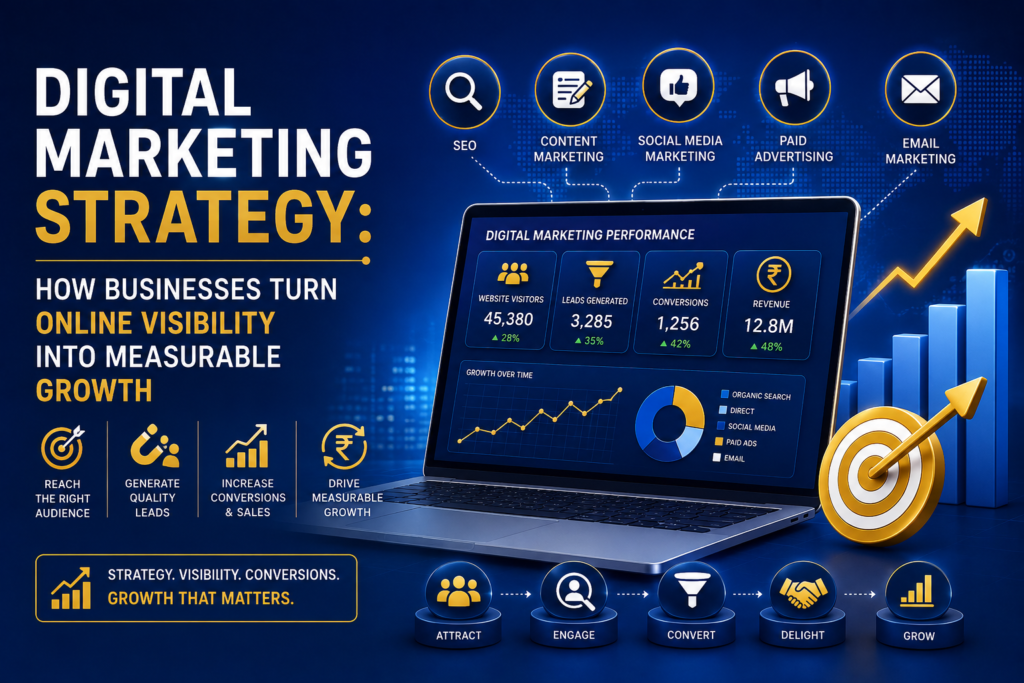
Digital Marketing Strategy: How Businesses Turn Online Visibility Into Measurable Growth

From Online Presence to Business Growth Having a website or social media account is no longer enough for a business to succeed online. A strong digital marketing strategy connects visibility with meaningful business outcomes such as qualified leads, sales, customer engagement, and long-term growth. Introduction Digital marketing has become an essential part of modern business growth. Customers now use search engines, social media platforms, websites, online reviews, videos, and other digital channels to discover businesses and make purchasing decisions. However, simply being visible online does not automatically generate revenue. A business may receive website visitors but very few enquiries. It may have thousands of social media followers but limited sales. Similarly, a website may rank for keywords but fail to convert visitors into customers. This is where a strategic approach to digital marketing becomes important. A well-planned digital marketing strategy connects different online activities with specific business objectives. Instead of focusing only on traffic, likes, followers, or rankings, businesses can measure how their marketing efforts contribute to leads, conversions, revenue, customer retention, and brand growth. The goal is not simply to get noticed online. The goal is to turn that visibility into measurable business results. What Is a Digital Marketing Strategy? A digital marketing strategy is a structured plan that explains how a business will use online channels to reach its target audience, communicate its value, generate demand, and achieve measurable business objectives. Depending on the business, a strategy may include: These channels should not operate independently. For example, SEO can bring organic visitors to a website, while strong landing pages can turn those visitors into leads. Social media can build awareness, while email marketing can help nurture potential customers. Paid advertising can generate immediate traffic, while analytics can show which campaigns are producing the best results. A successful strategy connects these activities into a clear customer journey. Why Online Visibility Alone Is Not Enough Online visibility is an important starting point, but it is not the final objective. Imagine a business website receives 10,000 visitors in a month. That number may look impressive. However, if only a few visitors contact the business or make a purchase, the traffic has limited business value. Now consider another website that receives 2,000 highly relevant visitors and generates hundreds of enquiries or purchases. The second business may have a much stronger digital marketing strategy even though it receives less traffic. This demonstrates an important principle: Quality and relevance matter more than vanity metrics alone. Businesses should therefore evaluate digital marketing using metrics that connect marketing activity with actual business outcomes. Start With Clear Business Goals Before selecting digital marketing channels, a business should define what it wants to achieve. Different businesses may have different objectives. For example: The marketing strategy should be built around these goals. Common Digital Marketing Goals A business may focus on: Brand awarenessGetting more potential customers familiar with the brand. Website trafficAttracting relevant visitors through search, social media, advertising, and other channels. Lead generationEncouraging prospects to submit forms, call, message, or request information. Sales and conversionsTurning prospects into paying customers. Customer retentionEncouraging existing customers to return and purchase again. Revenue growthIncreasing the financial return generated by marketing activities. Clear goals make it easier to decide which channels to use and which metrics to track. Understand Your Target Audience A digital marketing strategy becomes much more effective when a business understands who it is trying to reach. Before creating campaigns or content, businesses should identify: This information can influence everything from keyword research and content creation to advertising and website design. Create Customer Personas A customer persona is a simplified representation of an ideal customer. For example, a digital marketing agency targeting local businesses might create a persona such as: Business owner: Runs a small local company, wants more enquiries, has limited time for marketing, and needs measurable results from advertising and SEO. Understanding this type of customer helps the business create more relevant messaging. Instead of saying: “We provide digital marketing services.” the brand could communicate a more specific benefit: “We help local businesses increase search visibility, generate qualified leads, and build a stronger online presence.” The second message focuses more clearly on the customer’s needs and desired outcome. Build a Strong Digital Foundation Before investing heavily in marketing campaigns, businesses need a solid digital foundation. Your website is often the central destination where prospects learn about your business, evaluate your offering, and decide whether to take action. A strong website should be: Make Your Value Proposition Clear Visitors should quickly understand three things: What do you offer? Who do you help? Why should they choose you? If visitors have to search through several pages to understand what a business does, they may leave before taking action. A clear headline, concise supporting message, relevant visuals, and strong calls to action can make the customer journey easier. The Role of SEO in Digital Marketing Strategy SEO helps businesses improve their visibility in organic search results. When people search for products, services, solutions, or information related to a business, appearing prominently in relevant search results can bring valuable traffic. However, SEO should not be treated simply as a ranking exercise. The real objective is to attract relevant users who are likely to take meaningful action. Keyword Research Keyword research helps businesses understand what their target audience is searching for. Instead of targeting only broad keywords, businesses should consider: For example, someone searching for “what is SEO” may be researching the topic, while someone searching for “SEO agency in Mumbai” may already be looking for a service provider. Understanding this difference helps businesses create content and landing pages that match different stages of the customer journey. Create Content Around Search Intent Good SEO content should answer the question behind the search. If a user searches for a particular service, the page should explain that service clearly. If the user is researching a topic, an educational article may be more appropriate. If the user is comparing options, a detailed comparison or guide

Digital Marketing Strategy: How Businesses Turn Online Visibility Into Measurable Growth Read More »