
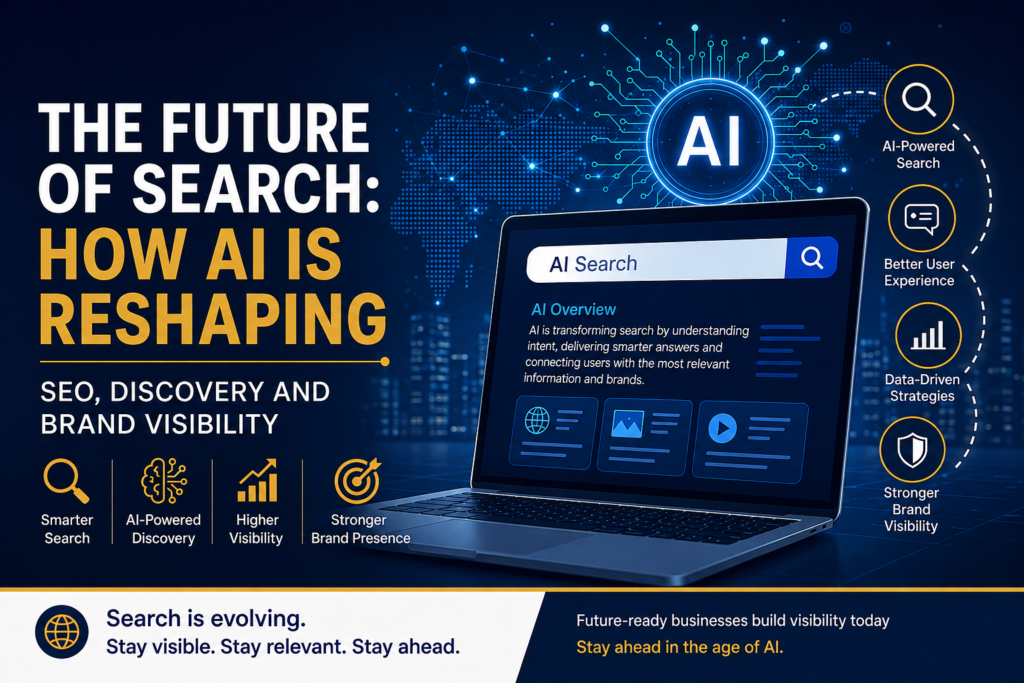
Search Is Changing, and Businesses Need to Change With It
Search is no longer limited to typing a few keywords into Google and choosing a website from a list of blue links. AI is changing how people discover information, compare options, ask questions, and find businesses online.
Introduction
Search engines have continuously evolved as technology and user behaviour have changed. Today, artificial intelligence is accelerating that evolution by changing how search queries are understood, how information is presented, and how users discover brands.
People are increasingly using conversational queries, asking detailed questions, and expecting direct answers rather than simply browsing through multiple websites. At the same time, AI-powered search experiences are becoming more capable of understanding context, intent, entities, and relationships between different pieces of information.
For businesses, this creates both opportunities and challenges.
Traditional SEO principles such as keyword relevance, quality content, technical optimisation, and authority remain important. However, businesses now also need to think about how their brand and content can be discovered across increasingly AI-driven search experiences.
The future of search is therefore not simply about ranking for keywords. It is about becoming a trusted, relevant, and recognizable source of information that search engines and AI systems can understand and confidently surface to users.
How Search Is Changing in the Age of AI
Artificial intelligence is changing the relationship between users and search engines.
Traditional search usually required users to enter a query, review several results, visit websites, and collect information from different sources. AI-powered search can make this process more conversational by helping users explore a topic through questions, follow-up queries, summaries, comparisons, and recommendations.
For example, instead of searching separately for:
- Best SEO strategies
- How SEO works
- SEO tools
- SEO costs
- SEO agency
A user may ask a more detailed question such as:
“What SEO strategy would be suitable for a small local business with a limited marketing budget?”
This type of search contains more context and intent.
AI systems can analyze that context and provide a response that attempts to address multiple aspects of the user’s question.
Search Intent Is Becoming More Important
Keyword matching has always been an important part of SEO, but understanding search intent is becoming even more valuable.
Search intent refers to what a person actually wants when they enter a query.
Someone searching for “what is SEO” is looking for information.
Someone searching for “SEO agency in Mumbai” may be looking for a service provider.
Someone searching for “best SEO tools” may be comparing different options.
As AI becomes better at interpreting natural language, businesses need to create content that answers the underlying need behind a search rather than simply repeating a specific keyword.
From Traditional Search to AI-Powered Discovery
The way people discover brands is expanding beyond traditional search results.
A potential customer may encounter a business through:
- Google Search
- AI-powered search experiences
- Google Maps
- Social media
- Online reviews
- Business directories
- YouTube
- Industry websites
- Forums and communities
- Brand mentions across the web
This means brand discovery is becoming broader than search engine rankings alone.
A business can benefit when its name, expertise, products, services, and information are consistently represented across trustworthy digital sources.
Why Brand Recognition Matters
When users repeatedly encounter the same brand across different channels, that brand can become more familiar and recognizable.
For example, someone might first discover a company through a Google search, later see its content on LinkedIn, read a review, and eventually visit its website.
Each interaction contributes to the overall customer journey.
Therefore, businesses should think beyond individual keywords and focus on building a consistent digital presence.
What AI Search Means for SEO
Artificial intelligence does not mean that traditional SEO is no longer relevant. Instead, it is changing how search engines interpret and organize information.
Search engines still need to understand websites, pages, topics, businesses, and relationships between different pieces of information. This makes strong SEO fundamentals important even as search experiences become more AI-driven.
Quality Content Still Matters
AI-powered search experiences rely on information from online sources. Businesses should therefore focus on creating content that is accurate, useful, original, and genuinely relevant to their audience.
Instead of creating articles simply to include keywords, focus on answering real questions and providing information that readers can use.
Useful content can include:
- Detailed guides
- Original research
- Case studies
- Expert insights
- Step-by-step tutorials
- Comparison articles
- Frequently asked questions
- Industry analysis
Context Is More Important Than Keyword Repetition
Older approaches to SEO often focused heavily on repeating exact keywords throughout a page.
Modern search requires a broader approach.
For example, an article targeting “local SEO” can naturally discuss:
- Google Business Profile
- Local search results
- Google Maps
- Customer reviews
- Local citations
- Location pages
- Search intent
- Local keywords
These related concepts help establish the overall subject of the content.
The goal should be to demonstrate expertise around a topic rather than repeatedly inserting the same phrase.
The Rise of AI Overviews and Answer-Based Search
Search experiences are increasingly capable of providing summaries and direct answers to complex questions.
Instead of requiring users to open multiple pages immediately, an AI-generated response may summarize information and provide sources for further exploration.
This creates a new consideration for businesses: visibility may happen inside an answer as well as through a traditional search result.
A page can therefore provide value even when the user does not immediately click through to the website.
However, businesses should not assume that appearing in an AI-generated answer is guaranteed simply by adding more keywords.
Strong topical relevance, useful information, clear website structure, authority, and trustworthy signals remain important.
Why Brand Visibility Matters More Than Rankings Alone
Search rankings remain important, but businesses should not measure their entire digital presence through rankings alone.
Imagine a customer encounters your brand through:
- A Google search
- An AI-generated answer
- A Google Maps listing
- A social media post
- A review website
- Another website mentioning your company
These interactions can all contribute to brand visibility.
Build a Recognizable Digital Identity
Your business information should be consistent across important online platforms.
Pay attention to:
- Business name
- Website
- Services
- Contact information
- Location
- Brand descriptions
- Social profiles
- Reviews
- Business listings
Consistency helps users understand who your business is and what it offers.
How AI Can Change Keyword Research
Keyword research remains valuable, but businesses may need to think beyond short phrases.
Users increasingly ask complete questions and conversational queries.
For example, instead of searching:
“SEO agency Mumbai”
a user may ask:
“Which SEO services can help a small business in Mumbai get more local customers?”
Both searches have a similar underlying topic, but the second provides much more context.
Focus on Topics and Questions
A stronger keyword strategy can include:
- Primary keywords
- Long-tail keywords
- Question-based searches
- Related topics
- Search intent
- Location-based searches
- Customer pain points
This approach helps businesses create content that answers the broader needs surrounding a topic.
Create Content That Answers Follow-Up Questions
A useful article should not stop after answering the main question.
Think about what the reader might ask next.
For example, an article about SEO for small businesses could naturally answer:
- What is SEO?
- How does SEO work?
- How long does SEO take?
- How much does SEO cost?
- Which keywords should a small business target?
- Is local SEO important?
- How can SEO generate leads?
Answering related questions can make content more comprehensive and useful.
Build Topical Authority
Topical authority means demonstrating strong and relevant knowledge around a particular subject.
Instead of publishing one article about SEO and then moving to an unrelated topic, a business can build a collection of connected resources.
For example:
Main Topic: SEO
Supporting topics:
- Keyword Research
- On-Page SEO
- Technical SEO
- Local SEO
- Link Building
- SEO Analytics
- Content Strategy
- SEO for Small Businesses
These pages can be connected through internal links.
This creates a structured content ecosystem that helps users discover related information while strengthening the overall relevance of the website.
How Businesses Can Optimize Content for AI-Powered Search
As search becomes more conversational and AI-driven, businesses need to create content that is easy for both people and search systems to understand.
This does not mean writing content specifically for machines. The better approach is to create clear, useful, trustworthy content for people while making the information easy to understand and organize.
Answer the Main Question Clearly
When someone visits your page, they should be able to quickly understand what the page is about.
Use:
- Clear headings
- Short paragraphs
- Direct answers
- Descriptive subheadings
- Relevant examples
- Helpful lists
- Logical content structure
For example, if the page targets “What is Local SEO?”, answer that question clearly near the beginning before moving into more detailed explanations.
Use Natural Language
People do not always search using perfect keyword phrases.
They may use conversational questions such as:
- How can I improve my Google Maps ranking?
- How does SEO help a small business?
- Is Google Ads better than SEO?
- How can I get more local customers?
Content that naturally addresses these questions can better match modern search behaviour.
Demonstrate Real Expertise
AI-generated content has made originality and expertise increasingly important.
Businesses should add information that demonstrates genuine knowledge and experience.
This can include:
- Original examples
- Expert opinions
- Case studies
- First-hand observations
- Industry-specific insights
- Data and research
- Practical recommendations
Generic information that can be found on hundreds of websites provides less opportunity for differentiation.
Entity SEO and Brand Authority
Modern search engines need to understand not only keywords but also the entities behind those keywords.
An entity can be a:
- Person
- Company
- Product
- Place
- Organization
- Service
- Topic
For example, if a website consistently publishes useful information about digital marketing and clearly identifies its business, services, authors, and areas of expertise, search systems can gain a clearer understanding of what the website represents.
Make Your Business Information Clear
Businesses should clearly communicate:
- Who they are
- What they do
- Where they operate
- Who they serve
- What services they provide
- How customers can contact them
This information should be consistent across the website and important external platforms.
Why Trust Matters in AI Search
When search systems summarize information for users, the reliability of the underlying information matters.
Businesses should therefore focus on building trust through:
- Accurate information
- Transparent authorship
- Reliable sources
- Genuine customer reviews
- Clear business information
- Original content
- Consistent online presence
Avoid making exaggerated claims that cannot be supported.
For example, instead of saying “We are the number-one digital marketing company,” explain specific areas of expertise, experience, services, or measurable achievements that can be supported.
The Importance of Technical SEO
AI-powered search does not eliminate the importance of technical SEO.
Search engines still need to discover, crawl, interpret, and understand website content.
Businesses should pay attention to:
- Website speed
- Mobile usability
- Internal linking
- Crawlability
- Indexing
- XML sitemaps
- Structured data
- HTTPS
- Clean website architecture
- Broken links
A technically strong website creates a better foundation for search visibility.
How Local Businesses Can Adapt to AI Search
AI-driven discovery can be particularly important for local businesses.
A customer may ask a conversational question such as:
“What are some reliable digital marketing agencies near Andheri that provide SEO and Google Ads services?”
To increase the chances of being discovered across local search experiences, businesses should maintain accurate information across their digital presence.
Strengthen Your Local SEO Foundation
Important elements include:
- Google Business Profile
- Accurate business information
- Local landing pages
- Customer reviews
- Location-specific content
- Local backlinks
- Consistent business details
- Relevant business categories
Businesses should also create genuinely useful local content instead of simply adding city names repeatedly to pages.
The Role of Structured Data
Structured data provides search engines with additional information about the content of a webpage.
Depending on the website, businesses may use relevant structured data for things such as:
- Organizations
- Local businesses
- Products
- Articles
- Events
- FAQs
- Reviews
Structured data does not guarantee higher rankings or AI visibility, but it can help search engines better understand certain types of information when implemented correctly.
Build a Future-Ready SEO Strategy
The most effective response to AI-driven search is not to abandon traditional SEO.
Instead, businesses should strengthen the fundamentals while adapting to changing search behaviour.
A future-ready strategy should include:
1. Strong technical SEO
Make your website accessible, fast, secure, and easy to navigate.
2. High-quality content
Create useful resources that answer genuine customer questions.
3. Topic coverage
Build depth around subjects that are important to your business.
4. Brand authority
Develop recognition through consistent content, mentions, reviews, and expertise.
5. Local visibility
Optimize your presence for relevant location-based searches.
6. Conversion optimization
Make it easy for visitors to contact, purchase, book, or enquire.
7. Continuous measurement
Monitor search performance, traffic, leads, and conversions.
Don’t Optimize Only for AI
One of the biggest mistakes businesses can make is becoming obsessed with trying to “game” AI search.
There is no guaranteed formula for getting a brand mentioned in every AI-generated response.
Instead, focus on becoming a genuinely useful and trustworthy source.
If your website provides accurate information, demonstrates expertise, answers customer questions, and maintains a strong digital presence, it has a better foundation for visibility across changing search experiences.
Common SEO Mistakes to Avoid in the AI Era
As search continues to evolve, businesses should avoid treating AI as a shortcut to better rankings or visibility. A sustainable SEO strategy still depends on useful content, technical quality, trust, and a strong understanding of the audience.
Creating Large Amounts of Low-Quality Content
AI tools can make it easier to produce content quickly. However, publishing large volumes of generic articles without adding useful information can weaken the overall quality of a website.
Focus on creating fewer, stronger resources that provide genuine value.
Keyword Stuffing
Adding the same keyword repeatedly does not make content more relevant.
Instead of forcing a phrase into every paragraph, use natural language and cover related concepts that help explain the topic.
Publishing Unedited AI-Generated Content
AI can be useful for research, brainstorming, outlining, and drafting. However, content should be reviewed and improved by people who understand the subject.
Check:
- Facts
- Examples
- Sources
- Accuracy
- Tone
- Originality
- Brand messaging
Human review can make content more useful and trustworthy.
Ignoring Brand Building
SEO should not be treated only as a ranking exercise.
A recognizable brand can benefit from visibility across search engines, social platforms, reviews, publications, directories, and other online channels.
Build a brand that people can recognize, remember, and trust.
Neglecting User Experience
Getting someone to your website is only the beginning.
If the website is slow, confusing, difficult to navigate, or unclear about what the business offers, visitors may leave without taking action.
SEO and user experience should work together.
What the Future of Search Could Look Like
Search is likely to become increasingly conversational, personalized, and context-aware.
Users may rely more heavily on AI assistants and search interfaces to:
- Research products
- Compare services
- Find local businesses
- Understand complex topics
- Make purchasing decisions
- Discover recommendations
- Complete multi-step tasks
This means businesses will need to think about discoverability across the entire digital ecosystem, not only traditional search rankings.
Search May Become More About Answers and Decisions
Traditional search often begins with a question and ends with a list of websites.
AI-powered experiences can move the user closer to an answer or decision.
For businesses, this means content should help users understand:
What is the problem?
What are the available options?
Which option may be suitable?
What should the customer do next?
Businesses that consistently provide useful answers can strengthen their position throughout the customer journey.
Frequently Asked Questions
Will AI replace traditional SEO?
AI is changing SEO, but it does not make SEO irrelevant. Search engines still need to discover, understand, evaluate, and organize information. Strong technical SEO, useful content, authority, and user experience remain important.
How can businesses prepare for AI-powered search?
Businesses should focus on high-quality content, clear website structure, technical SEO, topical authority, brand recognition, accurate business information, and genuine expertise.
Is keyword research still important for SEO?
Yes. Keyword research remains useful for understanding what people search for. However, businesses should also consider search intent, related topics, conversational questions, and the broader needs behind a query.
Does AI-generated content rank well on Google?
There is no simple rule that AI-generated content will or will not rank. The important consideration is whether the content is helpful, accurate, original, and created to satisfy users rather than simply manipulate search rankings.
How important is brand visibility in AI search?
Brand visibility can become increasingly important as users discover information through multiple search and discovery channels. A consistent online presence can help users understand and recognize a business.
Should small businesses invest in AI SEO?
Small businesses should focus first on strong SEO fundamentals, useful content, local visibility, technical website quality, and conversion optimization. AI should be viewed as a tool that can support these activities rather than a replacement for a sound strategy.
Final Thoughts
The future of search is not simply about artificial intelligence replacing traditional search engines.
It is about a broader transformation in how people discover information, evaluate businesses, and make decisions online.
As AI becomes more capable of understanding language, context, intent, and relationships between different sources, businesses need to move beyond a narrow focus on keyword rankings.
The goal should be to build a digital presence that is useful, trustworthy, technically strong, and recognizable.
That means creating original content, answering real customer questions, strengthening topical authority, maintaining accurate business information, improving user experience, and building a brand that people can trust.
SEO will continue to evolve, but its fundamental purpose remains the same: helping the right people discover useful information at the right moment.
The businesses most prepared for the future will not necessarily be those that try to manipulate every new search feature. They will be the ones that consistently provide genuine value and build authority around what they know best.
Key Takeaway
The future of search can be summarized in one simple idea:
Don’t optimize only for rankings. Optimize for discovery, relevance, trust, and visibility across the entire digital journey.
AI may change how search works, but businesses that focus on people, quality, expertise, and sustainable digital growth will be better positioned to adapt.