
Build a Digital Strategy That Turns Attention Into Business Results
Digital growth is not simply about getting more people to see your brand. The real opportunity lies in turning visibility into meaningful engagement, qualified leads, conversions, and sustainable revenue.
Introduction
Businesses today have more opportunities than ever to reach potential customers online. Search engines, social media platforms, websites, email marketing, online advertising, and content can all help a brand become more visible to its target audience.
However, visibility alone does not guarantee business growth. A website can receive thousands of visitors without generating enough enquiries. A social media account can have a large following without producing consistent sales. Similarly, a brand can appear prominently in search results but still struggle to convert visitors into customers.
This creates an important question: How can businesses move from simply being visible online to generating measurable revenue?
The answer is a strategic digital growth framework that connects visibility with the rest of the customer journey.
Instead of treating SEO, content marketing, social media, paid advertising, and conversion optimization as separate activities, businesses can bring them together around one goal: creating sustainable business growth.
What Does Digital Visibility Really Mean?
Digital visibility refers to how easily people can discover a business, brand, product, or service across online channels.
A business can build visibility through several sources, including:
- Google Search
- Google Maps
- Social media
- Online directories
- Business websites
- Content marketing
- Paid advertising
- Email marketing
- Industry websites
- Online reviews
For example, a customer searching for an SEO agency may discover a company through Google Search. Another customer may find the same company through Instagram, a blog article, Google Maps, or a recommendation.
The more relevant places where your target audience can discover your business, the greater your potential online visibility.
However, visibility should always be connected to the right audience. Reaching people who have no interest in your products or services may increase impressions without creating meaningful business results.
Why Visibility Alone Does Not Guarantee Revenue
Getting attention online is only the first stage of digital growth.
Imagine a business receives 10,000 website visitors in a month but only generates a few enquiries. Another business receives 2,000 visitors but converts a much higher percentage into leads and customers.
The second business may generate significantly more revenue despite receiving less traffic.
This is why businesses should look beyond metrics such as:
- Website visitors
- Social media followers
- Impressions
- Likes
- Reach
These metrics can provide useful information, but they do not always represent business success.
A stronger digital strategy connects visibility with:
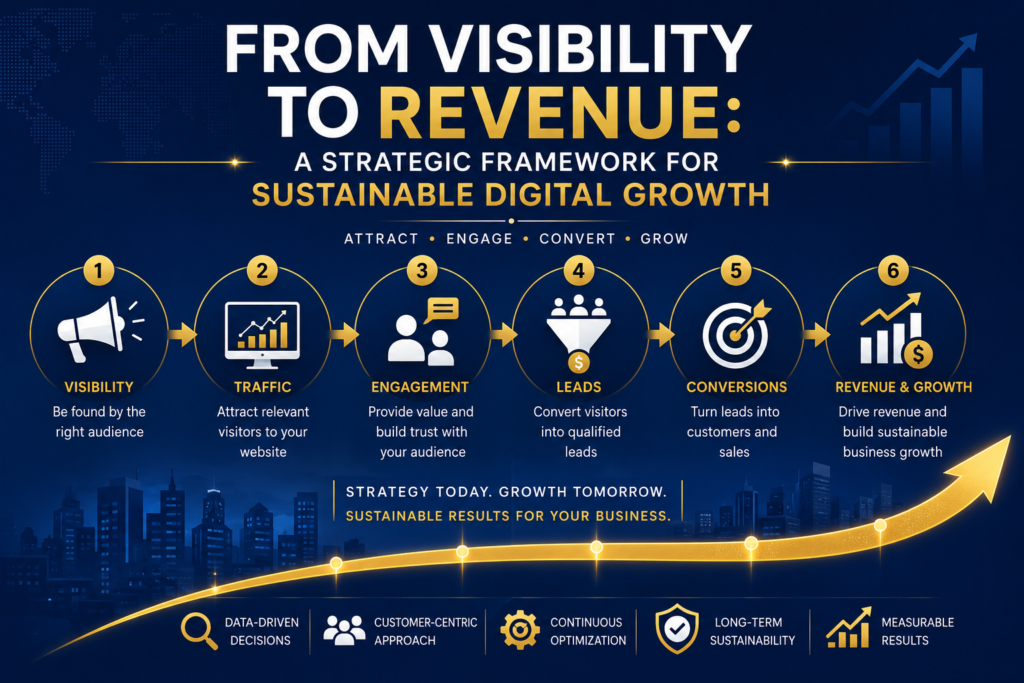
Visibility → Traffic → Engagement → Leads → Conversions → Revenue
Each stage needs to support the next.
Understanding the Digital Customer Journey
Customers rarely move from discovering a business directly to making a purchase. In many cases, they go through several stages before making a decision.
A typical customer journey may look like this:
Awareness: The customer discovers your brand.
Interest: They visit your website or social media profiles.
Research: They compare your services, read reviews, and consume your content.
Consideration: They evaluate whether your business can solve their problem.
Conversion: They contact you, request a quote, make a purchase, or book a service.
Retention: A satisfied customer returns or recommends your business to others.
Understanding this journey allows businesses to create the right content and marketing activities for each stage.
For example, an educational blog can help people in the research stage, while a detailed service page can help someone who is ready to make an enquiry.
Build a Strong Digital Foundation
Before investing heavily in traffic generation, businesses should make sure their digital foundation is strong.
Your website should clearly communicate:
- What your business offers
- Who you serve
- What problems you solve
- Why customers should choose you
- How visitors can contact you
- What action visitors should take next
Your website should also work well on mobile devices, load efficiently, provide clear navigation, and make important information easy to find.
A strong foundation ensures that the traffic generated through SEO, advertising, social media, and other channels has a better opportunity to produce meaningful results.
Build a Search Strategy That Attracts the Right Audience
Once your digital foundation is ready, the next step is to increase your visibility among people who are actually interested in your products or services.
Search engine optimization can play an important role here. Instead of trying to attract everyone, focus on the searches your potential customers are most likely to make.
Target Relevant Keywords
Keyword research helps you understand what your audience searches for on Google.
For example, a digital marketing agency may target terms such as:
- Digital marketing agency
- SEO services
- Local SEO services
- Google Ads management
- Social media marketing
- SEO agency in Mumbai
- Digital marketing services for small businesses
The goal is not simply to target keywords with the highest search volume. The keywords should also match your business, audience, and customer intent.
Create Content Around Customer Needs
Useful content can bring potential customers to your website before they are ready to purchase.
For example, someone searching for “how to improve Google rankings” may not be ready to hire an SEO agency immediately. However, a detailed article answering that question can introduce them to your brand.
Over time, helpful content can build trust and encourage visitors to explore your services.
Strengthen Local Visibility
For businesses serving specific locations, local SEO can connect the brand with nearby customers.
Optimizing your Google Business Profile, maintaining consistent business information, collecting genuine reviews, and creating location-relevant content can improve your chances of appearing in local searches.
For example, a Mumbai-based business can create content and service pages relevant to customers searching for services in Mumbai and its surrounding areas.
Turn Website Traffic Into Qualified Leads
Generating traffic is only part of the process. Once visitors arrive on your website, you need to give them clear reasons and opportunities to take the next step.
A visitor may be encouraged to:
- Request a consultation
- Submit an enquiry
- Call the business
- Book an appointment
- Request a quotation
- Subscribe to an email list
- Purchase a product
- Download a useful resource
These actions can turn anonymous website visitors into potential customers.
Create Clear Calls to Action
Every important page should guide visitors toward an appropriate next step.
For example:
Learn about the service → View the service details → Request a consultation
A call to action should be clear, visible, and relevant to the page.
Instead of using vague wording such as “Click Here,” businesses can use more descriptive options such as:
- Get a Free Consultation
- Request a Quote
- Talk to Our Team
- Explore Our SEO Services
- Book a Strategy Call
Build Trust Before Asking for the Sale
People may hesitate to contact a business if they do not have enough information to make a decision.
Trust can be strengthened through:
- Customer reviews
- Testimonials
- Case studies
- Portfolio examples
- Industry experience
- Helpful educational content
- Clear service information
- Transparent communication
The more confidence a potential customer has in your business, the easier it can become to move from interest to action.
Create Content That Supports Business Growth
Content marketing should have a purpose beyond publishing articles regularly.
Every piece of content should ideally support at least one business objective, such as increasing visibility, educating customers, building trust, generating leads, or supporting conversions.
Use Different Types of Content
A strong content strategy can include:
- Blog posts
- Service guides
- Case studies
- Videos
- Social media posts
- Infographics
- FAQs
- Comparison articles
- Industry insights
- Email newsletters
Different formats can reach customers at different stages of the buying journey.
For example, a blog post may introduce someone to your brand, while a case study can demonstrate your expertise to someone who is already considering your service.
Connect Content With Your Services
Your content should naturally lead interested readers toward relevant services or products.
For example, an article about Local SEO for Mumbai Businesses can link to a Local SEO service page.
This creates a connection between informational content and commercial pages while also improving website navigation.
Optimize Your Website for Conversions
A website should not only attract visitors. It should make it easy for those visitors to take action.
Conversion optimization involves improving different elements of a website so that more qualified visitors complete valuable actions.
Important areas include:
- Page layout
- Headlines
- Calls to action
- Contact forms
- Navigation
- Mobile experience
- Page speed
- Trust signals
- Service descriptions
- Testimonials
Small improvements can sometimes have a meaningful impact on the number of visitors who become leads or customers.
Use SEO, Paid Advertising, and Social Media Together
Businesses do not always need to choose between SEO, Google Ads, and social media marketing.
These channels can work together as part of a broader strategy.
SEO can help build long-term organic visibility.
Paid advertising can provide faster access to targeted audiences.
Social media can strengthen brand awareness, engagement, and relationships.
For example, a business might use SEO to attract organic traffic, Google Ads to target high-intent searches, and social media to build ongoing brand awareness.
The right combination depends on the business, audience, budget, competition, and goals.
Measure the Metrics That Actually Matter
Once your business starts generating visibility, traffic, and leads, the next step is understanding what is actually contributing to growth.
Digital marketing provides access to a large amount of data. However, collecting data is not enough. Businesses need to focus on metrics that connect marketing activity with real business outcomes.
Track Organic Search Performance
SEO performance can be monitored through metrics such as:
- Organic clicks
- Search impressions
- Average search position
- Click-through rate
- Organic traffic
- Conversions from organic search
These metrics can help you understand whether your content and SEO efforts are reaching the right audience.
For example, an increase in impressions shows that your pages are appearing more frequently in search results. However, if clicks remain low, you may need to improve your page titles, descriptions, content relevance, or search intent alignment.
Measure Lead Generation
Traffic becomes more valuable when it produces qualified leads.
Depending on your business, a lead could be:
- A completed contact form
- A phone call
- A consultation request
- A quotation request
- A product enquiry
- A booking
- A newsletter subscription
Tracking these actions helps you understand whether your website is turning visitors into potential customers.
Measure Conversion Rate
Conversion rate measures the percentage of visitors who complete a desired action.
For example, if 1,000 people visit a website and 30 submit an enquiry, the website has generated a 3% enquiry conversion rate.
However, the ideal conversion rate varies depending on the industry, audience, offer, traffic source, and type of conversion.
The goal should not be to chase a specific number. Instead, monitor your own performance and look for opportunities to improve it over time.
From Leads to Revenue: Improving Conversion Performance
Generating leads is an important milestone, but leads alone do not guarantee revenue.
A business needs to understand what happens after a lead is generated.
Consider this simplified journey:
Website Visitor → Lead → Qualified Lead → Customer → Repeat Customer
If a website generates many leads but very few become customers, the problem may not be traffic.
The issue could be related to:
- Lead quality
- Pricing
- Sales follow-up
- Customer experience
- Offer positioning
- Trust
- Communication
- Sales process
This is why marketing and sales should work together.
Focus on Lead Quality
Not every lead has the same potential value.
A large number of enquiries may look impressive, but if most of them are outside your target market, they may consume resources without producing meaningful revenue.
A stronger strategy focuses on attracting people who genuinely need your product or service.
For example, a local SEO agency may receive greater value from 20 highly relevant business enquiries than from hundreds of visitors who have no intention of purchasing SEO services.
Improve Your Offers
Your offer should clearly communicate the value customers can receive.
Instead of simply describing a service, explain how it can help solve a specific problem.
For example, instead of saying:
“We provide SEO services.”
A more customer-focused message could explain:
“Improve your online visibility, attract relevant search traffic, and generate more qualified enquiries through a strategic SEO campaign.”
Clear positioning helps visitors understand why they should consider your business.
Build a Sustainable Digital Growth Strategy
Sustainable growth requires more than short-term campaigns.
Businesses should create a digital strategy that can continue generating visibility, leads, and customers over time.
Combine Short-Term and Long-Term Channels
Some digital marketing activities can produce faster results, while others take longer to build.
For example:
Short-term: Google Ads and paid social campaigns
Long-term: SEO, content marketing, email marketing, and organic social media
Using both approaches can create a balanced growth strategy.
Paid campaigns can help generate immediate visibility while long-term organic efforts gradually build a stronger digital asset.
Create Evergreen Content
Evergreen content remains useful for an extended period.
Examples include:
- SEO guides
- How-to articles
- Industry tutorials
- Frequently asked questions
- Comparison guides
- Local business guides
Such content can continue attracting organic visitors when it is properly optimized, updated, and relevant to the audience.
Update Existing Content
Sustainable SEO is not only about publishing new articles.
Older content should also be reviewed periodically.
Look for opportunities to:
- Update outdated information
- Improve weak sections
- Add new examples
- Improve internal links
- Update statistics when necessary
- Improve titles and headings
- Strengthen calls to action
Updating useful content can help keep your website relevant as search behaviour changes.
Build a Strong Brand Alongside SEO
Search visibility is valuable, but businesses should also build recognition beyond search engines.
A strong brand can make customers more likely to remember your company and consider it when they need your product or service.
Brand building can include:
- Consistent visual identity
- Helpful content
- Social media presence
- Customer reviews
- Thought leadership
- Industry expertise
- Consistent messaging
When people repeatedly encounter a business across different channels, familiarity and trust can grow.
Use Data to Improve Your Strategy
Digital growth should be treated as an ongoing process.
Instead of launching a campaign and leaving it unchanged, review the results and identify what is working.
Ask questions such as:
- Which channels generate the most qualified leads?
- Which pages attract valuable visitors?
- Which keywords bring relevant traffic?
- Which campaigns generate conversions?
- Where do visitors leave the website?
- Which offers receive the most enquiries?
- Which customers generate the greatest long-term value?
These insights can help you allocate your time and marketing budget more effectively.
Common Digital Growth Mistakes to Avoid
A digital marketing strategy can fail even when a business is investing time and money into multiple channels. In many cases, the problem is not the lack of marketing activity but the lack of a clear strategy.
Avoiding common mistakes can help businesses use their resources more effectively.
Focusing Only on Traffic
More website traffic does not automatically mean more revenue.
If the visitors are not relevant to your business, traffic numbers may look impressive without producing meaningful results.
Instead, focus on attracting the right audience and measuring what happens after they arrive.
Chasing Vanity Metrics
Followers, likes, impressions, and views can provide useful insights, but they should not become the primary measure of business success.
Connect marketing metrics to outcomes such as:
- Qualified leads
- Sales
- Revenue
- Customer acquisition
- Conversion rate
- Customer retention
Using the Same Strategy for Every Business
A strategy that works for one business may not work for another.
An e-commerce company, local restaurant, professional service provider, and B2B company may have completely different audiences and customer journeys.
Your strategy should consider:
- Business model
- Target audience
- Industry
- Location
- Competition
- Marketing budget
- Sales cycle
- Business objectives
Ignoring the Website Experience
A business may invest heavily in generating traffic but lose potential customers because its website is difficult to use.
Common problems include:
- Slow loading pages
- Confusing navigation
- Weak calls to action
- Poor mobile experience
- Complicated contact forms
- Unclear service information
Marketing and website experience need to work together.
Expecting Immediate SEO Results
SEO is generally a long-term strategy. Rankings can take time to develop, particularly for competitive keywords.
Businesses should avoid constantly changing their strategy simply because results do not appear immediately.
Instead, monitor progress, improve content, strengthen the website, and continue building authority.
Neglecting Existing Customers
Digital growth is not only about finding new customers.
Existing customers can contribute significantly to business growth through repeat purchases, referrals, reviews, and recommendations.
Email marketing, customer support, loyalty strategies, and ongoing communication can help businesses maintain stronger customer relationships.
Frequently Asked Questions
What is the difference between digital visibility and digital growth?
Digital visibility refers to how easily people can discover your business online. Digital growth goes further by connecting visibility with traffic, leads, conversions, customers, and revenue.
How can a business turn website traffic into revenue?
Businesses can improve conversions by targeting relevant audiences, creating useful content, optimizing landing pages, using clear calls to action, building trust, and providing a smooth customer journey.
Is SEO enough to grow a business online?
SEO can be an important part of digital growth, but it may not be enough for every business. Combining SEO with content marketing, paid advertising, social media, email marketing, and conversion optimization can create a more balanced strategy.
Which digital marketing metrics should businesses track?
Important metrics depend on your goals, but businesses can track organic traffic, qualified leads, conversion rates, customer acquisition costs, sales, revenue, and return on marketing investment.
How long does it take to see digital marketing results?
The timeline varies by channel and business. Paid advertising can generate traffic quickly, while SEO and content marketing often require more time to build consistent organic visibility.
How can small businesses build sustainable digital growth?
Small businesses should focus on a specific audience, build a strong website, target relevant keywords, create useful content, develop local visibility where appropriate, track conversions, and improve their strategy based on performance data.
Final Thoughts
Moving from visibility to revenue requires more than increasing website traffic or social media reach.
A successful digital growth strategy connects every stage of the customer journey.
It starts by making your business discoverable to the right audience. From there, your website and content should provide value, build trust, and encourage visitors to take meaningful action.
Once leads are generated, businesses need an effective process for turning qualified prospects into customers. Measuring results then allows you to identify which activities are producing the greatest business value.
The most sustainable approach is to combine long-term strategies such as SEO, content marketing, and brand building with short-term opportunities such as paid advertising and targeted campaigns.
Most importantly, digital marketing should be treated as an ongoing process rather than a one-time project.
Visibility creates awareness. Strategy creates opportunities. Conversion creates customers. And consistent optimization creates sustainable growth.
Key Takeaway
A strong digital growth framework can be summarized as:
Visibility → Relevant Traffic → Engagement → Qualified Leads → Conversions → Revenue → Customer Retention
Every stage matters.
Instead of asking only, “How can we get more traffic?”, businesses should ask:
“How can we attract the right people, provide value, build trust, and turn their interest into measurable business results?”
That shift in thinking can help transform digital marketing from a collection of individual activities into a strategic growth engine.