
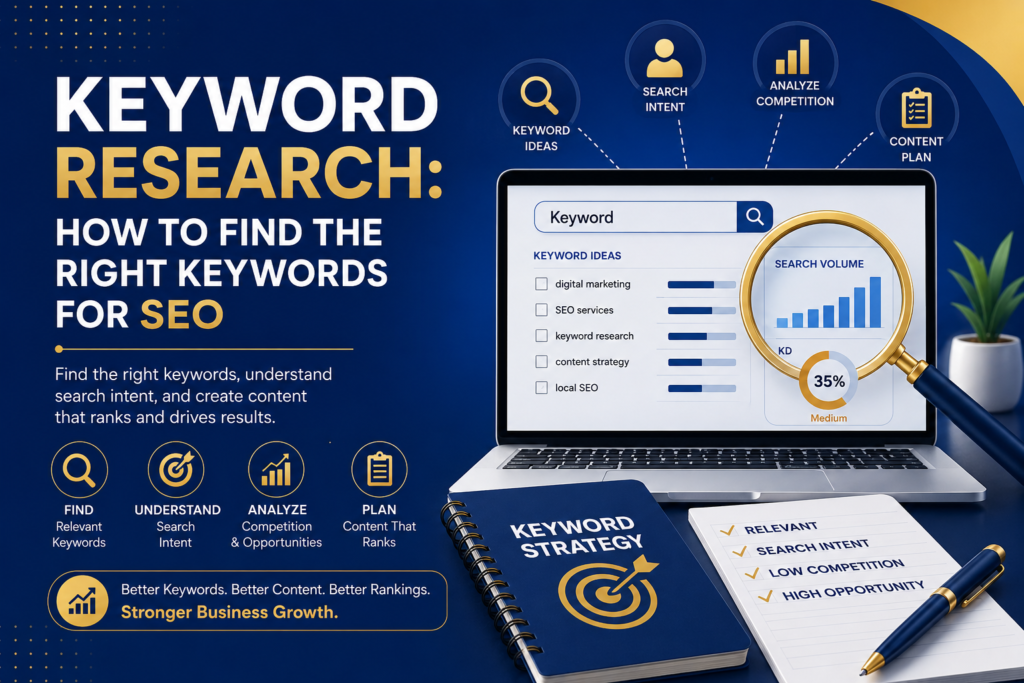
Find the Search Terms That Can Bring the Right Audience
Choosing the right keywords is one of the most important steps in building a successful SEO strategy. The right keywords help search engines understand your content and help potential customers find your website.
Introduction
Search engines connect people with information, products, services, and businesses based on what they search for. When someone types a phrase into Google, the search engine analyzes those words and determines which pages are most relevant to the query.
This is why keyword research plays an important role in SEO. It helps businesses understand what their target audience is searching for and what information they need. Instead of creating content based only on assumptions, keyword research provides useful insights into search behaviour.
However, finding keywords is not simply about choosing the phrases with the highest search volume. A successful keyword strategy also considers search intent, competition, relevance, and the potential value of the audience behind a search.
What Is Keyword Research?
Keyword research is the process of discovering and analyzing the words and phrases people enter into search engines when looking for information, products, services, or solutions.
For example, a person interested in digital marketing might search for:
- Digital marketing agency
- SEO services
- How to improve Google rankings
- Local SEO services
- SEO for small businesses
- Social media marketing agency
- Google Ads management
Each of these phrases represents a potential keyword that a business could target through its website content.
Keyword research helps you identify which search terms are relevant to your business and which ones have the potential to attract the right visitors.
Why Keyword Research Matters for SEO
Keyword research provides the foundation for many SEO activities. It can influence your website pages, blog topics, headings, URLs, product descriptions, and content strategy.
When you understand what your audience searches for, you can create content that directly addresses their questions and needs.
Helps You Understand Your Audience
Keyword research gives you insights into the language your audience uses when searching online.
For example, a business may describe its service as “online marketing solutions,” while potential customers may search for “digital marketing agency near me.”
Understanding this difference can help you create content that matches real search behaviour.
Helps You Create Relevant Content
Without keyword research, businesses may spend time creating content that receives very little search traffic.
Keyword research can reveal questions and topics that people are actively searching for. You can then use those insights to develop useful blog posts, service pages, guides, and other resources.
Supports Better Search Visibility
Using relevant keywords naturally throughout your content helps search engines understand the topic of a page.
However, keywords should never be added unnaturally simply to increase their frequency. Search engines are designed to understand content in context, so your priority should always be useful and readable information.
Helps Generate Targeted Traffic
Not every website visitor has the same value.
A broad keyword may attract many searches but may not bring people who are interested in your services. A more specific keyword with lower search volume could attract visitors who are much closer to making a purchase or contacting a business.
Therefore, the goal is not simply to get more traffic. The goal is to attract relevant traffic.
Understanding Search Intent
Search intent refers to the reason behind a person’s search.
Understanding intent is one of the most important parts of keyword research because the same topic can have completely different types of searches.
Informational Intent
People with informational intent want to learn something or find an answer.
Examples include:
- What is SEO?
- How does keyword research work?
- How to improve website rankings
- What is local SEO?
Blog posts, guides, tutorials, and educational resources can work well for these searches.
Commercial Intent
Commercial searches usually happen when people are researching options before making a decision.
Examples include:
- Best SEO agency
- Best keyword research tools
- SEO services comparison
- SEO agency reviews
Comparison articles, detailed guides, and service-related content can target these searches.
Transactional Intent
Transactional searches indicate that the person is closer to taking an action.
Examples include:
- Buy SEO software
- Hire an SEO agency
- SEO services pricing
- Google Ads management service
Service pages, product pages, pricing pages, and conversion-focused content may be appropriate for these searches.
Navigational Intent
Navigational searches are used when someone is trying to find a particular website, brand, or business.
Examples include:
- Google Search Console
- Elizeh Media
- Google Ads login
Understanding search intent helps you choose the right type of content for each keyword.
Types of Keywords
Keywords can also be categorized according to their length and specificity.
Short-Tail Keywords
Short-tail keywords are generally broad phrases containing one or two words.
Examples include:
- SEO
- Digital marketing
- Keyword research
- Social media
These keywords can have high search demand, but they are often highly competitive and may have broad search intent.
Long-Tail Keywords
Long-tail keywords are more specific search phrases.
Examples include:
- Keyword research for small business SEO
- How to find keywords for a local business
- Best SEO keywords for digital marketing agencies
- How to choose keywords for a business website
Long-tail keywords often have lower search volume than broad terms, but they can be more specific and may attract a more targeted audience.
Branded Keywords
Branded keywords include the name of a company, product, or brand.
For example:
- Elizeh Media
- Elizeh Media SEO services
- Google Ads
- Google Search Console
These searches are usually associated with users who already know the brand or product.
Location-Based Keywords
Location-based keywords include a city, region, neighbourhood, or “near me” phrase.
Examples include:
- SEO agency in Mumbai
- Digital marketing agency in Mumbai
- Local SEO services Mumbai
- SEO company near me
These keywords are particularly useful for businesses that serve specific geographic areas.
How to Find the Right Keywords for Your Website
Finding keywords is more than entering a topic into a keyword tool and choosing the phrase with the highest search volume. Effective keyword research requires understanding your audience, competitors, search intent, and business goals.
Start With Your Main Topics
Begin by listing the main products, services, and topics related to your business.
For a digital marketing agency, these could include:
- SEO services
- Local SEO
- Google Ads
- Social media marketing
- Content marketing
- Website development
- Digital marketing strategy
These broad topics can then be expanded into more specific keyword ideas.
Think Like Your Customer
Put yourself in the position of your target customer.
Ask yourself:
- What problem are they trying to solve?
- What service are they looking for?
- What questions might they ask?
- What words would they type into Google?
- Are they looking for information or ready to hire someone?
For example, someone who wants to improve their website might search for “how to improve Google rankings,” while someone ready to hire an agency might search for “SEO services for small businesses.”
Both searches are valuable, but they represent different stages of the customer journey.
Use Keyword Research Tools
Keyword research tools can help you discover search terms, related keywords, competition levels, and other useful data.
Popular tools include:
- Google Keyword Planner
- Google Search Console
- Google Trends
- Semrush
- Ahrefs
- Ubersuggest
You don’t necessarily need to use every tool. Choose the tools that provide the information you need and fit your SEO workflow.
Use Google Search Suggestions
Google itself can provide useful keyword ideas.
Start typing a phrase into Google and observe the suggestions that appear. These suggestions are based on common searches and can help you discover related topics.
For example, searching for “local SEO” may lead to related phrases such as:
- local SEO services
- local SEO for small business
- local SEO strategy
- local SEO tips
You can also review the People also ask section and related searches to discover questions and variations connected to your main topic.
Analyze Search Volume
Search volume indicates approximately how frequently a keyword is searched.
A keyword with high search volume may appear attractive because it has a large potential audience. However, high-volume keywords often have strong competition and broad search intent.
A keyword with lower search volume may sometimes be more valuable if it closely matches your service and attracts people who are ready to take action.
Therefore, don’t select keywords based on search volume alone.
Evaluate Keyword Competition
Competition is another important factor.
Highly competitive keywords may be difficult for a newer or smaller website to rank for, especially when established websites already dominate the search results.
Instead of targeting only extremely competitive terms, look for relevant keywords where your website has a realistic opportunity to compete.
A balanced strategy can include:
- Broad keywords
- Long-tail keywords
- Location-based keywords
- Question-based keywords
- Service-specific keywords
Analyze the Search Results
Before targeting a keyword, search for it on Google and examine the pages that currently rank.
Look at:
- Type of content ranking
- Website authority
- Content depth
- Search intent
- Featured snippets
- Local results
- Product or service pages
- Blog articles
This helps you understand what Google considers relevant for that search.
If the results are dominated by highly authoritative websites, ranking may require significant effort. If the results contain smaller websites with useful but relatively straightforward content, the keyword may offer a more realistic opportunity.
How to Choose Keywords for Blog Posts
When selecting keywords for a blog post, choose a primary keyword that closely matches the main topic.
Then identify related keywords and questions that can naturally support the article.
For example, if your primary keyword is:
Keyword Research
Related topics could include:
- How to do keyword research
- Keyword research tools
- Long-tail keywords
- Search intent
- Keyword competition
- SEO keyword strategy
- How to find keywords for a website
These related terms can help you create comprehensive content without repeatedly using the same keyword.
How to Choose Keywords for Service Pages
Service pages should focus on keywords that have a strong connection to what your business offers.
For example, an SEO agency could target:
- SEO services
- SEO agency
- SEO company
- Local SEO services
- SEO services for small businesses
Location can also be added when the business serves a specific market:
- SEO agency in Mumbai
- Local SEO services in Mumbai
- Digital marketing agency in Mumbai
The keyword should accurately describe the service you provide.
Use Local Keywords for Local Businesses
Businesses serving a specific geographic area should include relevant location-based keywords in their SEO strategy.
For example:
Business: Digital marketing agency
Location: Mumbai
Potential keywords could include:
- Digital marketing agency in Mumbai
- SEO agency in Mumbai
- Local SEO services Mumbai
- Google Ads agency Mumbai
However, avoid adding city names unnaturally throughout your content. Location keywords should appear naturally where they provide useful information.
Create a Keyword Map
A keyword map connects specific keywords with individual pages on your website.
For example:
| Website Page | Primary Keyword |
|---|---|
| Homepage | Digital Marketing Agency |
| SEO Service Page | SEO Services |
| Local SEO Page | Local SEO Services |
| Google Ads Page | Google Ads Management |
| Blog | Keyword Research |
| Contact Page | Digital Marketing Agency Contact |
This approach helps prevent multiple pages from competing for exactly the same primary keyword.
Avoid Keyword Cannibalization
Keyword cannibalization can occur when multiple pages on your website target the same search intent too closely.
For example, creating several pages that all target “SEO services” without a clear difference between them can make your website structure confusing.
Instead, assign different primary topics and search intents to different pages.
One page might target SEO services, while another focuses on Local SEO services for small businesses.
Don’t Focus Only on Exact-Match Keywords
Modern search engines can understand related words, concepts, and context.
Therefore, you don’t need to repeat an exact keyword in every sentence.
For example, an article targeting “keyword research” can naturally discuss:
- Search terms
- Search queries
- Keyword ideas
- Search intent
- SEO strategy
- Long-tail phrases
- Relevant topics
This creates more natural and useful content for readers.
Use Keywords Naturally in Your Content
Once you select your keywords, place them naturally in important areas of the page.
Depending on the content, relevant keywords can appear in:
- SEO title
- Main heading
- Introduction
- Subheadings
- Body content
- URL
- Meta description
- Image alt text
- Internal link anchor text
The priority should always be readability and usefulness.
Avoid keyword stuffing because repeatedly inserting keywords can make content difficult to read and may create a poor user experience.
Key Takeaway
Effective keyword research combines search demand, relevance, competition, and search intent. Instead of chasing the highest-volume keyword, focus on terms that connect your content with the people most likely to benefit from your business.
A well-planned keyword strategy can help you create better content, optimize important website pages, attract relevant visitors, and build a stronger foundation for long-term SEO growth.
How to Prioritize Your Keywords
Once you have a list of potential keywords, the next step is deciding which ones deserve your attention first. Not every keyword will have the same value for your website.
A useful keyword strategy considers four main factors:
- Relevance to your business
- Search intent
- Search demand
- Competition
A keyword with moderate search volume but strong relevance can be more valuable than a high-volume keyword that attracts the wrong audience.
Focus on Business-Relevant Keywords
Your keywords should have a clear connection to your products, services, or expertise.
For example, if your business provides SEO services, targeting a keyword such as SEO services for small businesses may be more valuable than targeting a broad term such as marketing.
The more closely a keyword matches your offering, the more likely the resulting traffic will be useful to your business.
Consider the Customer Journey
People use different search terms depending on where they are in the buying process.
Someone who searches “what is SEO” is likely researching the topic.
Someone searching “best SEO agency” may be comparing providers.
A person searching “SEO services in Mumbai” may be closer to contacting an agency.
Creating content for different stages of the customer journey can help your website attract visitors and gradually move them toward conversion.
Build a Keyword Strategy Around Topics
Instead of creating isolated pages for individual keywords, organize your content around broader topics.
For example, an SEO topic cluster could include:
Main Topic: SEO
Related content:
- What Is SEO?
- Keyword Research Guide
- On-Page SEO
- Technical SEO
- Local SEO
- Link Building
- SEO Analytics
- SEO for Small Businesses
This structure helps you cover a subject comprehensively and provides opportunities to connect related pages through internal links.
Create a Primary and Secondary Keyword List
Each important page should have a clear primary keyword or topic.
You can then use related keywords as secondary terms.
For example:
Primary keyword: Keyword Research
Secondary keywords:
- Keyword research tools
- SEO keyword research
- Long-tail keywords
- Search intent
- Keyword strategy
- How to find keywords
This keeps the content focused while allowing you to cover related concepts naturally.
Use Question-Based Keywords
Question keywords are valuable because they reveal exactly what people want to know.
Examples include:
- What is keyword research?
- How does keyword research work?
- How do I find keywords for SEO?
- What are long-tail keywords?
- Which keyword research tool is best?
- How many keywords should a page target?
These questions can become blog topics, FAQ sections, or subheadings within larger guides.
Find Content Gaps
Keyword research can also help you discover content gaps.
A content gap occurs when your competitors provide useful information that your website does not currently cover.
Analyze competing websites and look for:
- Topics they rank for
- Questions they answer
- Keywords they target
- Content formats they use
- Subtopics missing from your website
You can then create more useful and comprehensive content around relevant gaps.
Analyze Competitor Keywords
Competitor research can reveal keyword opportunities you may not have considered.
Start by identifying websites that rank for your target topics. Review their:
- Page titles
- Headings
- Blog topics
- Service pages
- Content structure
- Frequently covered questions
You don’t need to copy competitors. Instead, use their content to understand what users and search engines consider relevant, then create something more useful and distinctive.
Update Your Keyword Strategy Regularly
Keyword research should not be a one-time activity.
Search behaviour changes as customer needs, technology, products, and trends evolve. New search terms can also become important as your business grows.
Review your keyword strategy periodically and look for:
- New search opportunities
- Declining keywords
- New customer questions
- Changes in search intent
- New competitors
- Emerging topics
- Underperforming content
Updating older content can sometimes be more effective than constantly creating new pages.
Use Google Search Console to Find Opportunities
Google Search Console can provide useful information about how your website appears in Google Search.
You can review queries that generate:
- Impressions
- Clicks
- Click-through rate
- Search positions
This data can reveal keywords for which your pages already receive visibility.
For example, if a page appears for a related search but receives few clicks, improving the title and content may help make the page more useful and attractive to searchers.
Don’t Ignore Low-Volume Keywords
A keyword with low search volume should not automatically be rejected.
Some specific keywords can attract highly relevant visitors even when their search demand is relatively small.
For example, a local service provider may receive more value from a specific service-and-location search than from a broad keyword with thousands of searches.
The potential business value of a keyword matters just as much as its search volume.
Avoid Keyword Stuffing
Keyword stuffing means excessively repeating keywords in an attempt to manipulate search rankings.
For example, writing a paragraph that repeatedly uses the same phrase can make the content unnatural and difficult to read.
Instead:
- Use keywords naturally.
- Write for people first.
- Include related concepts.
- Answer the searcher’s question.
- Use clear headings.
- Maintain natural language.
A useful article does not need to repeat the same keyword in every sentence.
Measure Keyword Performance
After publishing and optimizing your content, track how your keywords perform.
Useful metrics include:
- Organic clicks
- Impressions
- Average search position
- Click-through rate
- Organic traffic
- Conversions
- Leads
- Revenue
Ranking is only one part of SEO success. A keyword that generates qualified leads can be more valuable than a keyword that produces high traffic but no conversions.
Turn Keyword Research Into an SEO Content Plan
Once you have researched and prioritized your keywords, turn them into an actionable content plan.
For example:
| Keyword Topic | Search Intent | Content Type |
|---|---|---|
| What is SEO | Informational | Guide |
| Keyword research | Informational | Blog |
| Local SEO services | Commercial | Service Page |
| SEO agency in Mumbai | Commercial | Local Service Page |
| How to improve Google rankings | Informational | Guide |
| SEO pricing | Commercial | Service/Pricing Page |
This approach connects keyword research with your broader SEO strategy.
Key Takeaway
Keyword research becomes much more valuable when it is connected to clear business goals. Instead of targeting keywords simply because they have high search volume, evaluate their relevance, intent, competition, and potential to attract the right audience.
Once you identify valuable keywords, organize them into a logical content strategy and continue measuring their performance. This creates a sustainable SEO process that can grow alongside your website.
Frequently Asked Questions (FAQs)
What is keyword research in SEO?
Keyword research is the process of finding and analyzing the search terms people use on search engines. It helps businesses understand what their audience is looking for and create content that matches those searches.
Why is keyword research important for SEO?
Keyword research helps you understand your audience, identify content opportunities, target relevant searches, and build a stronger SEO strategy. It can also help attract visitors who are more likely to be interested in your products or services.
How do I find the right keywords for my website?
Start by identifying your main products, services, and topics. Then use keyword research tools, Google search suggestions, related searches, competitor research, and Search Console data to discover relevant terms. Evaluate each keyword based on relevance, search intent, competition, and potential business value.
What is the difference between short-tail and long-tail keywords?
Short-tail keywords are broad phrases such as SEO or digital marketing. Long-tail keywords are more specific phrases such as SEO services for small businesses.
Short-tail terms can have greater search demand, while long-tail keywords may attract a more specific and targeted audience.
How many keywords should I target on one page?
There is no fixed number. Instead of trying to target a specific keyword count, focus on one primary topic and naturally cover relevant related terms and questions.
The content should be comprehensive enough to satisfy the searcher’s intent without unnecessarily repeating keywords.
Are long-tail keywords good for SEO?
Yes. Long-tail keywords can be valuable because they are more specific and often reflect a clearer search intent. They can help businesses reach audiences looking for particular products, services, solutions, or information.
Which keyword research tools can I use?
Several tools can help with keyword research, including:
- Google Keyword Planner
- Google Search Console
- Google Trends
- Semrush
- Ahrefs
- Ubersuggest
The best tool depends on your goals, budget, and level of research required.
Should I choose keywords with the highest search volume?
Not necessarily. High search volume does not automatically mean high business value.
A more specific keyword with lower search demand may attract visitors who are much more interested in your service. Consider relevance, search intent, competition, and conversion potential alongside search volume.
How often should I perform keyword research?
Keyword research should be reviewed regularly rather than treated as a one-time task. Search behaviour, customer needs, competitors, and industry trends can change over time.
Reviewing your keyword strategy periodically can help you identify new opportunities and improve existing content.
Final Thoughts
Keyword research is one of the foundations of a successful SEO strategy. It helps you understand what your audience searches for and gives you valuable direction when creating and optimizing website content.
However, effective keyword research is not about finding the largest possible search volume or adding keywords repeatedly to a page.
The real goal is to identify relevant search terms that match user intent and connect with your business objectives.
Start by understanding your audience and listing the products, services, and topics that matter to your business. Then expand those ideas using reliable keyword research tools, Google search results, competitor analysis, and Search Console data.
After identifying potential keywords, evaluate their relevance, search intent, competition, and business value. Use the most appropriate terms to build your website pages, blog content, service pages, and broader SEO strategy.
Remember that SEO is an ongoing process. Search behaviour changes, new topics emerge, and your business may introduce new products or services. Regular keyword research allows your content strategy to evolve with those changes.
Most importantly, write for people first. Use keywords naturally, answer real questions, provide useful information, and make your content easy to understand.
When keyword research and high-quality content work together, your website has a stronger foundation for attracting relevant organic traffic and supporting long-term business growth.
Key Takeaway
A successful keyword strategy is based on more than search volume.
Focus on:
- Relevance — Does the keyword relate to your business?
- Search intent — What does the user actually want?
- Competition — Can your website realistically compete?
- Business value — Can the search lead to meaningful engagement or conversions?
- Content quality — Can you provide a genuinely useful answer?
By combining these factors, you can find keywords that attract the right audience and support your overall SEO goals.
About the Author
Musarrat Jahan is the Founder of Elizeh Media, a digital marketing agency focused on helping businesses strengthen their online presence through SEO, Local SEO, Google Ads, social media marketing, content marketing, and website development.
Through practical and research-driven content, Musarrat Jahan helps businesses understand digital marketing strategies and make informed decisions that support sustainable online growth.
About Elizeh Media
Elizeh Media is a digital marketing agency helping businesses improve their online visibility, reach their target audience, and build sustainable digital growth.
Our services include:
- SEO
- Local SEO
- Google Ads
- Social Media Marketing
- Content Marketing
- Website Design and Development
- Digital Marketing Strategy
We create customized strategies based on each business’s goals, audience, industry, and growth opportunities.