
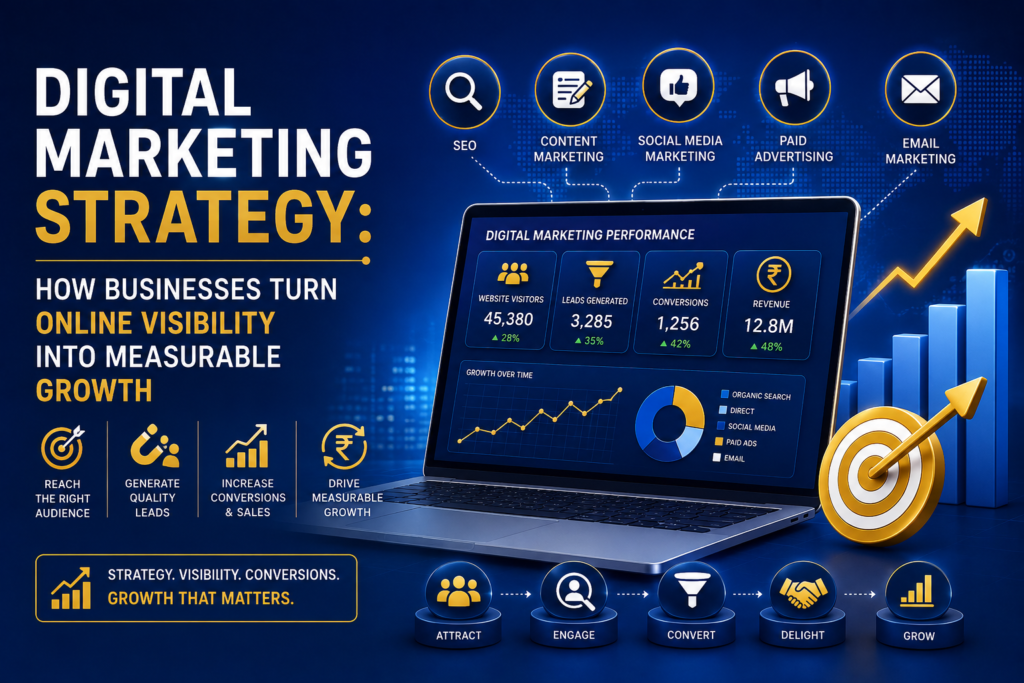
Digital Marketing Strategy: How Businesses Turn Online Visibility Into Measurable Growth
Having a website or social media account is no longer enough for a business to succeed online. A strong digital marketing strategy connects visibility with meaningful business outcomes such as qualified leads, sales, customer engagement, and long-term growth.
Introduction
Digital marketing has become an essential part of modern business growth. Customers now use search engines, social media platforms, websites, online reviews, videos, and other digital channels to discover businesses and make purchasing decisions.
However, simply being visible online does not automatically generate revenue.
A business may receive website visitors but very few enquiries. It may have thousands of social media followers but limited sales. Similarly, a website may rank for keywords but fail to convert visitors into customers.
This is where a strategic approach to digital marketing becomes important.
A well-planned digital marketing strategy connects different online activities with specific business objectives. Instead of focusing only on traffic, likes, followers, or rankings, businesses can measure how their marketing efforts contribute to leads, conversions, revenue, customer retention, and brand growth.
The goal is not simply to get noticed online. The goal is to turn that visibility into measurable business results.
What Is a Digital Marketing Strategy?
A digital marketing strategy is a structured plan that explains how a business will use online channels to reach its target audience, communicate its value, generate demand, and achieve measurable business objectives.
Depending on the business, a strategy may include:
- Search Engine Optimization (SEO)
- Local SEO
- Content marketing
- Social media marketing
- Google Ads and paid advertising
- Email marketing
- Video marketing
- Influencer marketing
- Website optimization
- Conversion rate optimization
- Analytics and performance tracking
These channels should not operate independently.
For example, SEO can bring organic visitors to a website, while strong landing pages can turn those visitors into leads. Social media can build awareness, while email marketing can help nurture potential customers. Paid advertising can generate immediate traffic, while analytics can show which campaigns are producing the best results.
A successful strategy connects these activities into a clear customer journey.
Why Online Visibility Alone Is Not Enough
Online visibility is an important starting point, but it is not the final objective.
Imagine a business website receives 10,000 visitors in a month. That number may look impressive. However, if only a few visitors contact the business or make a purchase, the traffic has limited business value.
Now consider another website that receives 2,000 highly relevant visitors and generates hundreds of enquiries or purchases.
The second business may have a much stronger digital marketing strategy even though it receives less traffic.
This demonstrates an important principle:
Quality and relevance matter more than vanity metrics alone.
Businesses should therefore evaluate digital marketing using metrics that connect marketing activity with actual business outcomes.
Start With Clear Business Goals
Before selecting digital marketing channels, a business should define what it wants to achieve.
Different businesses may have different objectives.
For example:
- An e-commerce company may want to increase online sales.
- A local restaurant may want more bookings and phone enquiries.
- A real estate company may want qualified leads.
- A professional service provider may want consultation requests.
- A new brand may want to build awareness.
- An established company may want to increase repeat purchases.
The marketing strategy should be built around these goals.
Common Digital Marketing Goals
A business may focus on:
Brand awareness
Getting more potential customers familiar with the brand.
Website traffic
Attracting relevant visitors through search, social media, advertising, and other channels.
Lead generation
Encouraging prospects to submit forms, call, message, or request information.
Sales and conversions
Turning prospects into paying customers.
Customer retention
Encouraging existing customers to return and purchase again.
Revenue growth
Increasing the financial return generated by marketing activities.
Clear goals make it easier to decide which channels to use and which metrics to track.
Understand Your Target Audience
A digital marketing strategy becomes much more effective when a business understands who it is trying to reach.
Before creating campaigns or content, businesses should identify:
- Who their ideal customers are
- What problems they are trying to solve
- What products or services they need
- What questions they ask online
- Which platforms they use
- What factors influence their purchasing decisions
- What objections prevent them from buying
This information can influence everything from keyword research and content creation to advertising and website design.
Create Customer Personas
A customer persona is a simplified representation of an ideal customer.
For example, a digital marketing agency targeting local businesses might create a persona such as:
Business owner: Runs a small local company, wants more enquiries, has limited time for marketing, and needs measurable results from advertising and SEO.
Understanding this type of customer helps the business create more relevant messaging.
Instead of saying:
“We provide digital marketing services.”
the brand could communicate a more specific benefit:
“We help local businesses increase search visibility, generate qualified leads, and build a stronger online presence.”
The second message focuses more clearly on the customer’s needs and desired outcome.
Build a Strong Digital Foundation
Before investing heavily in marketing campaigns, businesses need a solid digital foundation.
Your website is often the central destination where prospects learn about your business, evaluate your offering, and decide whether to take action.
A strong website should be:
- Mobile-friendly
- Fast-loading
- Easy to navigate
- Secure
- Professionally designed
- Clear about products or services
- Easy to contact
- Optimized for search engines
- Built around user intent
Make Your Value Proposition Clear
Visitors should quickly understand three things:
What do you offer?
Who do you help?
Why should they choose you?
If visitors have to search through several pages to understand what a business does, they may leave before taking action.
A clear headline, concise supporting message, relevant visuals, and strong calls to action can make the customer journey easier.
The Role of SEO in Digital Marketing Strategy
SEO helps businesses improve their visibility in organic search results.
When people search for products, services, solutions, or information related to a business, appearing prominently in relevant search results can bring valuable traffic.
However, SEO should not be treated simply as a ranking exercise.
The real objective is to attract relevant users who are likely to take meaningful action.
Keyword Research
Keyword research helps businesses understand what their target audience is searching for.
Instead of targeting only broad keywords, businesses should consider:
- High-intent keywords
- Long-tail keywords
- Location-based keywords
- Question-based searches
- Commercial keywords
- Informational keywords
- Service-related keywords
For example, someone searching for “what is SEO” may be researching the topic, while someone searching for “SEO agency in Mumbai” may already be looking for a service provider.
Understanding this difference helps businesses create content and landing pages that match different stages of the customer journey.
Create Content Around Search Intent
Good SEO content should answer the question behind the search.
If a user searches for a particular service, the page should explain that service clearly.
If the user is researching a topic, an educational article may be more appropriate.
If the user is comparing options, a detailed comparison or guide may provide greater value.
This alignment between search intent and content can improve both user experience and marketing performance.
Content Marketing as a Growth Engine
Content marketing supports digital visibility by giving audiences useful information before they become customers.
Businesses can create:
- Blog posts
- Guides
- Case studies
- Videos
- Infographics
- FAQs
- Social media posts
- Whitepapers
- Email newsletters
The most effective content is not created simply to fill a website.
It should answer customer questions, demonstrate expertise, solve problems, and guide potential customers toward an appropriate next step.
How Social Media Supports a Digital Marketing Strategy
Social media can help businesses build awareness, communicate with customers, distribute content, and drive traffic to their websites.
However, effective social media marketing is not simply about posting every day.
Each platform should have a clear purpose within the overall marketing strategy.
For example:
- Instagram can support visual branding and engagement.
- LinkedIn can help businesses build professional authority and generate B2B opportunities.
- Facebook can support community building and local promotion.
- YouTube can help businesses educate audiences through longer-form video content.
The right platform depends on the target audience and business objectives.
Focus on Meaningful Engagement
Follower numbers can be useful, but they do not tell the complete story.
Businesses should also monitor:
- Engagement
- Website visits
- Enquiries
- Leads
- Sales
- Audience growth
- Content performance
A smaller but highly relevant audience can be more valuable than a large audience that has little interest in the business.
Paid Advertising for Faster Visibility
SEO and organic content can take time to build momentum. Paid advertising can help businesses reach relevant audiences more quickly.
Platforms such as Google Ads and social media advertising allow businesses to target users based on factors such as:
- Search intent
- Location
- Interests
- Demographics
- Online behaviour
- Previous interactions
Google Ads and Search Intent
Google Ads can be particularly useful when people are already searching for a product or service.
For example, someone searching for “digital marketing agency in Mumbai” may have stronger commercial intent than someone simply searching for “what is digital marketing.”
This makes search advertising useful for businesses that want to reach customers closer to a purchasing decision.
However, paid advertising should be managed carefully. A campaign can generate a large amount of traffic while still producing poor results if targeting, landing pages, messaging, or conversion tracking are weak.
Build Landing Pages That Convert
Driving traffic to a website is only one part of the process.
The next step is giving visitors a clear reason to take action.
A strong landing page should generally include:
- A clear headline
- A relevant value proposition
- Benefits of the product or service
- Supporting information
- Trust signals
- Testimonials or reviews where appropriate
- A clear call to action
- Simple contact or enquiry options
For example, instead of sending an advertisement for SEO services to a generic homepage, a business could create a dedicated SEO service landing page designed around the user’s search intent.
This creates a more focused customer journey.
Email Marketing and Customer Nurturing
Not every website visitor is ready to purchase immediately.
Email marketing can help businesses maintain relationships with potential and existing customers.
Businesses can use email to share:
- Educational content
- Product updates
- Special offers
- Newsletters
- Case studies
- New services
- Personalized recommendations
Email can be particularly useful for nurturing prospects who need more information before making a purchasing decision.
Connect Marketing Channels Together
One of the biggest advantages of a strategic approach is that different channels can support each other.
For example:
SEO → Website Traffic → Content → Lead → Email Follow-Up → Customer
Another journey might look like:
Google Ads → Landing Page → Enquiry → Sales Conversation → Customer
Social media could support either journey by creating awareness and keeping the brand visible.
This connected approach is more effective than treating SEO, social media, advertising, and content as completely separate activities.
Measure What Actually Matters
Digital marketing provides access to a large amount of data.
The challenge is knowing which numbers actually matter.
Important Marketing Metrics
Businesses may track:
Website traffic
Shows how many people are visiting the website.
Organic traffic
Shows visitors coming from unpaid search results.
Click-through rate (CTR)
Shows how frequently users click an advertisement or search result after seeing it.
Conversion rate
Shows the percentage of visitors who complete a desired action.
Cost per lead (CPL)
Shows how much a business spends to generate a lead.
Customer acquisition cost (CAC)
Estimates the cost of acquiring a new customer.
Return on ad spend (ROAS)
Measures the revenue generated relative to advertising expenditure.
Return on investment (ROI)
Looks at the broader financial return from an investment.
The right metrics depend on the business model and marketing objective.
Turn Data Into Better Decisions
Collecting data is not enough.
Businesses need to analyze that information and use it to improve future campaigns.
For example, if one advertising campaign generates many clicks but very few enquiries, the business might investigate:
- Keyword targeting
- Ad messaging
- Landing page quality
- Offer
- Audience targeting
- Conversion tracking
If another campaign generates fewer visitors but significantly more customers, it may deserve a larger share of the marketing budget.
This creates a continuous improvement cycle:
Launch → Measure → Analyze → Improve → Repeat
Conversion Rate Optimization
Conversion Rate Optimization (CRO) focuses on improving the percentage of visitors who complete a desired action.
That action could be:
- Making a purchase
- Filling out a form
- Booking a consultation
- Calling a business
- Signing up for an email list
- Downloading a resource
Small improvements can have a meaningful impact.
For example, improving a landing page’s messaging and call-to-action can increase the number of visitors who become leads without increasing advertising traffic.
Create a Consistent Customer Journey
Customers rarely move from discovering a brand to purchasing immediately.
A typical journey may include:
Awareness → Interest → Consideration → Conversion → Retention
Digital marketing should support each stage.
Awareness
Use SEO, social media, video, content, and advertising to introduce the brand.
Interest
Provide useful information that helps potential customers understand their problem and possible solutions.
Consideration
Use case studies, comparisons, reviews, demonstrations, and detailed service information to build confidence.
Conversion
Make it easy to enquire, book, purchase, or contact the business.
Retention
Continue communicating with customers through email, social media, loyalty programs, useful content, and personalized offers.
A strategy that considers the complete journey can create stronger long-term results than one focused only on attracting new visitors.
Why Consistency Matters
Digital marketing rarely produces sustainable growth through one campaign or one social media post.
Businesses need consistency in:
- Content publishing
- Brand messaging
- SEO
- Social media activity
- Advertising
- Customer communication
- Performance analysis
Consistency allows businesses to build recognition while collecting enough data to understand what works.
How to Turn Digital Marketing Into Measurable Growth
A successful digital marketing strategy should ultimately contribute to business growth. Traffic, engagement, and rankings are useful indicators, but businesses need to connect these activities with leads, customers, revenue, and long-term relationships.
Align Marketing With Business Objectives
Every marketing activity should have a clear purpose.
For example, if the primary goal is lead generation, the strategy should prioritize:
- High-intent SEO keywords
- Search advertising
- Service landing pages
- Lead forms
- Calls and enquiries
- Conversion tracking
- Lead nurturing
If the goal is brand awareness, the strategy may focus more heavily on:
- Educational content
- Social media
- Video marketing
- PR and brand mentions
- Influencer collaborations
- Search visibility
This prevents businesses from spending money on channels simply because they are popular.
Build a Content Funnel
Content can support customers at different stages of their decision-making process.
Top of the Funnel: Awareness
At this stage, people are looking for information.
Useful content includes:
- Educational blog posts
- How-to guides
- Videos
- Social media content
- Infographics
The objective is to introduce the audience to the topic and brand.
Middle of the Funnel: Consideration
Users at this stage are evaluating possible solutions.
Businesses can provide:
- Comparisons
- Case studies
- Detailed guides
- Service pages
- Webinars
- Testimonials
The goal is to demonstrate expertise and build confidence.
Bottom of the Funnel: Conversion
At this stage, the potential customer is closer to taking action.
Useful assets include:
- Product pages
- Service pages
- Pricing information
- Free consultations
- Demonstrations
- Contact forms
- Special offers
The objective is to make the next step simple and clear.
Use SEO and Paid Advertising Together
SEO and paid advertising are often treated as competing strategies, but they can work together effectively.
SEO can build long-term organic visibility, while paid advertising can provide immediate exposure for targeted searches.
For example, a business launching a new service could use Google Ads to reach potential customers immediately while simultaneously building SEO content around the same service.
Over time, organic search may generate more traffic while paid campaigns continue targeting valuable commercial opportunities.
Local SEO Can Drive High-Intent Customers
For businesses serving specific locations, Local SEO can be an important part of digital growth.
People often search for businesses using terms such as:
- Digital marketing agency near me
- SEO agency in Mumbai
- Web design company in Andheri
- Best marketing agency near me
These searches can indicate strong local intent.
Businesses should therefore optimize their Google Business Profile, website location pages, reviews, local content, and business information across relevant platforms.
Use Customer Reviews as a Growth Asset
Reviews influence how potential customers perceive a business.
Positive reviews can provide social proof and help prospective customers feel more confident about contacting or purchasing from a company.
Businesses should encourage genuine customers to leave honest feedback and respond professionally to reviews.
Reviews should never be treated as something to manipulate. Authentic customer experiences are more valuable for long-term reputation.
Improve the Website Before Increasing Traffic
One common mistake is trying to generate more traffic before fixing website conversion problems.
If a website receives visitors but has:
- Unclear messaging
- Slow loading times
- Poor mobile experience
- Difficult navigation
- Weak calls to action
- Complicated forms
then increasing traffic may simply increase the number of people leaving without converting.
Improving the website first can make future marketing investments more productive.
Create a Data-Driven Marketing Process
A strong digital marketing strategy should continuously evolve.
Businesses can follow a simple process:
Set Goals → Launch Campaigns → Measure Results → Analyze Data → Optimize → Scale
For example, if a business discovers that one SEO topic generates highly qualified enquiries while another produces only low-value traffic, resources can be shifted toward the content that supports business goals more effectively.
The same principle applies to advertising, social media, email marketing, and landing pages.
Calculate the Real Value of Marketing
Businesses should look beyond surface-level metrics.
Suppose an advertising campaign generates 100 leads.
That sounds positive, but if only two leads become customers, the campaign may need improvement.
Another campaign might generate only 30 leads but produce 10 customers.
The second campaign could be significantly more valuable.
This is why businesses should connect marketing data with actual sales outcomes whenever possible.
Track the Full Journey
A useful measurement framework can look like:
Impressions → Clicks → Visitors → Leads → Qualified Leads → Customers → Revenue
Tracking this journey helps businesses understand where opportunities or problems exist.
For example:
- Many impressions but few clicks → improve messaging or targeting.
- Many clicks but few leads → improve the landing page.
- Many leads but few customers → improve lead quality or sales follow-up.
- Many customers but low profit → review acquisition costs and pricing.
This approach turns marketing data into actionable business decisions.
Personalization Can Improve Customer Experience
Customers increasingly expect relevant experiences.
Businesses can personalize marketing based on factors such as:
- Previous purchases
- Location
- Interests
- Website behaviour
- Customer stage
- Previous interactions
For example, an existing customer may receive different communication from someone who has never interacted with the brand.
Effective personalization should provide genuine relevance rather than becoming intrusive.
Use Automation Carefully
Marketing automation can help businesses manage repetitive activities more efficiently.
Examples include:
- Email sequences
- Lead notifications
- Appointment reminders
- Customer follow-ups
- Social media scheduling
- Reporting
- Audience segmentation
Automation should support the customer experience rather than replace thoughtful communication.
Build Long-Term Digital Assets
One of the biggest advantages of digital marketing is that some activities can continue creating value over time.
A useful SEO article can attract organic traffic for months or even years.
A helpful video can continue generating views.
A strong landing page can consistently generate enquiries.
An established email list can support future campaigns.
This is different from marketing activities that stop producing exposure as soon as the budget is turned off.
A balanced strategy can therefore combine short-term campaigns with long-term digital assets.
Avoid Depending on a Single Marketing Channel
Businesses can become vulnerable when most of their leads come from one source.
For example, relying entirely on paid advertising means performance may be affected by increasing advertising costs or changes in platform policies.
Similarly, depending entirely on organic search creates exposure to algorithm changes.
A stronger approach is to develop multiple complementary channels, such as:
SEO + Content + Social Media + Paid Advertising + Email + Local SEO
The exact combination should depend on the business, audience, budget, and goals.
Keep Testing and Improving
Digital marketing provides opportunities for continuous experimentation.
Businesses can test:
- Headlines
- Calls to action
- Landing pages
- Ad copy
- Images
- Offers
- Email subject lines
- Content formats
- Audience segments
The goal is not to change everything at once.
Instead, test specific elements, measure the results, and use the findings to make better decisions.
Common Digital Marketing Strategy Mistakes
A well-planned strategy can help a business grow, but several common mistakes can reduce its effectiveness. Avoiding these problems can make digital marketing more efficient and sustainable.
Focusing Only on Traffic
Website traffic is useful, but traffic alone does not guarantee growth.
A business should also evaluate whether visitors are:
- Relevant to the business
- Engaging with the website
- Submitting enquiries
- Making purchases
- Returning as customers
The objective should be to attract the right audience, not simply the largest audience.
Chasing Every Digital Marketing Trend
New platforms, tools, and marketing trends appear constantly.
Businesses do not need to use every new channel.
A better approach is to evaluate whether a particular platform or tactic:
- Reaches the target audience
- Supports a business objective
- Fits the available resources
- Can be measured
- Has realistic growth potential
A focused strategy is often more effective than trying to maintain a presence everywhere.
Ignoring Existing Customers
Digital marketing often focuses heavily on acquiring new customers.
However, existing customers can also contribute significantly to long-term growth.
Businesses can use email marketing, personalized communication, loyalty programs, useful content, and customer support to encourage repeat purchases and stronger relationships.
Not Tracking Conversions
One of the biggest problems in digital marketing is running campaigns without proper conversion tracking.
If a business does not know where its leads and sales are coming from, it becomes difficult to determine which marketing activities deserve more investment.
Conversion tracking should therefore be established before scaling campaigns.
Using the Same Strategy for Every Business
There is no universal digital marketing strategy.
A local restaurant, an e-commerce store, a real estate company, a B2B software business, and a professional services firm may require completely different approaches.
The strategy should consider:
- Industry
- Target audience
- Location
- Competition
- Budget
- Sales cycle
- Business objectives
- Customer behaviour
How to Build a Sustainable Digital Marketing Strategy
Sustainable growth usually comes from combining short-term opportunities with long-term marketing assets.
A practical framework can include five stages.
1. Define
Start by identifying the business objective.
Ask:
What does the business want to achieve?
This could be more leads, sales, bookings, brand awareness, website traffic, or customer retention.
2. Understand
Research the target audience, competitors, customer needs, search behaviour, and purchasing journey.
This creates the foundation for a more relevant strategy.
3. Execute
Select the digital channels that best support the objective.
Depending on the business, this could include SEO, Local SEO, content marketing, social media, Google Ads, email marketing, or other channels.
4. Measure
Track meaningful metrics such as:
- Leads
- Qualified leads
- Conversions
- Customer acquisition cost
- Revenue
- Return on investment
- Organic traffic
- Conversion rate
5. Optimize
Use the data to improve campaigns, content, landing pages, targeting, and customer journeys.
This creates an ongoing cycle of improvement rather than a one-time marketing campaign.
The Future of Digital Marketing Strategy
Digital marketing will continue to evolve as technology, consumer behaviour, search, artificial intelligence, and online platforms change.
Businesses may increasingly use AI for:
- Content research
- Audience analysis
- Data interpretation
- Marketing automation
- Customer segmentation
- Campaign optimization
- Personalization
However, technology should support strategy rather than replace it.
Businesses still need a clear understanding of their customers, products, positioning, goals, and value proposition.
The companies that succeed online will likely be those that combine technology with strong strategy and genuine customer value.
Frequently Asked Questions
What is the most important part of a digital marketing strategy?
There is no single element that works for every business. However, clearly defined business goals, a strong understanding of the target audience, useful content, effective digital channels, and measurable results form the foundation of a strong strategy.
How long does a digital marketing strategy take to produce results?
The timeline depends on the channel and business. Paid advertising can produce traffic quickly, while SEO and content marketing often require more time to build consistent visibility. Sustainable growth usually requires ongoing optimization rather than expecting immediate results from a single campaign.
Is SEO still important for digital marketing?
Yes. SEO remains an important way for businesses to attract people who are actively searching for relevant information, products, and services. SEO can also support long-term organic visibility and reduce dependence on paid traffic.
Should businesses use social media marketing?
Social media can be valuable when the target audience actively uses the selected platform. Businesses should choose platforms based on audience behaviour and business objectives rather than trying to maintain an account on every platform.
How can a business measure digital marketing success?
Businesses should connect marketing activities with measurable outcomes such as qualified leads, conversions, customer acquisition cost, revenue, and return on investment. Traffic and engagement can provide useful supporting information but should not be the only measures of success.
What is the difference between digital marketing and digital marketing strategy?
Digital marketing refers to the different online marketing activities a business can use. A digital marketing strategy is the plan that determines which activities to use, why they are being used, who they target, and how their results will be measured.
Final Thoughts
Digital marketing becomes more powerful when businesses stop viewing individual channels as isolated activities.
SEO, content marketing, social media, paid advertising, email marketing, Local SEO, and website optimization can work together to guide potential customers from awareness to conversion.
The key is to connect every activity with a clear business objective.
Instead of asking only:
“How much traffic did we get?”
businesses should also ask:
“Did this traffic reach the right audience?”
“Did it generate qualified leads?”
“Did those leads become customers?”
“What revenue did the campaign generate?”
This shift from visibility to measurable outcomes is what turns digital marketing into a genuine growth strategy.
A sustainable approach combines strong foundations, relevant content, targeted campaigns, accurate measurement, and continuous optimization. Businesses that consistently understand their audience and improve their digital customer journey can build stronger online visibility while creating opportunities for long-term growth.
Key Takeaway
Digital visibility is the starting point—not the final goal.
The real value of digital marketing comes from turning visibility into engagement, leads, customers, revenue, and lasting business relationships.