
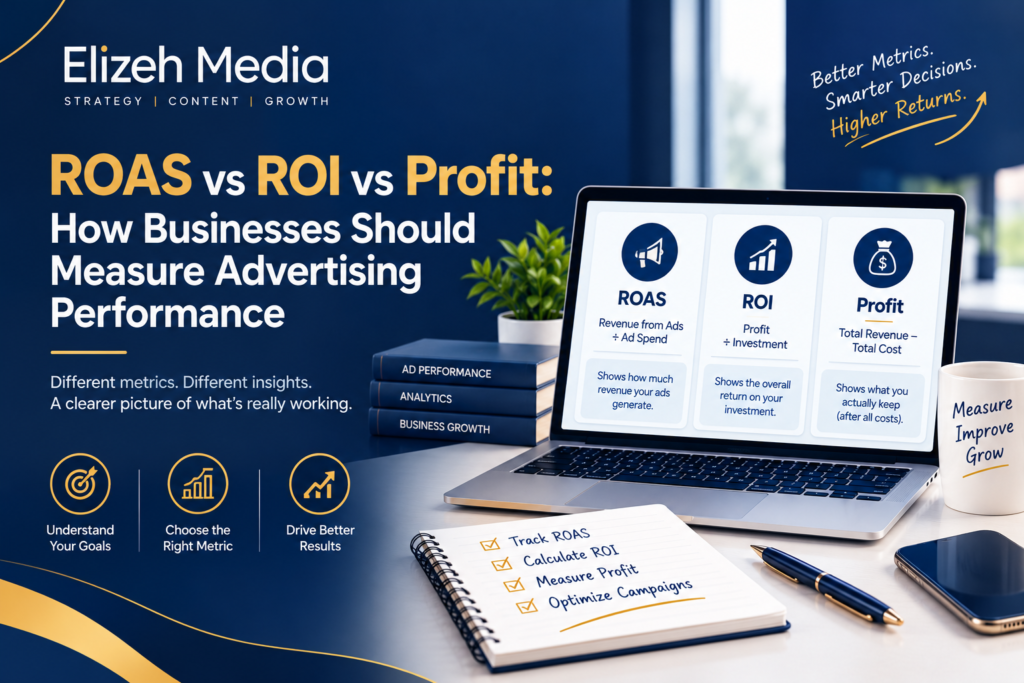
ROAS vs ROI vs Profit: How Businesses Should Measure Advertising Performance
ROAS vs ROI vs Profit: How Businesses Should Measure Advertising Performance Introduction Why Advertising Performance Is More Than Clicks Running ads can help a business reach new customers, generate leads, and increase sales. However, spending money on advertising does not always lead to profit. A campaign may attract thousands of visitors but generate very few sales. Another campaign may produce strong revenue while leaving the business with little money after expenses. That is why businesses need to measure advertising performance carefully. Clicks, impressions, and website visits can show how people respond to an ad. However, these numbers do not always reveal whether a campaign is financially successful. To understand advertising performance, businesses need to look beyond revenue and measure the money they actually earn. Three important metrics can help: Return on Ad Spend (ROAS), Return on Investment (ROI), and profit. Although these terms are related, they measure different things. ROAS shows how much revenue advertising generates compared with ad spend. ROI measures the return from an investment against its cost. Profit shows how much money remains after the relevant expenses are deducted. Understanding these differences helps businesses make better marketing decisions. Why These Metrics Matter Imagine that your business spends ₹20,000 on Google Ads. The campaign generates ₹1,00,000 in sales. At first, the result looks impressive. However, you still need to consider other expenses. These may include product costs, shipping, agency fees, employee salaries, payment processing charges, and discounts. After accounting for these expenses, the actual profit may be much lower than expected. A campaign can generate strong revenue without delivering strong profit. Therefore, businesses should measure advertising performance using more than one metric. What Is ROAS (Return on Ad Spend)? Return on Ad Spend, commonly called ROAS, measures how much revenue a business generates for every rupee spent on advertising. It is one of the most widely used metrics for evaluating paid advertising campaigns. Businesses often use ROAS to assess the performance of Google Ads, Meta Ads, and other paid marketing channels. The calculation is simple. Divide the revenue attributed to advertising by the amount spent on ads. How to Calculate ROAS The formula is: ROAS = Advertising Revenue ÷ Advertising Spend For example, suppose a business spends ₹10,000 on a Google Ads campaign and generates ₹50,000 in attributed revenue. The calculation is: ROAS = ₹50,000 ÷ ₹10,000 ROAS = 5x This means the campaign generated ₹5 in attributed revenue for every ₹1 spent on advertising. Businesses may also express this result as 500%. However, a 5x ROAS does not mean the business earned ₹5 in profit for every ₹1 spent. It measures revenue, not profit. Understanding ROAS With a Practical Example Consider an online clothing store that runs a Meta Ads campaign. The business records the following results: Metric Amount Advertising spend ₹15,000 Revenue attributed to ads ₹75,000 ROAS 5x The campaign generated five times its advertising cost in revenue. At first glance, this looks like a strong result. However, the business must still pay for the clothes sold, packaging, delivery, and other operating expenses. For this reason, ROAS should be viewed as an advertising performance metric rather than a complete measure of business success. What Is a Good ROAS? There is no single ROAS target that works for every business. A profitable target depends on several factors, including product margins, operating costs, average order value, and customer acquisition costs. For example, a business with high profit margins may remain profitable at a lower ROAS. In contrast, a business with thin margins may need a much higher ROAS to cover its expenses. Therefore, businesses should calculate their own break-even point before setting campaign targets. Why ROAS Alone Is Not Enough ROAS helps businesses understand how efficiently advertising generates revenue. However, it does not account for every cost involved in making a sale. A campaign can report a high ROAS while the business struggles to make money. Similarly, a campaign with a lower ROAS may still be valuable if it attracts profitable customers who make repeat purchases. The key is to understand ROAS in the context of your business costs and goals. Once you know how much revenue your ads generate, the next step is to measure the return on your overall investment. That is where ROI becomes important. What Is ROI (Return on Investment) in Advertising? Return on Investment, or ROI, measures how much return a business earns compared with the money it invests. While ROAS focuses on revenue generated by advertising, ROI considers the costs and returns included in the investment calculation. This makes ROI useful for understanding whether a marketing investment creates financial value. Businesses can use ROI to evaluate advertising campaigns, marketing strategies, and other business investments. For example, a company may generate ₹1,00,000 in revenue from paid ads. However, that revenue alone does not reveal whether the campaign was profitable. The company must also consider the costs involved in generating those sales. ROI helps businesses evaluate returns in relation to the investment costs they choose to measure. How to Calculate Advertising ROI A common ROI formula is: ROI = (Return − Investment Cost) ÷ Investment Cost × 100 The result is expressed as a percentage. For advertising, the exact calculation depends on how the business defines its return and which costs it includes. If you want to measure profit from an advertising campaign, you should account for the relevant expenses rather than treating all sales revenue as profit. Let’s look at an example. Suppose a business spends ₹20,000 on advertising. After accounting for the relevant costs, the campaign produces ₹30,000 in profit attributable to the investment. The calculation is: ROI = (₹30,000 ÷ ₹20,000) × 100 ROI = 150% This means the measured return is 150% of the investment cost. However, businesses must define their calculations consistently. If one report includes only advertising spend while another includes product costs, agency fees, and other expenses, their ROI figures will not be directly comparable. Why Advertising ROI Matters ROI helps business owners understand whether their
ROAS vs ROI vs Profit: How Businesses Should Measure Advertising Performance Read More »
Digital Marketing