
ROAS vs ROI vs Profit: How Businesses Should Measure Advertising Performance
Introduction
Why Advertising Performance Is More Than Clicks
Running ads can help a business reach new customers, generate leads, and increase sales. However, spending money on advertising does not always lead to profit.
A campaign may attract thousands of visitors but generate very few sales. Another campaign may produce strong revenue while leaving the business with little money after expenses.
That is why businesses need to measure advertising performance carefully.
Clicks, impressions, and website visits can show how people respond to an ad. However, these numbers do not always reveal whether a campaign is financially successful.
To understand advertising performance, businesses need to look beyond revenue and measure the money they actually earn.
Three important metrics can help: Return on Ad Spend (ROAS), Return on Investment (ROI), and profit.
Although these terms are related, they measure different things.
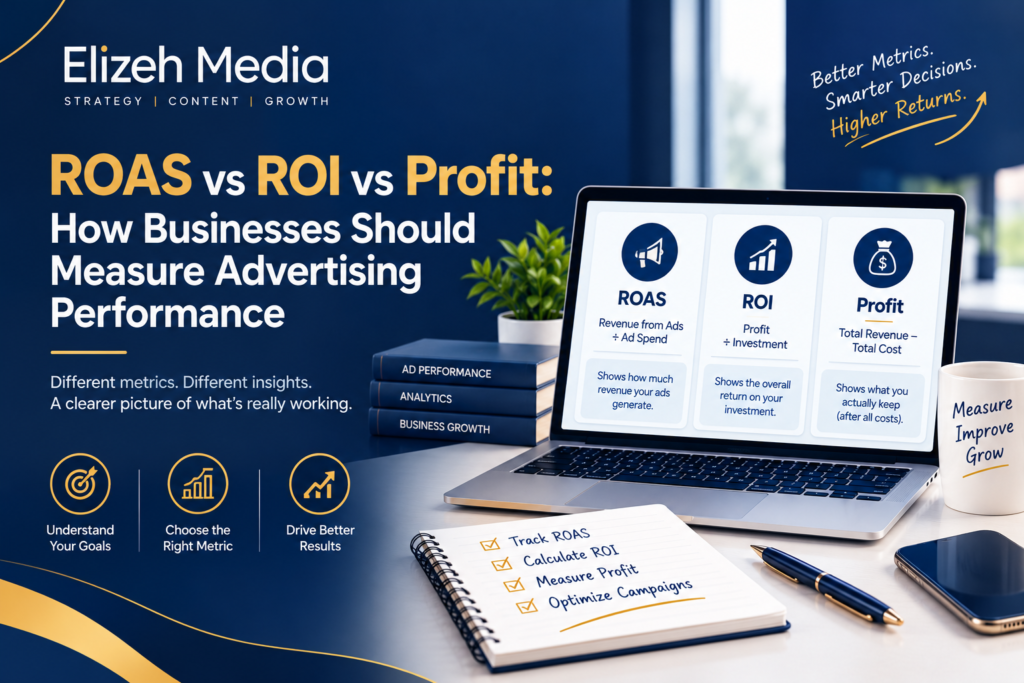
ROAS shows how much revenue advertising generates compared with ad spend. ROI measures the return from an investment against its cost. Profit shows how much money remains after the relevant expenses are deducted.
Understanding these differences helps businesses make better marketing decisions.
Why These Metrics Matter
Imagine that your business spends ₹20,000 on Google Ads.
The campaign generates ₹1,00,000 in sales. At first, the result looks impressive.
However, you still need to consider other expenses.
These may include product costs, shipping, agency fees, employee salaries, payment processing charges, and discounts.
After accounting for these expenses, the actual profit may be much lower than expected.
A campaign can generate strong revenue without delivering strong profit.
Therefore, businesses should measure advertising performance using more than one metric.
What Is ROAS (Return on Ad Spend)?
Return on Ad Spend, commonly called ROAS, measures how much revenue a business generates for every rupee spent on advertising.
It is one of the most widely used metrics for evaluating paid advertising campaigns.
Businesses often use ROAS to assess the performance of Google Ads, Meta Ads, and other paid marketing channels.
The calculation is simple. Divide the revenue attributed to advertising by the amount spent on ads.
How to Calculate ROAS
The formula is:
ROAS = Advertising Revenue ÷ Advertising Spend
For example, suppose a business spends ₹10,000 on a Google Ads campaign and generates ₹50,000 in attributed revenue.
The calculation is:
ROAS = ₹50,000 ÷ ₹10,000
ROAS = 5x
This means the campaign generated ₹5 in attributed revenue for every ₹1 spent on advertising.
Businesses may also express this result as 500%.
However, a 5x ROAS does not mean the business earned ₹5 in profit for every ₹1 spent. It measures revenue, not profit.
Understanding ROAS With a Practical Example
Consider an online clothing store that runs a Meta Ads campaign.
The business records the following results:
| Metric | Amount |
|---|---|
| Advertising spend | ₹15,000 |
| Revenue attributed to ads | ₹75,000 |
| ROAS | 5x |
The campaign generated five times its advertising cost in revenue.
At first glance, this looks like a strong result.
However, the business must still pay for the clothes sold, packaging, delivery, and other operating expenses.
For this reason, ROAS should be viewed as an advertising performance metric rather than a complete measure of business success.
What Is a Good ROAS?
There is no single ROAS target that works for every business.
A profitable target depends on several factors, including product margins, operating costs, average order value, and customer acquisition costs.
For example, a business with high profit margins may remain profitable at a lower ROAS.
In contrast, a business with thin margins may need a much higher ROAS to cover its expenses.
Therefore, businesses should calculate their own break-even point before setting campaign targets.
Why ROAS Alone Is Not Enough
ROAS helps businesses understand how efficiently advertising generates revenue.
However, it does not account for every cost involved in making a sale.
A campaign can report a high ROAS while the business struggles to make money.
Similarly, a campaign with a lower ROAS may still be valuable if it attracts profitable customers who make repeat purchases.
The key is to understand ROAS in the context of your business costs and goals.
Once you know how much revenue your ads generate, the next step is to measure the return on your overall investment.
That is where ROI becomes important.
What Is ROI (Return on Investment) in Advertising?
Return on Investment, or ROI, measures how much return a business earns compared with the money it invests.
While ROAS focuses on revenue generated by advertising, ROI considers the costs and returns included in the investment calculation. This makes ROI useful for understanding whether a marketing investment creates financial value.
Businesses can use ROI to evaluate advertising campaigns, marketing strategies, and other business investments.
For example, a company may generate ₹1,00,000 in revenue from paid ads. However, that revenue alone does not reveal whether the campaign was profitable.
The company must also consider the costs involved in generating those sales.
ROI helps businesses evaluate returns in relation to the investment costs they choose to measure.
How to Calculate Advertising ROI
A common ROI formula is:
ROI = (Return − Investment Cost) ÷ Investment Cost × 100
The result is expressed as a percentage.
For advertising, the exact calculation depends on how the business defines its return and which costs it includes. If you want to measure profit from an advertising campaign, you should account for the relevant expenses rather than treating all sales revenue as profit.
Let’s look at an example.
Suppose a business spends ₹20,000 on advertising. After accounting for the relevant costs, the campaign produces ₹30,000 in profit attributable to the investment.
The calculation is:
ROI = (₹30,000 ÷ ₹20,000) × 100
ROI = 150%
This means the measured return is 150% of the investment cost.
However, businesses must define their calculations consistently. If one report includes only advertising spend while another includes product costs, agency fees, and other expenses, their ROI figures will not be directly comparable.
Why Advertising ROI Matters
ROI helps business owners understand whether their marketing investments are delivering worthwhile financial returns.
It can also support better decisions about budgets, channels, and campaign priorities.
Here are three important benefits.
1. It supports better budget decisions
Businesses can compare the returns from different marketing investments. As a result, they can make more informed decisions about where to allocate their budgets.
2. It highlights the importance of costs
A campaign may generate substantial revenue but still produce a weak financial return. ROI encourages businesses to consider investment costs alongside the results.
3. It connects marketing with business goals
Marketing teams need to show how their activities support wider business objectives. ROI helps connect campaign performance with financial outcomes.
However, ROI is only useful when the calculation reflects the business question being asked. A short-term advertising ROI calculation, for example, may not capture the full value of customers who make repeat purchases.
ROAS vs ROI: Understanding the Difference
ROAS and ROI are closely related, but they answer different questions.
ROAS measures the revenue generated for each rupee spent on advertising. ROI measures the return earned relative to the investment cost.
This distinction matters because revenue and profit are not the same.
Consider a business that spends ₹20,000 on advertising and generates ₹1,00,000 in attributed revenue.
Its ROAS is 5x. In other words, the campaign generated ₹5 in revenue for every ₹1 spent on ads.
However, the business may also have product costs, delivery expenses, agency fees, and other operating costs. These expenses affect the financial return.
The following table highlights the key differences.
| Comparison | ROAS | ROI |
|---|---|---|
| Full form | Return on Ad Spend | Return on Investment |
| Main purpose | Measures revenue generated by advertising | Measures return relative to investment cost |
| Typical calculation | Ad-attributed revenue ÷ ad spend | (Return − investment cost) ÷ investment cost × 100 |
| Common format | 3x, 5x, or 500% | Percentage, such as 25% or 150% |
| Cost consideration | Usually focuses on ad spend | Depends on the costs included |
| Best used for | Comparing advertising revenue efficiency | Evaluating financial returns from an investment |
| Main limitation | Does not show actual profit | Can be misleading if costs or returns are defined inconsistently |
Can a Campaign Have High ROAS but Low ROI?
Yes. This can happen when a campaign generates substantial revenue but the business has high costs.
For example, an online store may achieve a 4x ROAS. However, its product costs, shipping expenses, discounts, and advertising fees may consume most of the revenue.
Consequently, the campaign may produce only a small return after expenses.
A different business with higher product margins might achieve a lower ROAS and still earn a better return.
Therefore, businesses should not compare campaigns using ROAS alone. They should also evaluate costs and financial outcomes.
Which Metric Should You Use?
The right metric depends on the question you want to answer.
- Use ROAS to understand how much revenue your ads generate compared with ad spend.
- Use ROI to evaluate the financial return from an investment, using clearly defined costs and returns.
- Use profit to understand how much money remains after the relevant expenses are deducted.
For a complete picture, businesses should review all three measures rather than relying on a single number.
Common Mistakes When Measuring ROI
Even experienced marketers can misinterpret advertising results. In many cases, the problem is not the formula itself but the information used in the calculation.
Avoiding the following mistakes can help businesses make more reliable decisions.
1. Treating Revenue as Profit
Revenue represents the money generated from sales. Profit is what remains after the relevant costs are deducted.
For example, a campaign may generate ₹1,00,000 in sales. However, the business still needs to account for the cost of the products sold and other expenses.
Therefore, revenue should not automatically be treated as the return earned in an ROI calculation.
2. Ignoring Costs Beyond Advertising Spend
Advertising is only one part of the cost of generating a sale.
Depending on the business, other expenses may include:
- Product manufacturing or purchase costs
- Packaging and shipping
- Payment processing charges
- Agency or freelancer fees
- Discounts and refunds
- Marketing tools and software
If these expenses are relevant to the decision, leaving them out may create an overly positive picture of campaign performance.
3. Comparing Different ROI Calculations
Two campaigns may appear to have different ROI figures because their calculations use different costs or return definitions.
For a fair comparison, use consistent measurement rules.
For example, include the same categories of costs when comparing similar campaigns. Also, make sure the measurement periods are comparable.
4. Ignoring the Customer Journey
Customers do not always purchase immediately after seeing an advertisement.
Some may click an ad, visit the website, compare products, and return several days later to complete a purchase. Others may discover the business through one channel and convert through another.
As a result, the reported return can vary depending on attribution settings and tracking methods.
Businesses should understand these limitations before deciding that one campaign performed better than another.
5. Making Decisions From Short-Term Results Alone
A campaign may need time to gather enough data for a meaningful evaluation. In addition, some businesses generate value through repeat purchases and long-term customer relationships.
This does not mean every campaign should continue without results. Instead, businesses should assess performance over an appropriate period and consider both immediate returns and longer-term value.
The goal is to measure advertising performance consistently, account for relevant costs, and make decisions based on reliable data.
In the next section, we will look at profit, why it matters more than revenue alone, and how businesses can compare ROAS, ROI, and profit using a practical example.
What Is Profit in Advertising?
Profit is the money a business has left after deducting its costs from the revenue it earns. When measuring advertising performance, profit helps businesses understand whether their campaigns contribute to financial growth.
ROAS shows how much revenue advertising generates. ROI measures the return compared with an investment cost. Profit reveals how much money remains after the relevant expenses are deducted.
This distinction is important because high advertising revenue does not always lead to high profit.
For example, an online clothing store may generate ₹2,00,000 in sales through paid ads. However, the business must still pay for inventory, packaging, shipping, payment processing, and advertising.
Once these costs are accounted for, the amount left may be much smaller than the original revenue.
Therefore, businesses should evaluate advertising performance based on both revenue and profitability.
How to Calculate Profit From Advertising
The basic profit formula is:
Profit = Revenue − Total Costs
For advertising analysis, businesses need to define which costs they want to include.
These costs may include advertising spend, product costs, shipping, agency fees, payment processing charges, and other expenses directly related to the sales generated.
Consider the following example:
| Business Metric | Amount |
|---|---|
| Revenue attributed to advertising | ₹1,00,000 |
| Product costs | ₹40,000 |
| Shipping and packaging | ₹8,000 |
| Advertising spend | ₹20,000 |
| Payment processing and other included costs | ₹5,000 |
| Profit after listed costs | ₹27,000 |
In this example, the campaign generated ₹1,00,000 in attributed revenue. However, after deducting the listed costs, ₹27,000 remains.
This is the profit after the costs included in the example. It should not automatically be treated as the company’s final net profit because other business expenses, taxes, or overheads may still need to be deducted.
The example also assumes that the listed revenue and costs relate to the same sales and measurement period.
Why Profit Is More Important Than Revenue Alone
Revenue helps businesses understand how much money their sales generate. However, it does not show how much money the business keeps.
Profit adds another layer to the analysis.
For example, two campaigns might each generate ₹1,00,000 in revenue. Yet one may have much higher product costs or advertising expenses than the other.
As a result, the campaigns can deliver very different financial outcomes.
Businesses should therefore consider the following questions:
- How much revenue did the campaign generate?
- How much did the business spend to acquire those sales?
- What other costs were associated with those sales?
- How much profit remained after the included costs?
- Did the campaign attract customers who may purchase again?
These questions help marketers connect campaign performance with business results.
Gross Profit vs Contribution Profit vs Net Profit
Businesses may use different types of profit when evaluating advertising performance. Understanding the differences helps prevent misleading comparisons.
Gross profit is revenue minus the cost of goods sold. For an online store, this usually includes the direct cost of the products sold.
Contribution profit measures the revenue remaining after deducting the variable costs associated with sales. Depending on the business’s accounting method, these costs may include product costs, shipping, payment fees, and advertising spend.
Net profit is what remains after all applicable business expenses have been deducted, including overheads, interest, and taxes where relevant.
For advertising decisions, contribution profit can be particularly useful because it helps businesses understand how much sales activity contributes after variable costs.
However, the right measure depends on the decision being made. A campaign may appear profitable on a contribution basis but still fail to cover the company’s full operating expenses.
Always define the type of profit you are measuring before comparing advertising campaigns.
Revenue vs Profit: Why the Difference Matters
Revenue and profit are often discussed together, but they represent different business outcomes.
Revenue is the money generated from sales before costs are deducted. Profit is the amount remaining after the relevant costs are accounted for.
Confusing these two measures can lead businesses to increase advertising budgets based on sales figures that do not reflect their actual financial position.
A Simple Example
Imagine that two advertising campaigns each generate ₹1,00,000 in revenue.
Campaign A spends ₹20,000 on advertising and has relatively low product costs. Campaign B spends the same amount on advertising but sells products with lower margins.
Both campaigns generate the same revenue. However, Campaign A may deliver much higher profit.
This difference shows why revenue alone is not enough to determine which campaign performs better.
How Advertising Costs Affect Profitability
Advertising costs can influence profitability in several ways.
1. Higher ad spend can reduce profit
Increasing the advertising budget may generate more sales. However, if the additional sales do not cover the extra advertising and related costs, profit can fall.
2. Low-margin products need careful measurement
Businesses selling products with small profit margins may need stronger advertising efficiency to remain profitable.
For example, a store selling low-priced products may generate many orders but retain little money from each sale. In this situation, even a small increase in customer acquisition costs can affect profitability.
3. Discounts can reduce the money retained from sales
Promotional offers may encourage customers to purchase. However, discounts also reduce the revenue retained per order.
Therefore, businesses should measure campaign results after accounting for discounts and other relevant costs.
4. Returns and cancellations can change the final result
An advertising dashboard may initially report a purchase value that later changes because of refunds, cancellations, or returned products.
Where possible, businesses should reconcile advertising reports with actual sales and refund data.
Why Businesses Need a Profit-Based Advertising Strategy
A profit-based strategy focuses on sustainable growth rather than revenue alone.
Instead of asking only how many sales a campaign generates, businesses also examine the cost of acquiring customers and the money retained from those sales.
This approach can help businesses identify which products, audiences, and campaigns contribute most effectively to financial performance.
For example, a campaign with a lower ROAS may still be attractive if it promotes products with stronger margins. In contrast, a campaign with a high ROAS may be less valuable if its sales carry substantial costs.
The best decision depends on the business’s margins, operating costs, objectives, and measurement method.
ROAS vs ROI vs Profit: A Practical Example
Now that we understand the three metrics, let’s see how they work together.
Suppose an ecommerce business sells clothing through Google Ads. During one measurement period, it records the following results:
| Metric | Amount |
|---|---|
| Revenue attributed to advertising | ₹1,00,000 |
| Advertising spend | ₹20,000 |
| Product costs | ₹40,000 |
| Shipping and packaging | ₹8,000 |
| Payment processing and other included costs | ₹5,000 |
| Profit after listed costs | ₹27,000 |
These figures help the business evaluate advertising performance from three different perspectives.
Step 1: Calculate ROAS
ROAS measures revenue attributed to ads relative to advertising spend.
ROAS = Advertising Revenue ÷ Advertising Spend
ROAS = ₹1,00,000 ÷ ₹20,000
ROAS = 5x
The campaign generated ₹5 in attributed revenue for every ₹1 spent on advertising.
However, this figure does not account for the other costs in the table.
Step 2: Calculate ROI Using the Defined Profit Measure
For this example, assume the business defines its return as the ₹27,000 profit remaining after all the listed costs, including advertising spend.
To avoid counting advertising spend twice, calculate ROI using the profit remaining after the included costs and divide it by the advertising investment.
Advertising ROI = Profit After Included Costs ÷ Advertising Spend × 100
Advertising ROI = ₹27,000 ÷ ₹20,000 × 100
Advertising ROI = 135%
This is a simplified, profit-based advertising ROI measure using the costs defined in the example. It is not the only possible ROI convention. A business may use a different formula depending on whether it is measuring advertising alone, a broader marketing investment, or the full financial return of an activity.
The key is to state the formula clearly and use it consistently.
Step 3: Understand the Profit
After deducting the costs listed in the table, the business has ₹27,000 remaining.
That amount shows the profit after the included expenses. It is not necessarily the final net profit because the calculation may exclude overheads, salaries, taxes, or other business expenses.
Nevertheless, it gives the business a more useful view of the campaign than revenue alone.
What Does This Example Tell Us?
Each metric answers a different question.
| Metric | Result | What It Tells the Business |
|---|---|---|
| ROAS | 5x | How much attributed revenue the ads generated relative to ad spend |
| Advertising ROI | 135% | The defined profit return relative to the advertising investment |
| Profit after listed costs | ₹27,000 | How much money remains after the expenses included in the example |
Together, these metrics provide a more complete picture of campaign performance.
ROAS helps assess revenue efficiency. ROI connects the return with the investment cost. Profit shows the financial amount remaining after the included expenses.
The most effective advertising decisions come from understanding all three metrics together, not choosing a campaign based on one number alone.
Which Metric Should Businesses Focus On?
ROAS, ROI, and profit each provide valuable information about advertising performance. However, businesses should not depend on a single metric to make every marketing decision.
The right approach is to use these measures together.
ROAS helps you understand how efficiently your ads generate revenue. ROI helps you evaluate the return against an investment cost. Profit shows how much money remains after the relevant expenses are deducted.
For example, an ecommerce business may achieve a high ROAS but earn very little profit because its product costs are high. Meanwhile, a service-based business may generate fewer conversions but earn more from each new customer.
Therefore, the best metric depends on your business model, profit margins, and marketing goals.
When Should You Focus on ROAS?
ROAS is useful when you want to measure the revenue generated by paid advertising.
It can help you compare campaigns, ad groups, audiences, and products. In addition, it can highlight which campaigns generate more attributed revenue relative to their advertising costs.
Consider using ROAS when you want to:
- Compare the revenue efficiency of Google Ads campaigns.
- Evaluate the performance of Meta Ads campaigns.
- Identify products that generate strong advertising revenue.
- Monitor changes in campaign performance.
- Understand how efficiently your ad budget generates sales.
However, a high ROAS does not automatically mean a campaign is profitable. You should compare the result with your product margins and other relevant costs before increasing your budget.
When Should You Focus on ROI?
ROI is useful when you want to understand the financial return from an investment.
It can help business owners compare marketing investments and assess whether their spending supports wider business goals.
For example, a company may invest in paid advertising, content marketing, and SEO. Each channel has different costs and timelines.
A consistent ROI framework can help the company evaluate these investments more effectively.
Consider using ROI when you want to:
- Evaluate the financial return from a marketing investment.
- Compare investments using consistent cost definitions.
- Assess whether campaign returns justify the costs.
- Support decisions about future marketing budgets.
- Connect marketing performance with business objectives.
Keep in mind that ROI calculations can differ. Always define which returns and costs you include before comparing results.
When Should You Focus on Profit?
Profit becomes especially important when your main goal is sustainable business growth.
A campaign may generate many sales but leave little money after expenses. Therefore, businesses should understand how advertising affects their actual financial results.
Profit-based measurement is particularly useful for ecommerce stores, businesses with low product margins, and companies that operate with tight budgets.
Use profit analysis when you want to:
- Identify campaigns that contribute more financially.
- Understand whether advertising costs are sustainable.
- Evaluate the impact of discounts and product costs.
- Decide whether increasing ad spend makes financial sense.
- Protect profit margins while growing sales.
A campaign should not be judged only by how much revenue it generates. Businesses must also understand what remains after costs.
How to Measure Google Ads and Meta Ads Performance
Google Ads and Meta Ads can both generate valuable business results. However, their roles in the customer journey may differ.
Google Ads often reaches people who are actively searching for a product or service. Meta Ads can help businesses reach audiences based on interests, behaviours, and other targeting signals, while also building awareness and demand.
Because these platforms work differently, businesses should evaluate them using consistent financial measures and suitable campaign goals.
Measuring Google Ads Performance
Google Ads can help businesses attract search traffic, generate leads, and drive purchases.
For ecommerce campaigns, ROAS can show how much revenue is attributed to advertising spend. However, businesses should also review the cost of goods sold, shipping, refunds, and other relevant expenses.
For lead-generation campaigns, revenue may not occur immediately after a click. In that case, businesses should track qualified leads, conversion rates, and the percentage of leads that become paying customers.
For example, a campaign that generates 100 leads may appear successful. However, if only a small number of those leads become customers, the campaign may not deliver the expected financial return.
Therefore, businesses should connect Google Ads data with their actual sales outcomes wherever possible.
Measuring Meta Ads Performance
Meta Ads can support brand awareness, audience engagement, lead generation, and sales.
For ecommerce businesses, ROAS can help assess revenue attributed to campaigns promoting products. Nevertheless, the result should be evaluated alongside margins and other costs.
For service-based businesses, useful measures may include:
- Cost per lead
- Cost per qualified lead
- Lead-to-customer conversion rate
- Customer acquisition cost
- Revenue from acquired customers
- Profit generated from converted leads
These measures help businesses understand whether their advertising attracts valuable customers rather than simply generating clicks or enquiries.
Why You Should Compare Platforms Carefully
Google Ads and Meta Ads may report conversions using different attribution settings, reporting windows, and measurement methods.
As a result, the same purchase may sometimes appear in more than one platform’s reports.
To avoid overstating performance, businesses should use a consistent measurement approach and compare platform reports with their own sales or customer records.
The goal is not simply to find the platform with the highest reported ROAS. It is to identify which advertising activities contribute most effectively to business growth.
Common Mistakes When Measuring Advertising Performance
Even when businesses track ROAS, ROI, and profit, incorrect assumptions can lead to poor decisions.
Avoiding these common mistakes can make advertising reports more useful.
1. Treating a High ROAS as Guaranteed Profit
A high ROAS may look impressive, but it does not account for every expense.
For example, a business may generate ₹1,00,000 in attributed revenue from ₹20,000 in advertising spend. Although the campaign achieves 5x ROAS, product costs and other expenses can reduce the money retained.
Therefore, calculate the relevant costs before deciding whether the campaign is financially successful.
2. Ignoring Customer Acquisition Cost
Customer acquisition cost (CAC) measures the cost of acquiring a customer.
For a simple calculation, divide the relevant acquisition costs by the number of new customers acquired during the same period.
For example, if a business spends ₹30,000 to acquire 15 new customers, its acquisition cost is ₹2,000 per customer, assuming the ₹30,000 includes the costs defined for this calculation.
CAC is useful because revenue per customer alone does not show whether acquiring that customer was financially worthwhile.
Businesses should compare acquisition costs with customer margins and, where reliable data exists, the expected value of future purchases.
3. Using Inconsistent Measurement Periods
Comparing one campaign’s weekly results with another campaign’s monthly results can create misleading conclusions.
Similarly, advertising spend and sales revenue should relate to compatible measurement periods.
For better comparisons, use consistent reporting windows and account for delays between the first ad interaction and the final purchase.
4. Forgetting Refunds and Cancellations
Reported revenue may change after a customer cancels an order or requests a refund.
If advertising performance reports continue to count these transactions as successful sales, the results may overstate actual revenue.
Businesses should reconcile campaign reports with their order management, ecommerce, or accounting records.
5. Scaling Campaigns Too Quickly
A campaign may perform well with a small budget but produce different results after spending increases.
For example, increasing the budget may expand reach to less responsive audiences. As a result, acquisition costs can rise and ROAS can fall.
Instead of increasing spending based on one strong result, review performance over a suitable period and monitor the effect of budget changes.
6. Ignoring Tracking and Attribution
Accurate measurement depends on reliable tracking.
Missing conversion events, duplicate reporting, consent settings, and attribution differences can affect reported results.
Businesses should regularly check their conversion tracking and compare platform reports with actual sales data.
In addition, they should understand that attribution assigns credit according to a particular measurement method. It does not always prove that a specific ad caused the entire purchase.
A Practical Framework for Measuring Advertising Performance
Businesses do not need a complicated reporting system to begin measuring advertising performance effectively.
A clear framework can help them understand the results, identify problems, and make better budget decisions.
Step 1: Define Your Advertising Goal
Start by deciding what the campaign needs to achieve.
For example, an ecommerce campaign may focus on product sales. A local service business may want qualified enquiries, while a B2B company may prioritise sales opportunities.
Your primary goal determines which metrics deserve the most attention.
Step 2: Track Advertising Spend and Results
Record the amount spent on advertising and the results generated during the measurement period.
Depending on your business, these results may include sales revenue, completed purchases, qualified leads, or new customers.
Use suitable analytics and conversion tracking tools to collect the data.
Step 3: Calculate ROAS
For campaigns with measurable attributed revenue, divide advertising revenue by advertising spend.
This provides a straightforward view of revenue efficiency.
However, make sure the revenue figure is based on a clearly defined attribution method. Also, remember that ROAS does not measure profit.
Step 4: Calculate ROI Using Consistent Definitions
Identify the return and investment costs relevant to your business decision.
Then apply the same calculation method across the campaigns or investments you want to compare.
If you are using profit as the return measure, clearly state which expenses have already been deducted. This prevents costs from being counted twice.
Step 5: Measure Profitability
Include the relevant expenses associated with generating sales.
These may include product costs, shipping, discounts, advertising spend, agency fees, and other applicable expenses.
The result helps you understand how much money remains after the included costs.
For a complete business-level picture, account for the remaining overheads, taxes, and other expenses where appropriate.
Step 6: Review Customer Acquisition Cost
Calculate how much it costs to acquire a new customer.
Next, compare that cost with the contribution the customer generates for the business.
This step is particularly important for companies that rely on repeat purchases or long sales cycles.
Step 7: Review Performance Regularly
Set a reporting schedule that suits your business and campaign goals.
During each review, compare results with previous periods and examine changes in advertising spend, revenue, acquisition costs, and profit.
Also, investigate unusual results before making major decisions.
Step 8: Use the Findings to Improve Campaigns
Once you understand the results, decide what needs to change.
For example, you may need to improve landing pages, refine targeting, review product pricing, or reduce unnecessary costs.
You may also discover that certain products or customer groups generate stronger financial returns.
Use these findings to guide future advertising decisions rather than relying on clicks or revenue alone.
Frequently Asked Questions (FAQs)
1. What Is the Main Difference Between ROAS and ROI?
ROAS measures the revenue generated by advertising compared with ad spend. ROI measures the return from an investment relative to its cost.
ROAS focuses on advertising revenue efficiency, while ROI evaluates financial returns using a defined set of costs and returns.
2. Is a 5x ROAS Good?
A 5x ROAS means that advertising generated ₹5 in attributed revenue for every ₹1 spent on ads.
Whether this result is good depends on product margins, operating expenses, and other business costs. A 5x ROAS may be profitable for one business but insufficient for another.
3. Can ROAS Be High While Profit Is Low?
Yes. A campaign can generate substantial revenue while leaving little money after product costs, shipping, advertising fees, and other expenses.
That is why businesses should evaluate ROAS alongside profit and other relevant financial measures.
4. Should Businesses Focus on ROAS or ROI?
Businesses should choose the metric that answers their immediate question.
ROAS is useful for measuring advertising revenue efficiency. ROI helps evaluate returns against investment costs. For financial decision-making, profit analysis is also important.
Using these measures together provides a more complete picture.
5. How Do You Calculate Advertising Profit?
Start with the revenue generated from the relevant sales. Then subtract the expenses included in your calculation.
These may include product costs, advertising spend, shipping, payment fees, and other relevant expenses.
For accurate reporting, define which costs are included and distinguish campaign-level profit from the company’s final net profit.
6. Is ROAS the Same as Profit Margin?
No. ROAS measures attributed advertising revenue relative to advertising spend.
Profit margin measures profit as a percentage of revenue. The two metrics answer different questions and should not be used interchangeably.
7. Which Metrics Should Small Businesses Track?
Small businesses can start with a practical set of measures:
- Advertising spend
- Revenue or qualified leads
- ROAS, where revenue attribution is available
- Customer acquisition cost
- Profit or contribution profit
- Conversion rate
The exact selection depends on the business model and campaign objective.
Conclusion: Measure Advertising Success Beyond Revenue
ROAS, ROI, and profit help businesses understand advertising performance from different perspectives.
ROAS shows how efficiently advertising generates attributed revenue. ROI evaluates the return against an investment cost. Profit reveals how much money remains after the relevant expenses are deducted.
Each metric serves a different purpose. Therefore, businesses should avoid relying on one figure to judge the success of every campaign.
Instead, define clear goals, track conversions accurately, include relevant costs, and review results consistently.
For sustainable growth, the objective is not simply to generate more clicks or sales. It is to attract valuable customers, manage advertising costs, and improve financial outcomes over time.
When businesses connect advertising data with real financial results, they can make more confident decisions about where to invest, which campaigns to improve, and how to grow sustainably.