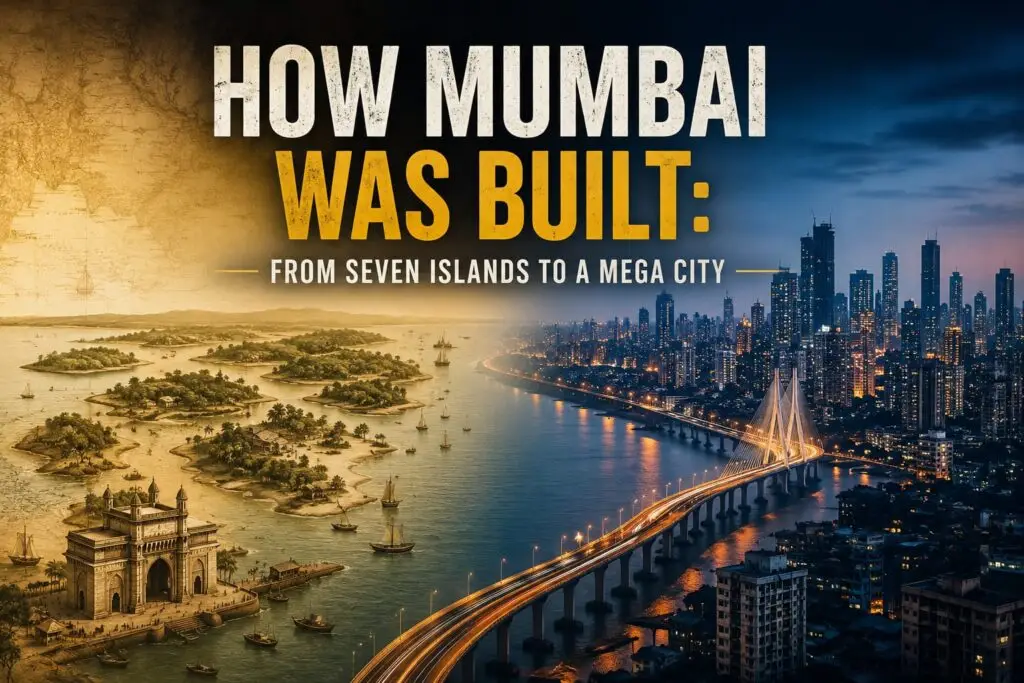
How Mumbai Was Built: From Seven Islands to a Mega City
The Remarkable Journey of Mumbai’s Transformation Mumbai is known today as India’s financial capital, home to millions of people and one of the busiest cities in the world. However, the city we know today did not always exist. Centuries ago, Mumbai was nothing more than a collection of seven small islands separated by creeks, marshes, and the Arabian Sea. Its transformation into a thriving metropolitan city is one of the greatest engineering and urban development stories in history. Introduction When people think of Mumbai, they often picture towering skyscrapers, the Gateway of India, Marine Drive, Bollywood, and a fast-paced lifestyle. Few realize that this global city was once made up of seven separate islands connected only by shallow waters and tidal marshes. The story of how Mumbai was built is a fascinating journey of geography, colonial rule, ambitious land reclamation projects, trade expansion, and rapid urban development. Over several centuries, these isolated islands were gradually connected to create the modern city that has become India’s commercial and financial powerhouse. In this guide, you’ll discover how Mumbai evolved from a group of small islands into one of the world’s largest mega cities, the people and projects that shaped its history, and the engineering achievements that continue to define its landscape today. What Were the Seven Islands of Mumbai? Island Historical Significance Bombay Island Commercial and administrative centre Colaba Military and coastal area Little Colaba Also known as Old Woman’s Island Mazagaon Historic fishing and trading settlement Mahim Ancient fishing village and fort Parel Textile mills and industrial growth Worli Coastal settlement with strategic importance Each island had its own villages, fishing communities, coconut plantations, and marshy landscapes. During high tide, large portions of land disappeared beneath the sea, making travel between the islands difficult and often dangerous. The early inhabitants of these islands were primarily the Koli fishing community, who depended on fishing and maritime trade for their livelihood. Even today, the Kolis remain an important part of Mumbai’s cultural heritage. Mumbai Before Colonial Rule Long before European powers arrived, the seven islands were ruled by several Indian dynasties. Historical records suggest that the islands came under the control of: During these periods, the islands were mainly occupied by small settlements, agricultural communities, and fishing villages. Although they were strategically located along important maritime trade routes, they had not yet developed into a major urban center. Trade with merchants from Arabia, Persia, and East Africa helped establish the region’s importance along the western coast of India. The Arrival of the Portuguese A major turning point in Mumbai’s history came in the early 16th century when the Portuguese arrived on India’s western coast. In 1534, the Sultan of Gujarat ceded the islands to Portugal through the Treaty of Bassein. The Portuguese named the region Bom Bahia, meaning “Good Bay,” because of its excellent natural harbor. During Portuguese rule, churches, forts, and settlements were built across the islands. They also encouraged agriculture and strengthened maritime trade, although the islands remained largely undeveloped compared to modern Mumbai. Many historic churches and Portuguese architectural influences can still be seen in parts of Mumbai today. How the British Acquired Mumbai Timeline of Mumbai’s Transformation Another significant chapter began in 1661, when the islands were transferred from Portugal to England as part of the marriage treaty between King Charles II of England and Catherine of Braganza, the Portuguese princess. Initially, the British Crown struggled to manage the islands effectively. Just a few years later, in 1668, King Charles II leased the islands to the British East India Company for an annual rent of only £10. This decision would completely transform the future of Mumbai. Recognizing the region’s strategic location and natural harbor, the British East India Company began investing in trade, infrastructure, and urban development. Their long-term vision laid the foundation for the city that would eventually become India’s financial capital. Why the Seven Islands Needed to Be Connected Although Mumbai possessed one of the finest natural harbors in the world, the seven islands remained physically separated by tidal creeks, mudflats, and marshes. During high tide: To unlock the city’s full economic potential, engineers and administrators realized that the islands needed to be connected through ambitious land reclamation projects. This vision marked the beginning of one of the largest urban engineering transformations in Indian history. The Hornby Vellard Project: The Beginning of Mumbai’s Transformation One of the most important milestones in Mumbai’s history was the Hornby Vellard Project. In the late 18th century, Governor William Hornby proposed an ambitious plan to connect the seven islands by constructing embankments across the tidal creeks. At that time, seawater regularly flooded low-lying areas during high tide, making travel difficult and limiting urban development. The Hornby Vellard Project aimed to block seawater from entering these marshy regions and reclaim land for roads, buildings, and public infrastructure. Although the project faced financial and engineering challenges, it became the foundation for Mumbai’s future expansion. It demonstrated that large-scale land reclamation was possible and encouraged further development across the islands. Land Reclamation: Turning Sea into Land Mumbai’s growth is one of the world’s most remarkable examples of land reclamation. Instead of expanding outward naturally, engineers gradually reclaimed land from the Arabian Sea to connect the islands and create space for development. Large quantities of soil, rocks, and construction material were used to fill creeks and marshlands. Over several decades, separate islands slowly merged into a single landmass. This engineering achievement allowed the construction of: Without land reclamation, modern Mumbai would not exist in its present form. The Rise of Bombay Port Mumbai’s natural harbour played a major role in its transformation into an international trading centre. During British rule, Bombay Port became one of the busiest ports in Asia. Ships carrying cotton, spices, textiles, tea, and other goods connected India with Europe, Africa, and the Middle East. The growth of maritime trade encouraged investment in: As trade increased, Bombay attracted merchants, entrepreneurs, and skilled workers from different parts of India and abroad. Railways
How Mumbai Was Built: From Seven Islands to a Mega City Read More »
Digital Marketing