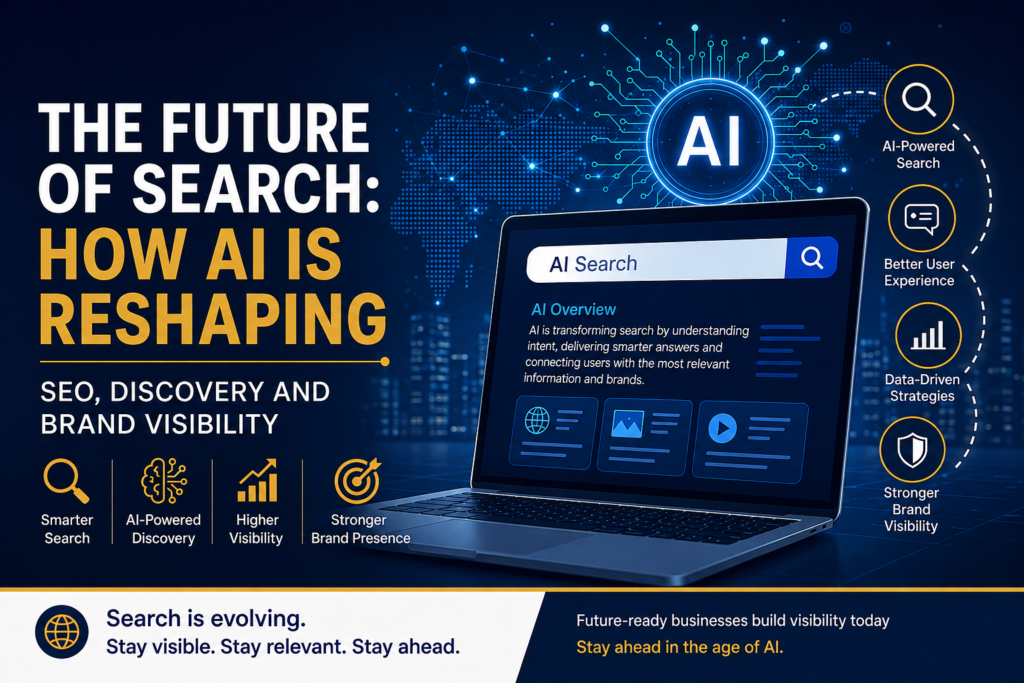
The Future of Search: How AI Is Reshaping SEO, Discovery and Brand Visibility
Search Is Changing, and Businesses Need to Change With It Search is no longer limited to typing a few keywords into Google and choosing a website from a list of blue links. AI is changing how people discover information, compare options, ask questions, and find businesses online. Introduction Search engines have continuously evolved as technology and user behaviour have changed. Today, artificial intelligence is accelerating that evolution by changing how search queries are understood, how information is presented, and how users discover brands. People are increasingly using conversational queries, asking detailed questions, and expecting direct answers rather than simply browsing through multiple websites. At the same time, AI-powered search experiences are becoming more capable of understanding context, intent, entities, and relationships between different pieces of information. For businesses, this creates both opportunities and challenges. Traditional SEO principles such as keyword relevance, quality content, technical optimization, and authority remain important. However, businesses now also need to think about how their brand and content can be discovered across increasingly AI-driven search experiences. The future of search is therefore not simply about ranking for keywords. It is about becoming a trusted, relevant, and recognizable source of information that search engines and AI systems can understand and confidently surface to users. How Search Is Changing in the Age of AI Artificial intelligence is changing the relationship between users and search engines. Traditional search usually required users to enter a query, review several results, visit websites, and collect information from different sources. AI-powered search can make this process more conversational by helping users explore a topic through questions, follow-up queries, summaries, comparisons, and recommendations. For example, instead of searching separately for: A user may ask a more detailed question such as: “What SEO strategy would be suitable for a small local business with a limited marketing budget?” This type of search contains more context and intent. AI systems can analyze that context and provide a response that attempts to address multiple aspects of the user’s question. Search Intent Is Becoming More Important Keyword matching has always been an important part of SEO, but understanding search intent is becoming even more valuable. Search intent refers to what a person actually wants when they enter a query. Someone searching for “what is SEO” is looking for information. Someone searching for “SEO agency in Mumbai” may be looking for a service provider. Someone searching for “best SEO tools” may be comparing different options. As AI becomes better at interpreting natural language, businesses need to create content that answers the underlying need behind a search rather than simply repeating a specific keyword. From Traditional Search to AI-Powered Discovery The way people discover brands is expanding beyond traditional search results. A potential customer may encounter a business through: This means brand discovery is becoming broader than search engine rankings alone. A business can benefit when its name, expertise, products, services, and information are consistently represented across trustworthy digital sources. Why Brand Recognition Matters When users repeatedly encounter the same brand across different channels, that brand can become more familiar and recognizable. For example, someone might first discover a company through a Google search, later see its content on LinkedIn, read a review, and eventually visit its website. Each interaction contributes to the overall customer journey. Therefore, businesses should think beyond individual keywords and focus on building a consistent digital presence. What AI Search Means for SEO Artificial intelligence does not mean that traditional SEO is no longer relevant. Instead, it is changing how search engines interpret and organize information. Search engines still need to understand websites, pages, topics, businesses, and relationships between different pieces of information. This makes strong SEO fundamentals important even as search experiences become more AI-driven. Quality Content Still Matters AI-powered search experiences rely on information from online sources. Businesses should therefore focus on creating content that is accurate, useful, original, and genuinely relevant to their audience. Instead of creating articles simply to include keywords, focus on answering real questions and providing information that readers can use. Useful content can include: Context Is More Important Than Keyword Repetition Older approaches to SEO often focused heavily on repeating exact keywords throughout a page. Modern search requires a broader approach. For example, an article targeting “local SEO” can naturally discuss: These related concepts help establish the overall subject of the content. The goal should be to demonstrate expertise around a topic rather than repeatedly inserting the same phrase. The Rise of AI Overviews and Answer-Based Search Search experiences are increasingly capable of providing summaries and direct answers to complex questions. Instead of requiring users to open multiple pages immediately, an AI-generated response may summarize information and provide sources for further exploration. This creates a new consideration for businesses: visibility may happen inside an answer as well as through a traditional search result. A page can therefore provide value even when the user does not immediately click through to the website. However, businesses should not assume that appearing in an AI-generated answer is guaranteed simply by adding more keywords. Strong topical relevance, useful information, clear website structure, authority, and trustworthy signals remain important. Why Brand Visibility Matters More Than Rankings Alone Search rankings remain important, but businesses should not measure their entire digital presence through rankings alone. Imagine a customer encounters your brand through: These interactions can all contribute to brand visibility. Build a Recognizable Digital Identity Your business information should be consistent across important online platforms. Pay attention to: Consistency helps users understand who your business is and what it offers. How AI Can Change Keyword Research Keyword research remains valuable, but businesses may need to think beyond short phrases. Users increasingly ask complete questions and conversational queries. For example, instead of searching: “SEO agency Mumbai” a user may ask: “Which SEO services can help a small business in Mumbai get more local customers?” Both searches have a similar underlying topic, but the second provides much more context. Focus on Topics and Questions A stronger keyword strategy can
The Future of Search: How AI Is Reshaping SEO, Discovery and Brand Visibility Read More »