
Introduction
In today’s fast-paced world, almost everything has moved online. People shop online, search for information online, connect with friends online, and even make major life decisions based on what they discover on the internet. This fundamental shift in human behaviour has created an entirely new universe of opportunity for businesses — and that universe is called digital marketing.
If you have heard the term digital marketing but are not entirely sure what it means, how it works, or why it matters, you are in exactly the right place. This comprehensive beginner’s guide will walk you through everything you need to know about digital marketing — from its basic definition to its various components, how it works in practice, and why it has become absolutely essential for businesses of every size and type in today’s world.
By the time you finish reading this guide, you will have a solid foundational understanding of digital marketing that will serve you well whether you are a business owner looking to grow your company online, a student exploring career possibilities, or simply someone curious about how the digital world around you actually works.
What Is Digital Marketing?
At its most fundamental level, digital marketing refers to any form of marketing that takes place through digital channels — meaning the internet, electronic devices, and online platforms. It is the practice of promoting products, services, brands, or ideas to target audiences using digital technologies and online platforms.
Think of it this way. Traditional marketing involves reaching potential customers through physical and offline channels — newspaper advertisements, television commercials, radio spots, billboards, printed flyers, and direct mail campaigns. Digital marketing, by contrast, reaches those same potential customers through digital channels — websites, search engines, social media platforms, email, mobile applications, online videos, and more.
The distinction might sound simple, but its implications are profound. Digital marketing is not just a different medium for delivering the same messages — it is an entirely different approach to marketing that offers capabilities and advantages that traditional marketing simply cannot match.
Why Is Digital Marketing So Important?
Before diving into the various types and components of digital marketing, it is worth taking a moment to understand why it has become so critically important in today’s business environment.
The World Has Gone Digital
Consider how you spend your own time each day. You probably wake up and check your phone. You search Google when you have a question. You scroll through Instagram or Facebook during your commute. You watch YouTube videos in the evening. You shop on Amazon or Flipkart when you need something. You read news articles on your phone or laptop rather than picking up a physical newspaper.
This pattern is not unique to you — it describes the daily behavior of billions of people around the world. According to global internet statistics, there are now more than five billion internet users worldwide, and the average person spends approximately six to seven hours online every single day. In India alone, there are over eight hundred million internet users, and this number continues to grow rapidly as smartphone prices fall and internet connectivity improves across the country.
For businesses, this massive shift in where people spend their time has a clear and unavoidable implication — if you want to reach your customers, you need to be present where they are. And increasingly, they are online.
Digital Marketing Is Measurable
One of the most significant advantages of digital marketing over traditional marketing is the ability to measure results with extraordinary precision. When a business places an advertisement in a newspaper or puts up a billboard, it is extremely difficult to know exactly how many people saw that advertisement, how many of them were genuinely interested in the product, and how many actually made a purchase as a result.
Digital marketing eliminates this uncertainty entirely. Every digital marketing activity generates detailed data that marketers can analyze to understand exactly what is working and what is not. You can see precisely how many people visited your website, which pages they looked at, how long they spent on each page, and whether they ultimately made a purchase or took another desired action. This measurability allows businesses to make informed decisions about where to invest their marketing budgets and how to continuously improve their marketing performance.
It Is Accessible to Businesses of All Sizes
Perhaps most importantly for small businesses and startups, digital marketing is accessible in a way that traditional marketing never was. Running a television commercial or placing a full-page advertisement in a major newspaper requires a substantial budget that many small businesses simply do not have. Digital marketing, by contrast, can be started with almost any budget. A small business can create a free social media profile, publish valuable content, engage with potential customers, and begin building an online following without spending a single rupee on advertising.
As the business grows and the marketing budget expands, digital marketing scales beautifully — more sophisticated campaigns, paid advertising, professional content creation, and advanced analytics tools can be layered in progressively. This scalability makes digital marketing the great equalizer of the business world, giving small businesses the ability to compete with much larger competitors in ways that were simply not possible before the internet era.
The Main Types of Digital Marketing
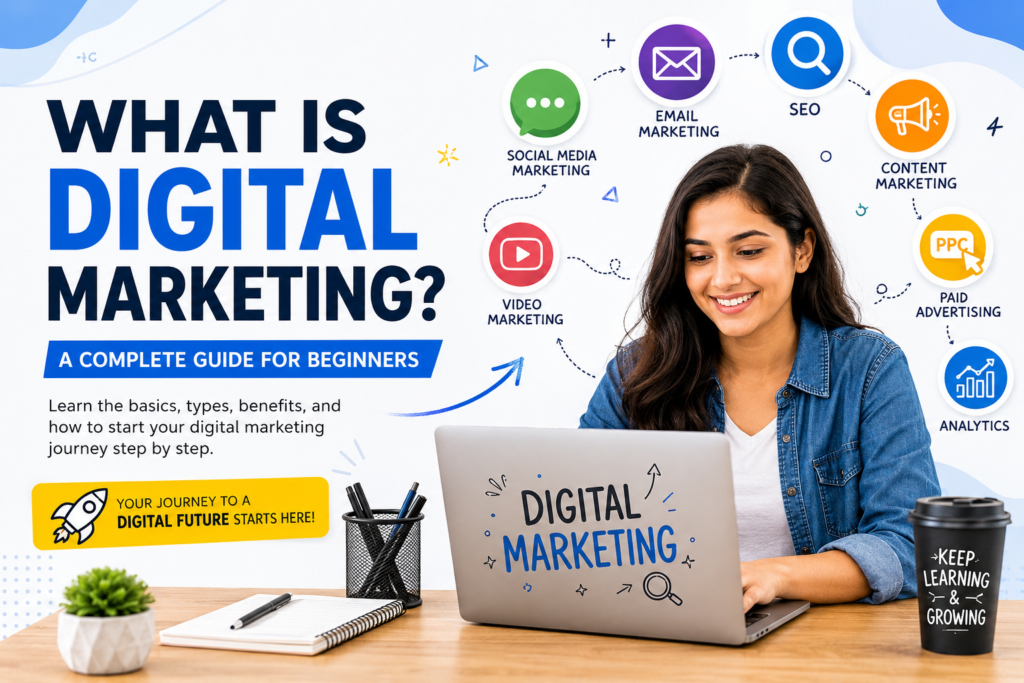
Digital marketing is not a single activity — it is an umbrella term that encompasses a wide range of distinct disciplines and channels. Here is a comprehensive overview of the main types of digital marketing and what each one involves.
Search Engine Optimization — SEO
Search engine optimization, universally known as SEO, is the practice of optimizing a website so that it appears as high as possible in the results that search engines like Google display when someone searches for relevant terms. When you type a query into Google, the results that appear on the first page are there because they have been optimized to signal to Google that they are the most relevant and valuable results for that particular search.
SEO involves a wide range of activities, including researching the specific words and phrases that your target audience uses when searching for products or services like yours, incorporating those keywords naturally throughout your website content, ensuring that your website is technically well-structured and fast-loading, and building credibility through links from other reputable websites.
The ultimate goal of SEO is to drive organic traffic to your website — meaning visitors who find you through search engines without you having to pay for each visit. This organic traffic is extremely valuable because it tends to be highly relevant — people who find your website through a Google search were actively looking for exactly what you offer.
Social Media Marketing
Social media marketing involves using platforms like Instagram, Facebook, LinkedIn, Twitter, YouTube, and others to build brand awareness, engage with audiences, and drive business results. With billions of active users across these platforms, social media represents one of the most powerful channels available to marketers today.
Effective social media marketing involves more than simply posting content regularly. It requires a deep understanding of each platform’s unique characteristics and audience, a consistent content strategy that delivers genuine value to followers, active community management and engagement, and increasingly, a sophisticated understanding of each platform’s algorithm — the system that determines which content gets shown to which users.
Social media marketing can serve many different business objectives — building brand awareness among new audiences, deepening engagement with existing customers, driving traffic to a website, generating leads, or directly selling products through social commerce features. The most effective social media strategies are those that clearly define their objectives and build their approach around achieving specific, measurable goals.
Pay Per Click Advertising — PPC
Pay per click advertising, commonly abbreviated as PPC, refers to a model of digital advertising where advertisers pay a fee each time someone clicks on their advertisement. Google Ads is the most well-known PPC platform, allowing businesses to display advertisements in Google’s search results for specific keywords. Meta Ads, which covers advertising on Facebook and Instagram, is another major PPC platform.
PPC advertising offers businesses the ability to reach highly targeted audiences with great precision. Advertisers can define exactly who they want their advertisements to reach based on factors including location, age, gender, interests, online behavior, and much more. This targeting capability means that every rupee spent on PPC advertising is directed toward people who are genuinely likely to be interested in what the business offers, maximizing the efficiency of the advertising spend.
Unlike SEO, which builds results gradually over time, PPC advertising can generate immediate visibility and traffic. This makes it particularly useful for new businesses that have not yet established organic search rankings, for time-sensitive promotions and campaigns, and for testing marketing messages before investing in longer-term content strategies.
Content Marketing
Content marketing is the practice of creating and distributing valuable, relevant, and consistently published content to attract and retain a clearly defined target audience. Rather than directly promoting products or services, content marketing focuses on providing genuinely useful information that helps the target audience solve problems, answer questions, or achieve goals.
Blog articles, videos, podcasts, infographics, ebooks, case studies, and webinars are all common forms of content marketing. The underlying principle is straightforward — when a business consistently provides valuable information that helps its target audience, it builds trust and credibility over time. When those audience members are eventually ready to make a purchase, they are far more likely to choose the business that has demonstrated its expertise and earned their trust through consistently valuable content.
Content marketing also works powerfully in combination with SEO — well-written, genuinely valuable content naturally incorporates the keywords that target audiences search for, helping the business rank higher in search engine results while simultaneously building authority and trust.
Email Marketing
Email marketing involves sending targeted, personalized messages directly to a list of people who have expressed interest in receiving communications from a business. Despite being one of the oldest forms of digital marketing, email remains extraordinarily effective — research consistently shows that email marketing delivers among the highest returns on investment of any digital marketing channel.
The power of email marketing lies in the directness and personalization it enables. Unlike social media, where a business’s content competes with countless other posts for attention in a user’s feed, an email lands directly in the recipient’s inbox. And because the people on a business’s email list have actively chosen to receive those communications, they tend to be among the most engaged and valuable segments of the business’s audience.
Effective email marketing involves building a quality email list, segmenting that list based on subscriber characteristics and behaviors, crafting compelling and personalized email content, and continuously analyzing campaign performance to optimize open rates, click-through rates, and conversions.
Influencer Marketing
Influencer marketing involves partnering with individuals who have established credibility and significant followings on social media platforms to promote a brand’s products or services. The fundamental premise of influencer marketing is that audiences trust recommendations from people they follow and admire far more than they trust traditional advertising.
Influencer marketing has grown into a major industry in India, with influencers across every niche — from fashion and beauty to technology, travel, food, fitness, and business — building large and engaged audiences that brands are eager to reach. The most effective influencer partnerships are those where the influencer’s content, values, and audience align naturally with the brand being promoted, creating authentic endorsements that resonate genuinely with the target audience.
Video Marketing
Video has emerged as one of the most powerful and engaging content formats in digital marketing. Platforms like YouTube, Instagram Reels, and Facebook Watch have made video content consumption a central part of how people engage with digital content daily. Businesses that invest in video marketing benefit from higher engagement rates, stronger emotional connections with audiences, and greater content shareability compared to text or image-based content.
Video marketing encompasses a wide range of content types — from educational how-to videos and product demonstrations to brand storytelling pieces, customer testimonials, live streams, and short-form Reels designed to capture attention quickly and drive immediate engagement.
How Digital Marketing Works Together
One of the most important things to understand about digital marketing is that its various components work most powerfully when they are integrated into a cohesive overall strategy. SEO drives organic traffic to a website, where compelling content converts visitors into email subscribers. Email marketing nurtures those subscribers and builds the relationship over time. Social media amplifies content reach and builds brand awareness among new audiences. Paid advertising accelerates results when immediate visibility is needed. Video content deepens engagement across multiple platforms simultaneously.
The businesses that achieve the greatest digital marketing success are those that take this integrated, holistic view — understanding how each component contributes to the overall customer journey and ensuring that all their digital marketing activities work together in a coordinated and complementary way.
Getting Started With Digital Marketing
If you are new to digital marketing and wondering where to begin, the most important first step is to clearly define your goals. What do you want digital marketing to help you achieve? More website visitors? More leads? More sales? A stronger brand presence in your market? Clearer goals make it far easier to determine which digital marketing channels and tactics to prioritize.
From there, start with the fundamentals — establish a professional website, create profiles on the social media platforms where your target audience is most active, and begin creating content that genuinely serves your audience’s needs and interests. As you build momentum and develop a clearer understanding of what works for your specific business and audience, you can progressively incorporate more sophisticated strategies and tools.
Digital marketing is ultimately a discipline of continuous learning and experimentation. The platforms, tools, and best practices are constantly evolving, and the most successful digital marketers are those who remain curious, stay current with industry developments, and are always willing to test new approaches in pursuit of better results.
Conclusion
Digital marketing has fundamentally transformed the relationship between businesses and their customers. It has created new channels for connection, new tools for understanding audience behavior, and new opportunities for businesses of all sizes to compete and succeed in the marketplace. For anyone looking to build a career in marketing, grow a business, or simply understand how the modern commercial world operates, a solid grasp of digital marketing principles is not just useful — it is essential.
The journey into digital marketing begins with understanding its foundations — what it is, why it matters, and how its various components work together to create meaningful results. With the knowledge you have gained from this guide, you now have that foundation. The next step is simply to start exploring, experimenting, and building your own digital marketing experience.