
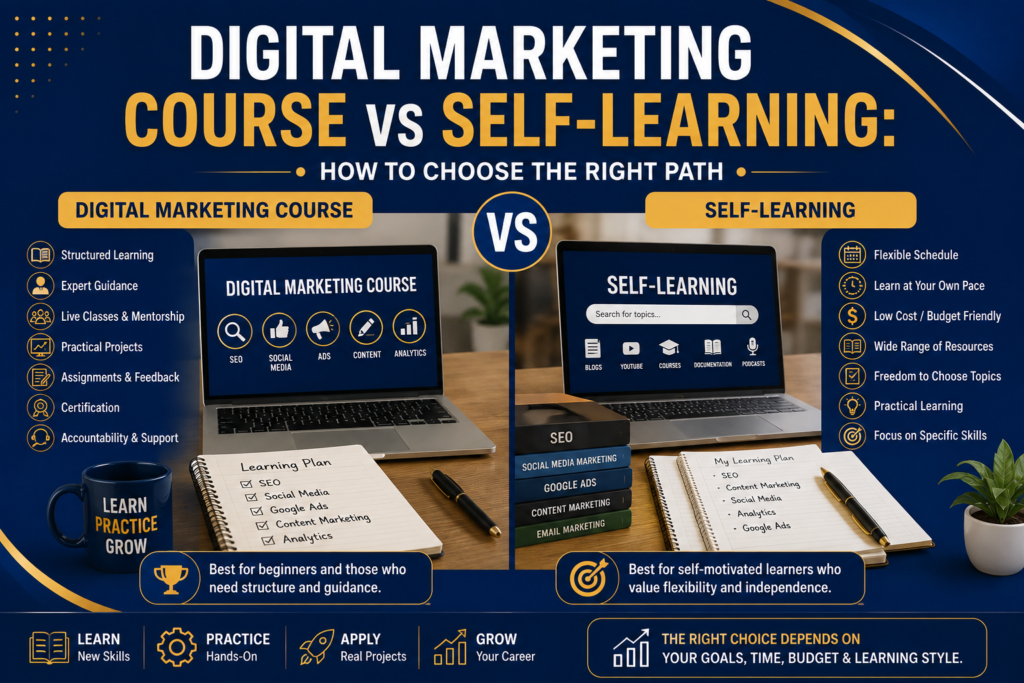
Choosing the Right Way to Learn Digital Marketing
Digital marketing can be learned through a structured course or through independent self-learning. Understanding the advantages of both approaches can help you choose the learning path that best matches your goals, budget, time, and preferred learning style.
Introduction
Digital marketing has become an important skill for businesses, entrepreneurs, freelancers, and professionals looking to build a strong online presence. As demand for digital marketing skills continues to grow, many people want to learn areas such as SEO, social media marketing, content marketing, Google Ads, email marketing, and analytics.
However, one important question often comes up: Should you take a digital marketing course or learn everything through self-study?
Both approaches have their advantages and limitations. A structured course can provide a clear learning path, expert guidance, practical assignments, and a defined curriculum. Self-learning, on the other hand, offers flexibility and allows you to choose what you want to study and when you want to study it.
The right choice depends on your personal goals, available time, budget, existing knowledge, and ability to stay consistent.
In this guide, we will compare digital marketing courses and self-learning in detail so you can make a more informed decision and choose the learning path that works best for you.
What Is Digital Marketing?
Digital marketing refers to promoting businesses, products, or services through digital channels. It combines different strategies to reach audiences, build brand awareness, generate leads, and increase conversions.
Important areas of digital marketing include:
- Search Engine Optimization (SEO)
- Social Media Marketing
- Google Ads and paid advertising
- Content Marketing
- Email Marketing
- Local SEO
- Website Marketing
- Affiliate Marketing
- Online Reputation Management
- Web Analytics
Because digital marketing covers many different areas, learning it effectively requires both theoretical knowledge and practical experience.
What Is a Digital Marketing Course?
A digital marketing course is a structured learning program designed to teach digital marketing concepts and skills through a planned curriculum.
Depending on the provider, a course may include:
- Video lessons
- Live classes
- Practical assignments
- Case studies
- Projects
- Quizzes
- Mentorship
- Industry tools
- Certification
Some courses focus on a specific area, such as SEO or social media marketing, while others provide a broader overview of digital marketing.
What Is Self-Learning in Digital Marketing?
Self-learning means acquiring digital marketing knowledge independently instead of following a formal course.
You can learn through:
- Blogs
- YouTube videos
- Official documentation
- Online tutorials
- Podcasts
- E-books
- Industry publications
- Free educational resources
- Practical experimentation
Self-learning gives you greater control over what you study and how quickly you progress.
Digital Marketing Course vs Self-Learning
Both learning methods can help you develop useful digital marketing skills, but they offer different experiences.
Structured Learning vs Flexible Learning
A course usually provides a predefined learning path. Topics are arranged in a logical order, which can make it easier to understand how different areas of digital marketing connect.
Self-learning provides much more flexibility. You can choose your own topics and move between subjects based on your interests.
For example, if your main goal is to learn SEO, you can focus heavily on keyword research, technical SEO, content optimization, and link building without spending as much time on areas that are less relevant to your immediate goals.
Expert Guidance vs Independent Research
One major advantage of a good digital marketing course is access to structured guidance.
An instructor or mentor may help explain difficult concepts, provide feedback, and suggest practical improvements.
With self-learning, you are responsible for finding reliable information and determining whether you have understood a topic correctly.
This independence can be valuable, but it also requires strong research and critical-thinking skills.
Curriculum vs Freedom of Choice
Courses generally follow a curriculum that determines what you learn and in what order.
Self-learning allows you to create your own curriculum.
For example, you might choose to study:
SEO → Content Marketing → Local SEO → Google Ads → Analytics
Another learner may choose:
Social Media Marketing → Instagram Marketing → Content Creation → Paid Social Advertising
This flexibility is useful when your learning goals are specific.
Compare the Cost of Learning
Cost is one of the biggest factors when deciding between a digital marketing course and self-learning.
A paid course may require an upfront investment or monthly subscription. The cost can vary depending on the course provider, duration, curriculum, instructor, mentorship, and certification.
Self-learning can be much more affordable because many high-quality educational resources are available for free. However, you may eventually choose to pay for premium tools, books, workshops, or specialized training.
The important question is not simply which option is cheaper, but which option provides the right value for your learning goals.
Consider Your Available Time
Your schedule can also influence the best learning method.
A structured course may provide a fixed timetable, particularly when it includes live classes. This can help people who need deadlines and regular study sessions.
Self-learning provides greater flexibility. You can study whenever you have time and adjust your learning speed according to your schedule.
For example, someone working full-time may prefer self-learning because they can study for an hour in the evening or during weekends.
Practical Experience Matters
Digital marketing is a practical field. Reading about SEO, advertising, analytics, or social media marketing is useful, but applying that knowledge is equally important.
A good course may include practical assignments and projects. These can help learners understand how digital marketing works in real situations.
Self-learners can also gain practical experience by creating their own projects.
For example, you could:
- Create a website or blog
- Optimize pages for SEO
- Build a social media account
- Create a content calendar
- Run a small advertising campaign
- Analyze website traffic
- Practice keyword research
- Improve a Google Business Profile
- Create email marketing campaigns
Practical experience can help turn theoretical knowledge into useful skills.
Certification: Does It Matter?
Some digital marketing courses provide certificates after completion.
A certificate can demonstrate that you completed a particular learning program, but it should not be considered a replacement for actual skills and practical experience.
Employers and clients may also want to know whether you can:
- Develop a marketing strategy
- Conduct keyword research
- Optimize content
- Analyze campaign performance
- Manage advertising campaigns
- Understand analytics
- Generate measurable results
Therefore, when choosing a course, consider the quality of the training and practical learning opportunities rather than choosing a program simply because it offers a certificate.
Mentorship and Feedback
Mentorship can be valuable when learning complex digital marketing concepts.
A mentor or instructor can help you:
- Understand difficult topics
- Identify mistakes
- Review your work
- Answer questions
- Suggest practical improvements
- Explain industry concepts
Self-learning generally does not provide this type of direct guidance. You may need to use communities, forums, professional networks, or other learners to get feedback.
Access to Learning Resources
Both learning methods can provide access to useful resources, but the experience is different.
A course may organize resources in one place, making it easier to follow a specific learning path.
Self-learning requires you to search for resources yourself. This gives you more freedom, but it also means you need to evaluate whether the information is accurate, current, and relevant.
When learning digital marketing independently, prioritize reliable sources such as official platform documentation, established industry publications, and reputable educational websites.
Learning at Your Own Pace
Self-learning is particularly useful for people who prefer complete control over their learning speed.
You can spend more time on difficult subjects and move quickly through topics you already understand.
For example, if you already understand social media marketing, you could spend more time learning technical SEO or Google Ads instead of repeating basic social media concepts.
A structured course may be less flexible, although many online courses allow learners to watch lessons at their own pace.
Advantages of a Digital Marketing Course
A well-designed digital marketing course can offer several benefits:
- Structured curriculum
- Clear learning path
- Expert instruction
- Practical assignments
- Mentorship
- Organized resources
- Deadlines and accountability
- Community support
- Potential certification
These benefits can be particularly useful for people who find it difficult to create and follow their own learning plan.
Advantages of Self-Learning
Self-learning also has several important benefits:
- Greater flexibility
- Lower initial cost
- Freedom to choose topics
- Personalized learning speed
- Access to many resources
- Opportunity to explore current trends
- Ability to focus on specific skills
It can also encourage independent research, which is valuable because digital marketing changes continuously.
Limitations of Digital Marketing Courses
Not every course provides the same level of value.
Potential limitations include:
- Course fees
- Fixed curriculum
- Outdated information
- Limited practical experience
- Variable instructor quality
- Additional costs for tools
- Limited individual feedback
Before enrolling, research the curriculum, instructor experience, practical components, reviews, and learning support.
Limitations of Self-Learning
Self-learning also comes with challenges.
These may include:
- Lack of structured guidance
- Information overload
- Difficulty choosing reliable resources
- No guaranteed feedback
- Lack of accountability
- Difficulty staying consistent
- Confusion about what to learn next
Without a clear plan, learners may jump between different topics without developing strong knowledge in any particular area.
Which Learning Method Offers Better Flexibility?
Self-learning generally offers greater flexibility.
You can choose your own schedule, resources, topics, and learning speed.
However, a self-directed approach requires discipline. If you frequently postpone your study sessions or struggle to organize your learning, a structured course may provide the accountability you need.
Which Option Is Better for Practical Skills?
Both can provide practical skills.
A course may provide projects and assignments as part of the curriculum, while self-learners can create their own projects and practice with real websites, social media accounts, or marketing campaigns.
The important factor is how much you practice, not simply how you learn the theory.
Key Takeaway
The choice between a digital marketing course and self-learning depends on your goals, budget, schedule, learning style, and ability to stay consistent.
A structured course can provide guidance and accountability, while self-learning provides flexibility and control. Neither approach is automatically better for everyone.
The most effective approach may even combine both methods: use structured training to build a foundation and continue learning independently to stay updated with new tools, platforms, and digital marketing trends.
How to Choose Between a Digital Marketing Course and Self-Learning
There is no single learning method that is right for everyone. The best option depends on your current knowledge, career goals, available time, budget, and preferred way of learning.
Before making a decision, consider the following factors.
Choose a Digital Marketing Course If You Need Structure
A structured course may be a good choice if you want someone to guide you through the learning process.
A course can help you understand:
- What to learn first
- Which topics to study next
- Which tools to practice
- How different marketing channels work together
- How to apply concepts through projects
This can reduce the time spent searching for resources and deciding what to study.
Choose Self-Learning If You Prefer Flexibility
Self-learning can be a better option if you want complete control over your schedule and learning materials.
You can choose:
- What topics to study
- Which resources to use
- How quickly to learn
- When to study
- Which skills to prioritize
This approach works particularly well for people who are comfortable researching information and creating their own learning plans.
Consider Your Budget
Your budget can strongly influence your decision.
A paid course may require a significant investment, especially if it includes live training, mentorship, projects, or advanced resources.
Self-learning can start with free resources, allowing you to build your knowledge without a large upfront cost.
However, free learning does not necessarily mean zero cost forever. You may eventually invest in books, premium courses, software, analytics tools, or advertising platforms for practical experience.
Think About Your Career Goal
Your career objective should influence what you learn and how you learn it.
If you want to work as an SEO specialist, for example, you may need deeper knowledge of:
- Keyword research
- Technical SEO
- On-page SEO
- Content optimization
- Link building
- Search analytics
If your goal is to become a social media marketer, you may focus more on:
- Content strategy
- Social media platforms
- Short-form video
- Community management
- Paid social advertising
- Social media analytics
You don’t necessarily need to master every area of digital marketing at the same time.
Build a Learning Roadmap
Whether you choose a course or self-learning, having a roadmap can make the process easier.
A possible learning sequence is:
Digital Marketing Fundamentals → SEO → Content Marketing → Social Media Marketing → Paid Advertising → Analytics → Practical Projects
Once you understand the fundamentals, you can specialize in the area that best matches your interests and career goals.
Combine Courses With Self-Learning
You don’t necessarily have to choose only one method.
A combination of structured learning and independent study can be highly effective.
For example, you could take a structured course to understand the fundamentals and then use self-learning to explore advanced topics, industry updates, tools, and practical case studies.
This approach gives you both structure and flexibility.
Learn From Reliable Sources
Digital marketing changes frequently. Search algorithms, advertising platforms, social media features, analytics tools, and content formats can change over time.
Therefore, learning should not stop after completing a course.
Use reliable sources such as:
- Official platform documentation
- Search engine resources
- Industry publications
- Reputable marketing blogs
- Professional case studies
- Practical experiments
Learning from current and trustworthy sources helps you avoid outdated strategies.
Practice With Real Projects
One of the best ways to develop digital marketing skills is to practice on real projects.
You could create a small website or blog and practice:
- Keyword research
- On-page SEO
- Content creation
- Internal linking
- Website analytics
- Social media promotion
You could also create a social media page for a personal project and experiment with content formats, audience engagement, and performance tracking.
Practical projects can help you understand how marketing strategies work outside a classroom or tutorial.
Build a Digital Marketing Portfolio
A portfolio can demonstrate your skills more effectively than simply listing completed courses.
Your portfolio could include:
- SEO projects
- Content samples
- Social media campaigns
- Google Ads examples
- Website optimization projects
- Analytics reports
- Case studies
- Marketing strategies
If you are looking for freelance clients or employment opportunities, a portfolio can help potential employers or clients understand what you can actually do.
Keep Learning After the Course
Completing a digital marketing course should not be considered the end of your education.
The industry continues to evolve, so professionals need to keep learning.
You may need to stay updated about:
- Search engine changes
- Social media updates
- Advertising features
- AI tools
- Analytics platforms
- Content trends
- Consumer behaviour
- New marketing technologies
This is one reason self-learning remains valuable even after completing a formal course.
Digital Marketing Course vs Self-Learning: Quick Comparison
| Factor | Digital Marketing Course | Self-Learning |
|---|---|---|
| Structure | High | Flexible |
| Schedule | May be fixed or guided | Completely flexible |
| Cost | Usually paid | Can start with free resources |
| Mentorship | May be available | Usually limited |
| Curriculum | Pre-planned | Self-created |
| Practical Projects | Often included | Self-created |
| Certification | May be available | Usually not |
| Learning Speed | Course-dependent | Fully controlled |
| Accountability | Usually higher | Depends on you |
| Resource Selection | Provided | You choose |
| Flexibility | Moderate to high | Very high |
Which Is Better for Career Growth?
Both approaches can support career growth when combined with practical skills and continuous learning.
A course can provide a foundation, while self-learning can help you stay updated and specialize.
Employers and clients generally need more than theoretical knowledge. They want people who can understand marketing objectives, develop strategies, use relevant tools, analyze results, and improve campaigns based on data.
Therefore, focus on skills and results, not just certificates.
A Practical Learning Approach
If you’re unsure which option to choose, consider this approach:
Step 1: Learn the fundamentals through reliable free resources.
Step 2: Identify the digital marketing area you enjoy most.
Step 3: Take a structured course if you need deeper guidance.
Step 4: Practice your skills through real projects.
Step 5: Build a portfolio showing your work.
Step 6: Continue self-learning to stay updated.
This approach combines the strengths of both methods without forcing you to rely entirely on one.
Frequently Asked Questions (FAQs)
Is a digital marketing course necessary to learn digital marketing?
No. A course is not the only way to learn digital marketing. You can develop digital marketing skills through self-learning, practical projects, industry resources, and hands-on experience. A structured course can simply make the learning process more organized.
Is self-learning digital marketing difficult?
Self-learning can be challenging because you need to decide what to study, find reliable resources, and stay consistent. However, with a clear learning roadmap and regular practice, it is possible to develop strong digital marketing skills independently.
Is a digital marketing course worth the investment?
It can be worth the investment if the course provides a useful curriculum, practical projects, experienced instructors, feedback, and relevant resources. Before enrolling, evaluate the course carefully rather than choosing one based only on its certificate or price.
Can I learn digital marketing for free?
Yes. Many high-quality resources are available online at no cost, including official documentation, educational articles, tutorials, videos, and industry resources. You can start with free learning and later invest in specialized training or tools when needed.
How long does it take to learn digital marketing?
There is no fixed timeline because digital marketing covers many different skills. The time required depends on your starting knowledge, learning schedule, chosen specialization, and amount of practical experience.
Instead of focusing only on how quickly you can finish a course, focus on developing skills that you can actually apply.
Which is better for getting a digital marketing job: a course or self-learning?
Both can help. A course can provide structured knowledge and potentially a certificate, while self-learning can demonstrate initiative and independent research skills.
For career opportunities, practical experience and a strong portfolio can be particularly valuable. Employers and clients want to see what you can actually do.
Can I become a freelancer through self-learning?
Yes. Self-learning can help you develop skills that can eventually be offered as freelance services. However, you should practice extensively and build a portfolio before taking on professional client work.
Should I learn everything in digital marketing?
You don’t need to master every area immediately. Digital marketing contains many specializations, including SEO, social media marketing, paid advertising, content marketing, email marketing, and analytics.
A better approach is to understand the fundamentals and then develop deeper expertise in one or two areas.
Final Thoughts
Choosing between a digital marketing course and self-learning is ultimately a personal decision. Both paths can lead to valuable skills when approached with commitment and practical application.
A structured course can provide a clear curriculum, expert guidance, accountability, and practical assignments. It may be especially useful if you prefer having someone explain concepts and guide you through the learning process.
Self-learning offers freedom, flexibility, and access to a wide range of resources. It allows you to choose exactly what you want to learn and adapt your study schedule around your personal commitments.
However, neither approach guarantees success on its own.
The most important factors are consistent learning, practical experience, continuous improvement, and the ability to apply your knowledge to real marketing situations.
For many learners, combining both approaches can be the most effective solution. A structured course can provide the foundation, while self-learning can help you explore advanced topics, stay updated with industry changes, and develop specialized skills.
Whether you choose a course, self-learning, or a combination of both, focus on building skills that create real value. Practice with websites, content, social media accounts, analytics, and marketing campaigns whenever possible.
Digital marketing is a continuously evolving field. The ability to keep learning and adapting can be just as important as the initial training you receive.
Key Takeaway
There is no universal winner between a digital marketing course and self-learning.
Choose a course if you need structure, mentorship, accountability, and a guided curriculum.
Choose self-learning if you value flexibility, independence, and control over what and when you learn.
Combine both if you want structured fundamentals with the freedom to continue exploring and developing your skills independently.
Ultimately, your success will depend less on how you started learning and more on what you learned, how much you practiced, and how effectively you can apply your skills.
About the Author
Musarrat Jahan is the Founder of Elizeh Media, a digital marketing agency focused on helping businesses build stronger online visibility through SEO, Local SEO, Google Ads, social media marketing, content marketing, and website development.
Through practical and research-driven content, Musarrat Jahan helps business owners and digital marketing learners understand online marketing strategies and make informed decisions for sustainable growth.
About Elizeh Media
Elizeh Media is a digital marketing agency helping businesses strengthen their online presence and reach their target audiences through effective digital strategies.
Our services include:
- SEO
- Local SEO
- Google Ads
- Social Media Marketing
- Content Marketing
- Website Design and Development
- Digital Marketing Strategy
We create customized marketing strategies based on business objectives, target audiences, and long-term growth opportunities.
Video Button Style
Make a call to action button for your videos. An amazing video button can increase the action from users.