
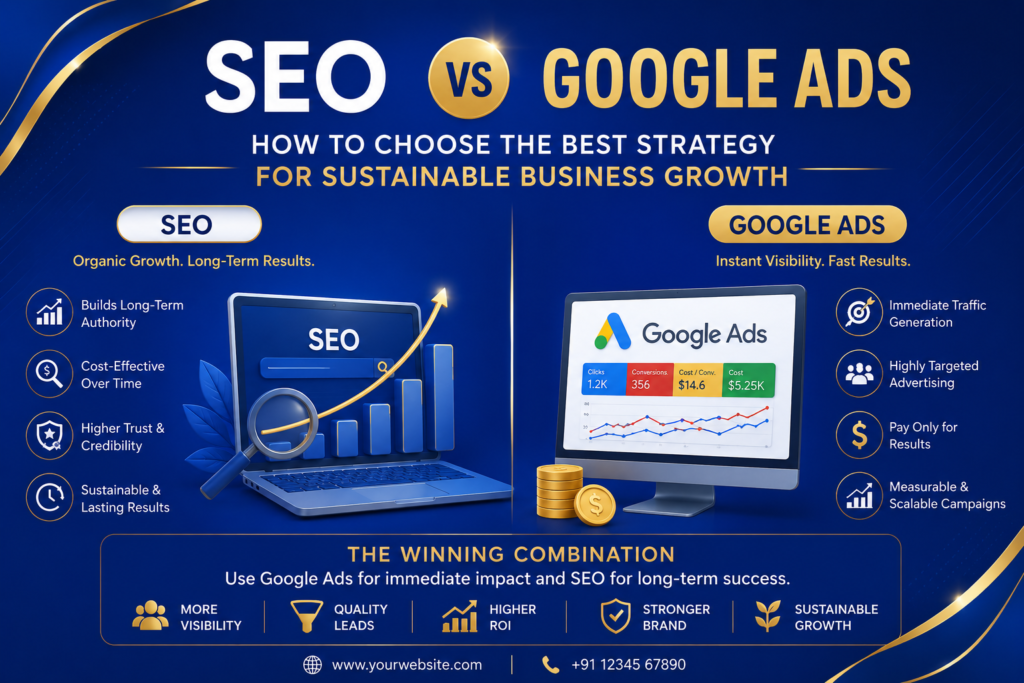
SEO vs Google Ads: How to Choose the Best Strategy for Sustainable Business Growth
Introduction SEO vs Google Ads Every business wants the same outcome—increased visibility, qualified leads, and sustainable revenue growth. The challenge is deciding where to invest your marketing budget to achieve the best results. Two of the most powerful digital marketing strategies are Search Engine Optimization (SEO) and Google Ads, but they work in very different ways. Some businesses invest heavily in Google Ads because they need immediate visibility and fast lead generation. Others focus on SEO to build long-term authority, attract organic traffic, and reduce customer acquisition costs over time. Choosing between the two isn’t always straightforward because the right strategy depends on your business goals, budget, competition, timeline, and target audience. Many business owners make the mistake of assuming that SEO and Google Ads compete with each other. In reality, they are complementary strategies. One helps you build a long-term digital asset, while the other delivers instant visibility for high-intent searches. Understanding how each channel works allows you to allocate your marketing budget more effectively and maximize your return on investment. This guide explores the differences between SEO and Google Ads, compares their strengths and limitations, and helps you determine which strategy aligns best with your business objectives. Understanding Search Engine Optimization (SEO) Search Engine Optimization (SEO) is the process of improving a website so it ranks higher in organic search engine results. Instead of paying for every visitor, SEO focuses on increasing your website’s visibility by creating valuable content, improving website performance, optimizing technical elements, and building authority over time. When someone searches for products or services on Google, businesses that appear on the first page often receive the majority of clicks. SEO helps position your website in front of users who are actively looking for solutions, making it one of the most cost-effective long-term marketing strategies. Unlike paid advertising, SEO is built on trust, relevance, and user experience. Search engines evaluate hundreds of ranking factors before deciding which pages deserve top positions. Businesses that consistently publish high-quality content and maintain technically optimized websites are more likely to achieve sustainable rankings. Key Components of SEO A successful SEO strategy combines multiple disciplines that work together to improve visibility and user experience. On-Page SEO On-page SEO focuses on optimizing individual web pages to make them more relevant for search engines and users. This includes: Keyword optimization High-quality content creation Meta titles and descriptions Internal linking Image optimization URL structure Header tags User-friendly formatting Well-optimized pages help search engines understand your content while providing a better experience for visitors. Technical SEO Technical SEO ensures that search engines can crawl, index, and understand your website efficiently. Important technical elements include: Website speed optimization Mobile responsiveness Secure HTTPS connections XML sitemaps Structured data Core Web Vitals Crawlability Indexability A technically sound website provides the foundation for strong organic performance. Off-Page SEO Off-page SEO focuses on improving your website’s authority through external signals. Common strategies include: High-quality backlinks Digital PR Brand mentions Guest blogging Business citations Industry partnerships Search engines consider authoritative backlinks as indicators of trust and credibility. Local SEO For businesses serving specific geographic areas, Local SEO is essential. Optimizing your local presence involves: Google Business Profile optimization Local keyword targeting Customer reviews Location pages Local citations NAP consistency (Name, Address, Phone Number) A strong Local SEO strategy helps businesses appear in local search results and Google Maps, making it easier for nearby customers to find them. What Are Google Ads? Google Ads is Google’s online advertising platform that enables businesses to display paid advertisements across Google Search, YouTube, Gmail, Google Maps, and millions of partner websites. Unlike SEO, where rankings are earned over time, Google Ads allows businesses to appear at the top of search results almost immediately after launching a campaign. Advertisers bid on keywords related to their products or services. When users search for those keywords, Google determines which ads to display based on factors such as bid amount, ad relevance, expected click-through rate, and landing page quality. Businesses only pay when users perform a specific action, such as clicking on an advertisement. This model is commonly known as Pay-Per-Click (PPC). Google Ads is particularly effective for businesses that need immediate traffic, seasonal promotions, product launches, or rapid lead generation. Types of Google Ads Campaigns Google Ads offers multiple campaign formats designed to support different marketing objectives. Search Campaigns Search Ads appear above and below organic search results when users search for relevant keywords. These ads work exceptionally well for high-intent searches where users are actively looking for products or services. Example searches include: SEO agency near me Website development company Digital marketing services Local SEO expert Search campaigns often generate high-quality leads because they target users with clear purchase intent. Display Campaigns Display Ads appear across Google’s partner websites using image-based advertisements. These campaigns are ideal for: Brand awareness Remarketing Product promotion Audience expansion Although Display Ads generally have lower click-through rates than Search Ads, they are highly effective for increasing visibility. Shopping Campaigns Shopping Ads showcase product images, prices, ratings, and store information directly within Google Search. These campaigns are especially valuable for eCommerce businesses because they help customers compare products before clicking. Video Campaigns Video Ads are displayed on YouTube before, during, or alongside video content. Businesses use video campaigns to: Increase brand awareness Demonstrate products Share customer stories Launch new services Educate audiences Video advertising combines visual storytelling with powerful audience targeting capabilities. SEO vs Google Ads: Understanding the Fundamental Difference Although both strategies aim to increase website traffic and generate business opportunities, their approach is entirely different. SEO focuses on earning visibility through valuable content, website optimization, and long-term authority. Google Ads focuses on buying visibility by paying for premium placements within Google’s advertising network. Neither strategy is universally better than the other. The right choice depends on factors such as your business objectives, competition, marketing budget, and expected timeline for results. Understanding these differences is the first step toward building a digital marketing strategy that delivers sustainable business growth. SEO vs
SEO vs Google Ads: How to Choose the Best Strategy for Sustainable Business Growth Read More »