
Introduction
SEO vs Google Ads Every business wants the same outcome—increased visibility, qualified leads, and sustainable revenue growth. The challenge is deciding where to invest your marketing budget to achieve the best results. Two of the most powerful digital marketing strategies are Search Engine Optimization (SEO) and Google Ads, but they work in very different ways.
Some businesses invest heavily in Google Ads because they need immediate visibility and fast lead generation. Others focus on SEO to build long-term authority, attract organic traffic, and reduce customer acquisition costs over time. Choosing between the two isn’t always straightforward because the right strategy depends on your business goals, budget, competition, timeline, and target audience.
Many business owners make the mistake of assuming that SEO and Google Ads compete with each other. In reality, they are complementary strategies. One helps you build a long-term digital asset, while the other delivers instant visibility for high-intent searches. Understanding how each channel works allows you to allocate your marketing budget more effectively and maximize your return on investment.
This guide explores the differences between SEO and Google Ads, compares their strengths and limitations, and helps you determine which strategy aligns best with your business objectives.
Understanding Search Engine Optimization (SEO)
Search Engine Optimization (SEO) is the process of improving a website so it ranks higher in organic search engine results. Instead of paying for every visitor, SEO focuses on increasing your website’s visibility by creating valuable content, improving website performance, optimizing technical elements, and building authority over time.
When someone searches for products or services on Google, businesses that appear on the first page often receive the majority of clicks. SEO helps position your website in front of users who are actively looking for solutions, making it one of the most cost-effective long-term marketing strategies.
Unlike paid advertising, SEO is built on trust, relevance, and user experience. Search engines evaluate hundreds of ranking factors before deciding which pages deserve top positions. Businesses that consistently publish high-quality content and maintain technically optimized websites are more likely to achieve sustainable rankings.
Key Components of SEO
A successful SEO strategy combines multiple disciplines that work together to improve visibility and user experience.
On-Page SEO
On-page SEO focuses on optimizing individual web pages to make them more relevant for search engines and users.
This includes:
- Keyword optimization
- High-quality content creation
- Meta titles and descriptions
- Internal linking
- Image optimization
- URL structure
- Header tags
- User-friendly formatting
Well-optimized pages help search engines understand your content while providing a better experience for visitors.
Technical SEO
Technical SEO ensures that search engines can crawl, index, and understand your website efficiently.
Important technical elements include:
- Website speed optimization
- Mobile responsiveness
- Secure HTTPS connections
- XML sitemaps
- Structured data
- Core Web Vitals
- Crawlability
- Indexability
A technically sound website provides the foundation for strong organic performance.
Off-Page SEO
Off-page SEO focuses on improving your website’s authority through external signals.
Common strategies include:
- High-quality backlinks
- Digital PR
- Brand mentions
- Guest blogging
- Business citations
- Industry partnerships
Search engines consider authoritative backlinks as indicators of trust and credibility.
Local SEO
For businesses serving specific geographic areas, Local SEO is essential.
Optimizing your local presence involves:
- Google Business Profile optimization
- Local keyword targeting
- Customer reviews
- Location pages
- Local citations
- NAP consistency (Name, Address, Phone Number)
A strong Local SEO strategy helps businesses appear in local search results and Google Maps, making it easier for nearby customers to find them.
What Are Google Ads?
Google Ads is Google’s online advertising platform that enables businesses to display paid advertisements across Google Search, YouTube, Gmail, Google Maps, and millions of partner websites.
Unlike SEO, where rankings are earned over time, Google Ads allows businesses to appear at the top of search results almost immediately after launching a campaign.
Advertisers bid on keywords related to their products or services. When users search for those keywords, Google determines which ads to display based on factors such as bid amount, ad relevance, expected click-through rate, and landing page quality.
Businesses only pay when users perform a specific action, such as clicking on an advertisement. This model is commonly known as Pay-Per-Click (PPC).
Google Ads is particularly effective for businesses that need immediate traffic, seasonal promotions, product launches, or rapid lead generation.
Types of Google Ads Campaigns
Google Ads offers multiple campaign formats designed to support different marketing objectives.
Search Campaigns
Search Ads appear above and below organic search results when users search for relevant keywords.
These ads work exceptionally well for high-intent searches where users are actively looking for products or services.
Example searches include:
- SEO agency near me
- Website development company
- Digital marketing services
- Local SEO expert
Search campaigns often generate high-quality leads because they target users with clear purchase intent.
Display Campaigns
Display Ads appear across Google’s partner websites using image-based advertisements.
These campaigns are ideal for:
- Brand awareness
- Remarketing
- Product promotion
- Audience expansion
Although Display Ads generally have lower click-through rates than Search Ads, they are highly effective for increasing visibility.
Shopping Campaigns
Shopping Ads showcase product images, prices, ratings, and store information directly within Google Search.
These campaigns are especially valuable for eCommerce businesses because they help customers compare products before clicking.
Video Campaigns
Video Ads are displayed on YouTube before, during, or alongside video content.
Businesses use video campaigns to:
- Increase brand awareness
- Demonstrate products
- Share customer stories
- Launch new services
- Educate audiences
Video advertising combines visual storytelling with powerful audience targeting capabilities.
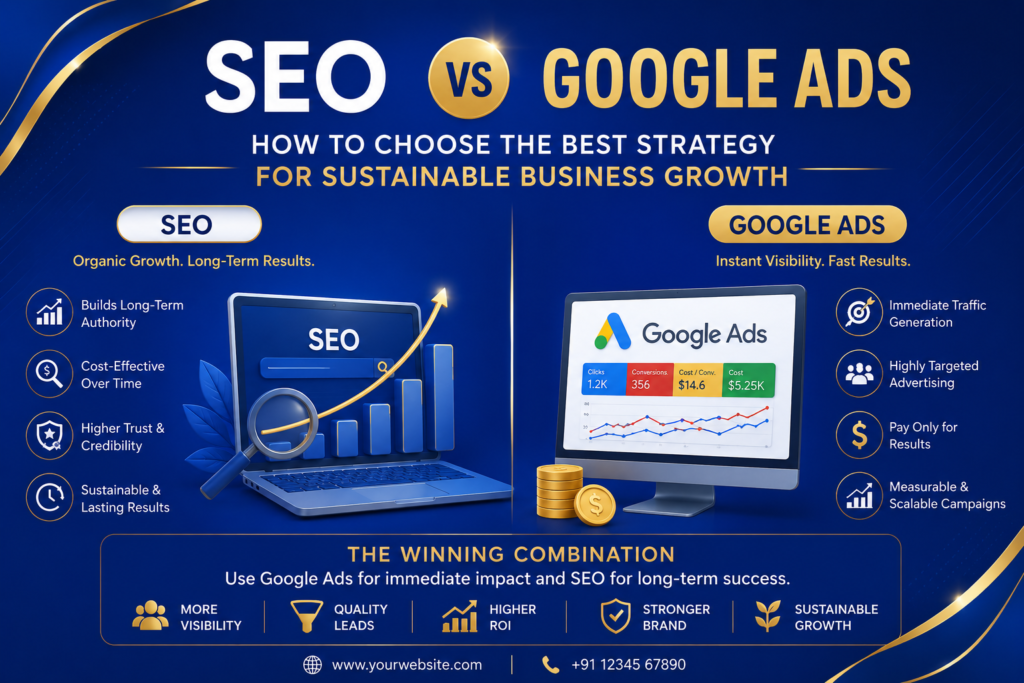
SEO vs Google Ads: Understanding the Fundamental Difference
Although both strategies aim to increase website traffic and generate business opportunities, their approach is entirely different.
SEO focuses on earning visibility through valuable content, website optimization, and long-term authority.
Google Ads focuses on buying visibility by paying for premium placements within Google’s advertising network.
Neither strategy is universally better than the other. The right choice depends on factors such as your business objectives, competition, marketing budget, and expected timeline for results.
Understanding these differences is the first step toward building a digital marketing strategy that delivers sustainable business growth.
SEO vs Google Ads: A Detailed Comparison
Choosing between SEO and Google Ads becomes easier when you evaluate both strategies across the factors that directly impact business growth. While both aim to increase online visibility, they differ in cost, speed, sustainability, and overall return on investment.
The comparison below highlights the key differences.
| Factor | SEO | Google Ads |
|---|---|---|
| Traffic Source | Organic Search Results | Paid Search Results |
| Cost Structure | Investment in optimization and content | Pay for every click (PPC) |
| Time to See Results | Medium to Long Term | Immediate |
| Long-Term Value | High | Stops when the budget ends |
| Brand Credibility | Strong | Moderate |
| ROI Timeline | Improves over time | Depends on campaign optimization |
| Click-Through Rate | Generally higher for strong organic rankings | Varies based on ad quality and competition |
| Sustainability | Long-lasting | Budget dependent |
| Scalability | Gradual but sustainable | Fast and highly scalable |
| Best For | Long-term business growth | Quick lead generation and product promotion |
This comparison shows that SEO and Google Ads are designed for different objectives. Businesses looking for immediate visibility often benefit from Google Ads, while those aiming to build lasting authority generally see greater value from SEO.
Cost Comparison: Which Strategy Is More Budget-Friendly?
Marketing should always be viewed as an investment rather than an expense. However, understanding the cost structure of each strategy helps businesses allocate resources more effectively.
SEO Investment
SEO does not require payment for individual website visits. Instead, businesses invest in activities that improve their website’s performance and visibility over time.
Typical SEO investments include:
- Website optimization
- Technical improvements
- Content creation
- Keyword research
- Link building
- Local SEO
- Ongoing performance monitoring
Although SEO requires patience, the long-term cost per acquisition usually decreases as organic traffic grows.
For example, a well-optimized blog article can continue generating qualified visitors for months or even years without additional advertising costs.
Google Ads Investment
Google Ads follows a Pay-Per-Click (PPC) model.
Every time someone clicks on your advertisement, you pay Google. The actual cost depends on several factors, including:
- Industry competition
- Keyword demand
- Quality Score
- Ad relevance
- Landing page experience
- Geographic targeting
Highly competitive industries such as legal services, finance, insurance, and healthcare often experience higher cost-per-click than niche markets.
Google Ads can produce excellent returns when campaigns are well managed, but traffic usually stops once the advertising budget is exhausted.
Which Strategy Delivers Faster Results?
One of the biggest differences between SEO and Google Ads is the speed at which results appear.
SEO: A Long-Term Investment
SEO requires consistent effort before rankings improve. Search engines need time to discover, evaluate, and trust new content.
Depending on the competition and website authority, meaningful SEO results may take several months.
However, once rankings are established, businesses can continue receiving qualified organic traffic without paying for every visitor.
Think of SEO as building a valuable business asset that appreciates over time.
Google Ads: Immediate Visibility
Google Ads offers almost instant exposure.
A well-structured campaign can begin attracting visitors within hours of activation.
This makes Google Ads ideal for:
- Product launches
- Seasonal promotions
- New businesses
- Limited-time offers
- Event registrations
- Rapid lead generation
Businesses that require immediate results often use Google Ads while simultaneously building their long-term SEO strategy.
Traffic Quality: Organic vs Paid Visitors
Traffic volume is important, but traffic quality has a greater impact on business growth.
Organic Traffic Through SEO
Visitors arriving through organic search often spend more time researching products and services before making decisions.
Because these users actively search for information, they frequently demonstrate stronger intent and higher engagement.
Organic visitors often:
- Read multiple pages
- Explore related resources
- Return to the website later
- Share useful content
- Build long-term trust with the brand
High-quality content helps businesses nurture these relationships over time.
Paid Traffic Through Google Ads
Google Ads targets users searching for specific keywords or matching selected audience criteria.
Paid campaigns provide exceptional targeting capabilities, allowing businesses to reach potential customers based on:
- Location
- Interests
- Device type
- Demographics
- Search behavior
- Previous website visits
Well-optimized campaigns can generate highly qualified leads, particularly when users are close to making purchasing decisions.
The key difference is that paid traffic depends on continuous advertising investment.
Return on Investment (ROI)
Every business wants its marketing budget to generate measurable returns.
Understanding how ROI differs between SEO and Google Ads helps businesses make informed decisions.
SEO ROI
SEO typically produces stronger long-term returns because successful content continues attracting visitors without requiring payment for every click.
Benefits include:
- Lower customer acquisition costs over time
- Continuous organic traffic
- Higher brand credibility
- Better long-term profitability
- Sustainable lead generation
As website authority grows, ranking for additional keywords becomes easier, creating a compounding effect.
Google Ads ROI
Google Ads can deliver excellent ROI when campaigns are carefully optimized.
Success depends on factors such as:
- Keyword selection
- Bid strategy
- Ad copy
- Landing page quality
- Conversion rate optimization
- Campaign monitoring
Businesses selling high-value products or services often achieve strong returns because even a small number of qualified leads can generate significant revenue.
However, campaign profitability requires ongoing optimization and budget management.
Brand Authority and Customer Trust
Building trust has become one of the most important factors in digital marketing.
Consumers are more likely to purchase from brands they recognize and trust.
SEO Builds Authority
Businesses appearing consistently in organic search results are often viewed as industry leaders.
Publishing educational content, solving customer problems, and maintaining an informative website gradually strengthens brand authority.
Customers frequently associate high organic rankings with expertise and credibility.
Google Ads Build Visibility
Google Ads increases brand exposure very quickly.
Even if users do not click immediately, repeated visibility can improve brand recognition.
However, advertisements generally do not create the same level of long-term trust as consistent organic visibility supported by valuable content.
Which Strategy Generates Better Long-Term Business Growth?
If the objective is sustainable growth, SEO usually provides greater long-term value because it builds an asset that continues delivering results over time.
Google Ads, on the other hand, functions more like an accelerator. It helps businesses generate immediate traffic, validate offers, and reach customers quickly, but its effectiveness depends on continuous investment.
The most successful businesses rarely rely on only one strategy. They use Google Ads to generate immediate opportunities while simultaneously investing in SEO to reduce future acquisition costs and strengthen their online authority.
SEO vs Google Ads for Different Types of Businesses
There is no universal answer to whether SEO or Google Ads is the better investment. Every business has unique goals, budgets, competition levels, and customer journeys. Choosing the right strategy depends on understanding your business model and matching it with the strengths of each marketing channel.
Let’s explore how different types of businesses can benefit from SEO, Google Ads, or a combination of both.
SEO vs Google Ads for Local Businesses
Local businesses rely on attracting customers from a specific geographic area. Whether you own a restaurant, dental clinic, real estate agency, law firm, fitness center, or home service business, local visibility is essential.
Why SEO Works Well for Local Businesses
Local SEO helps businesses appear in location-based searches such as:
- Digital marketing agency near me
- Best café in Andheri
- SEO company in Mumbai
- Website designer near me
Optimizing your Google Business Profile, earning positive customer reviews, creating location-specific pages, and maintaining accurate business information significantly improve your chances of appearing in local search results and Google Maps.
Local SEO also builds trust because customers often prefer businesses with strong organic visibility and genuine reviews.
When Google Ads Is a Better Choice
If your business has recently launched or you’re running a limited-time offer, Google Ads can help generate enquiries immediately.
Examples include:
- Festival promotions
- Limited-time discounts
- New service launches
- Event registrations
- Emergency services
For many local businesses, the most effective strategy is to use Google Ads for immediate visibility while investing in Local SEO for sustainable long-term growth.
SEO vs Google Ads for Service-Based Businesses
Service businesses depend on trust, expertise, and credibility. Customers usually compare multiple providers before making a decision.
Examples include:
- Digital marketing agencies
- Chartered accountants
- Legal firms
- Interior designers
- Consultants
- Healthcare providers
- Education and training institutes
Why SEO Is Highly Effective
Service-based businesses benefit greatly from educational content.
Publishing in-depth blogs, case studies, service pages, and industry guides helps answer customer questions while demonstrating expertise.
This approach supports both search rankings and customer confidence.
Where Google Ads Adds Value
Google Ads is useful for targeting high-intent keywords where potential clients are actively looking for professional services.
Examples include:
- SEO agency
- Website development company
- Business consultant
- Tax consultant
Well-designed landing pages combined with targeted advertising can generate qualified enquiries quickly.
SEO vs Google Ads for E-commerce Businesses
E-commerce businesses operate in highly competitive environments where visibility directly impacts sales.
SEO Advantages
SEO helps e-commerce websites attract customers through:
- Product pages
- Category pages
- Buying guides
- Comparison articles
- Product reviews
- Informational blogs
Organic traffic often reduces dependency on paid advertising over time.
Google Ads Advantages
Google Shopping Ads and Search Ads provide immediate product visibility.
Customers can compare:
- Product images
- Pricing
- Ratings
- Store information
This increases purchase intent and often leads to faster conversions.
Successful e-commerce brands usually combine SEO with Google Ads to maximize both immediate sales and long-term organic growth.
When Should You Choose SEO?
SEO is the right choice if your business aims to build sustainable growth rather than relying solely on paid campaigns.
Consider prioritizing SEO when:
- You want consistent organic traffic.
- Building long-term brand authority is important.
- You are willing to invest in content and website improvements.
- Your goal is to reduce customer acquisition costs over time.
- You want your website to become a valuable marketing asset.
Although SEO requires patience, its benefits often continue long after the initial investment.
When Should You Choose Google Ads?
Google Ads is ideal when speed is a priority.
It works particularly well if:
- You need immediate website traffic.
- You’re launching a new product or service.
- Your business depends on seasonal demand.
- You have a well-defined advertising budget.
- You want to test new markets or offers quickly.
Because campaigns can be adjusted in real time, Google Ads offers flexibility and measurable performance.
Why Combining SEO and Google Ads Often Delivers the Best Results
Many businesses think they must choose one strategy over the other. In reality, the strongest digital marketing strategies combine both.
Here’s why:
Immediate and Long-Term Growth
Google Ads generates immediate visibility, while SEO builds lasting organic traffic. Running both strategies together creates a balanced marketing approach.
Better Keyword Insights
Google Ads campaigns reveal which keywords convert well. These insights can then guide your SEO content strategy, helping you prioritize topics that drive real business results.
Greater Search Visibility
Appearing in both paid and organic search results increases brand exposure and builds confidence among potential customers.
Improved Lead Generation
While SEO attracts users throughout the research phase, Google Ads captures users who are ready to take action. Together, they support the entire customer journey.
Stronger Marketing ROI
Businesses that integrate SEO and Google Ads often achieve a healthier balance between short-term lead generation and long-term customer acquisition.
Rather than viewing these channels as competitors, successful organizations treat them as complementary investments that support sustainable business growth.
Common Mistakes Businesses Make When Choosing Between SEO and Google Ads
Many businesses fail to achieve their marketing goals not because SEO or Google Ads are ineffective, but because they choose the wrong strategy or have unrealistic expectations. Understanding these common mistakes can help you make smarter marketing decisions and maximize your return on investment.
Expecting SEO to Deliver Instant Results
SEO is a long-term strategy. It involves improving your website, creating valuable content, building authority, and earning trust from search engines. These improvements take time to produce measurable results.
Businesses that stop investing in SEO after a few weeks often miss the long-term benefits that organic search can provide.
Depending Only on Paid Advertising
Google Ads can generate traffic quickly, but relying exclusively on paid campaigns can become expensive over time.
The moment you stop your campaigns, your visibility and traffic can decline significantly. That’s why businesses should gradually build organic visibility alongside their paid campaigns.
Ignoring Landing Page Experience
Whether traffic comes from SEO or Google Ads, visitors expect a fast, informative, and user-friendly website.
A slow-loading page, poor navigation, or unclear messaging can reduce conversions, regardless of how much traffic you generate.
Focusing on Traffic Instead of Business Goals
More website visitors do not always mean more customers.
Successful marketing focuses on attracting qualified visitors who are likely to enquire, purchase, or become long-term customers.
Tracking meaningful metrics such as leads, sales, and conversion rates provides a clearer picture of marketing success.
Neglecting Performance Analysis
Digital marketing is an ongoing process.
Regularly reviewing campaign data, search performance, and user behaviour helps businesses identify opportunities for improvement and make informed decisions based on real insights rather than assumptions.
Expert Recommendations
Choosing the right strategy depends on your business objectives rather than following a one-size-fits-all approach.
Choose SEO if:
- Your goal is long-term, sustainable growth.
- You want to establish industry authority.
- You are committed to publishing high-quality content.
- Reducing customer acquisition costs over time is a priority.
- Building long-term organic visibility is part of your business strategy.
Choose Google Ads if:
- You need immediate enquiries or sales.
- You’re launching a new product or service.
- You want to test new offers or markets.
- Your business depends on seasonal demand.
- You have a dedicated advertising budget.
Invest in Both if:
For most established businesses, combining SEO and Google Ads delivers the strongest results.
SEO builds long-term visibility and credibility, while Google Ads provides immediate reach and valuable customer insights. Together, they create a balanced strategy that supports every stage of the customer journey.
Frequently Asked Questions
Is SEO better than Google Ads?
Neither strategy is universally better. SEO is ideal for sustainable long-term growth, while Google Ads is better suited for businesses that need immediate visibility and faster lead generation.
Which strategy is more cost-effective?
SEO generally becomes more cost-effective over time because it continues generating organic traffic after rankings are established. Google Ads requires ongoing advertising spend to maintain visibility.
Can SEO and Google Ads work together?
Yes. Many successful businesses combine both strategies. Google Ads generates immediate traffic, while SEO builds long-term authority and reduces dependence on paid advertising.
Which strategy is better for small businesses?
Small businesses with limited budgets often benefit from investing in SEO for sustainable growth. However, Google Ads can also be effective for targeted campaigns, product launches, or time-sensitive promotions.
How long does SEO take to produce results?
The timeline depends on factors such as competition, website authority, and content quality. While improvements may begin earlier, meaningful growth generally requires consistent effort over several months.
Does Google Ads improve SEO rankings?
No. Running Google Ads does not directly influence organic search rankings. However, paid campaigns can provide valuable keyword and audience insights that support your overall SEO strategy.
Final Thoughts
The debate between SEO and Google Ads is not about choosing a winner. It is about selecting the strategy that aligns with your business goals, available resources, and long-term vision.
If your priority is immediate visibility, lead generation, and rapid campaign launches, Google Ads provides an effective solution.
If your objective is sustainable growth, stronger brand authority, and lower customer acquisition costs over time, SEO offers long-term value that continues to benefit your business long after the initial investment.
For many businesses, the most effective approach is not choosing one over the other—it is integrating both into a unified digital marketing strategy. Paid advertising delivers immediate momentum, while SEO builds a lasting online presence that supports consistent growth.
By understanding the strengths of each channel and using them strategically, businesses can create a marketing ecosystem that attracts qualified traffic, generates high-quality leads, and supports long-term success.
About the Author
Musarrat Jahan is the Founder of Elizeh Media, a digital marketing agency focused on helping businesses achieve measurable online growth through SEO, content marketing, website development, local SEO, Google Ads, and performance-driven digital strategies. She regularly publishes practical, research-backed insights that help business owners make informed marketing decisions and build a stronger digital presence.
About Elizeh Media
Elizeh Media is a full-service digital marketing agency dedicated to helping startups, local businesses, and established brands grow through strategic SEO, Google Ads, website development, content marketing, local SEO, and conversion-focused digital marketing solutions.
Our approach combines data-driven strategy, creative execution, and measurable performance to help businesses increase visibility, attract qualified leads, and achieve sustainable growth in today’s competitive digital landscape.
Explore our services to discover how Elizeh Media can help your business build a stronger online presence and achieve long-term success
Pingback: The Future of Search: How AI Is Reshaping SEO | Elizeh Media