
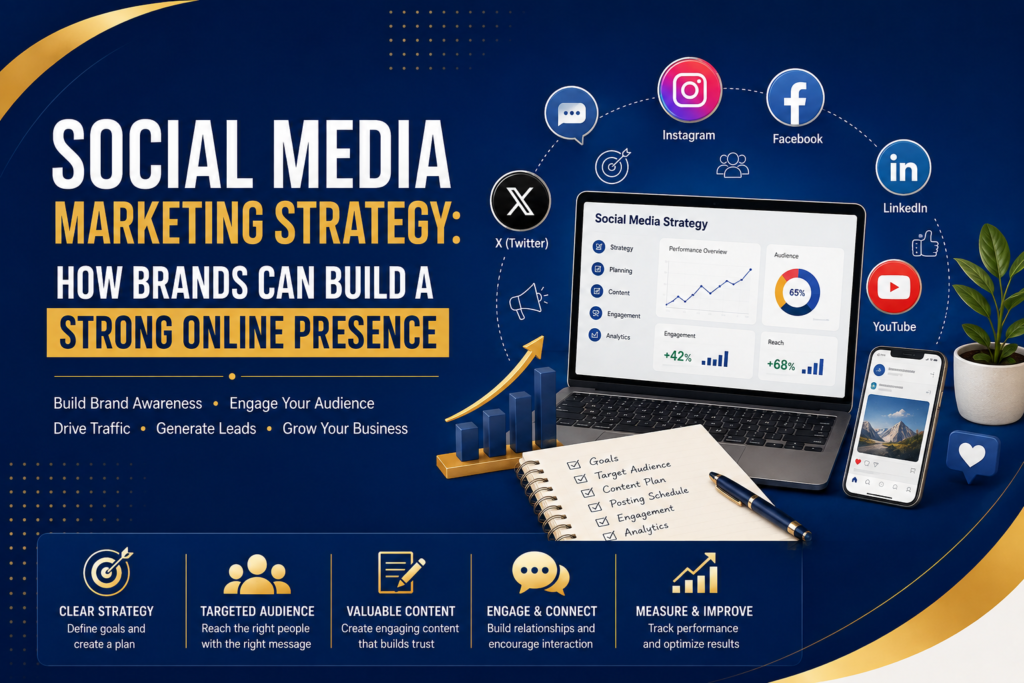
Why Every Brand Needs a Social Media Marketing Strategy
Social media has become one of the most powerful tools for building brand awareness, engaging customers, and driving business growth. However, simply posting content regularly is no longer enough. Brands need a well-planned social media marketing strategy that aligns with their goals, reaches the right audience, and delivers measurable results.
Introduction
Social media has transformed the way businesses connect with their audiences. Platforms like Facebook, Instagram, LinkedIn, X, Pinterest, and YouTube have become essential marketing channels where brands build relationships, showcase products and services, and establish credibility.
With billions of active users worldwide, social media offers businesses an opportunity to reach potential customers at every stage of the buying journey. However, success doesn’t come from posting random updates or following trends without a plan. It requires a clear strategy based on business objectives, audience insights, valuable content, and continuous performance analysis.
Whether you’re a startup, a local business, or an established brand, having a well-defined social media marketing strategy helps you stay consistent, strengthen your brand identity, and achieve sustainable growth.
In this comprehensive guide, you’ll learn how to build an effective social media marketing strategy that increases brand visibility, engages your audience, generates leads, and supports long-term business success.
What Is a Social Media Marketing Strategy?
A social media marketing strategy is a structured plan that outlines how a business will use social media platforms to achieve its marketing goals. It defines what content will be shared, where it will be published, who the target audience is, how success will be measured, and how each activity supports the overall business objectives.
Instead of posting without direction, a strategy ensures that every piece of content contributes to building brand awareness, increasing engagement, generating leads, or driving sales.
A successful strategy combines creativity with data-driven decision-making, allowing businesses to adapt their approach based on audience behaviour and campaign performance.
Why Is a Social Media Marketing Strategy Important?
Many businesses create social media accounts but struggle to achieve meaningful results because they lack a clear plan. A strong strategy provides direction, consistency, and measurable outcomes.
An effective social media marketing strategy helps businesses:
- Increase brand awareness.
- Build trust and credibility.
- Reach the right target audience.
- Drive qualified website traffic.
- Generate leads and sales.
- Improve customer engagement.
- Strengthen customer relationships.
- Stay ahead of competitors.
- Support long-term business growth.
Rather than focusing solely on vanity metrics such as likes or followers, a strategic approach prioritises meaningful engagement and measurable business results.
The Role of Social Media in Modern Brand Building
Today’s customers expect brands to maintain an active and professional presence across social media platforms. Before making a purchase, many consumers check a company’s social profiles to learn more about its products, services, customer interactions, and reputation.
Social media allows brands to:
- Tell their brand story.
- Showcase expertise.
- Demonstrate products and services.
- Share customer success stories.
- Educate their audience.
- Build an engaged community.
- Provide customer support.
- Collect valuable feedback.
When used strategically, social media becomes much more than a marketing channel—it becomes a platform for building long-term relationships with customers.
Key Benefits of a Strong Social Media Marketing Strategy
A well-planned strategy provides several long-term advantages that contribute to sustainable business growth.
Increased Brand Visibility
Consistent, high-quality content helps your brand reach a wider audience and remain visible in an increasingly competitive digital landscape.
Better Audience Engagement
Social media enables two-way communication. Responding to comments, answering questions, and participating in conversations helps build stronger relationships with your audience.
Higher Website Traffic
Sharing valuable content with clear calls to action encourages users to visit your website, explore your services, and learn more about your business.
Improved Lead Generation
A strategic combination of educational content, promotional campaigns, and lead magnets can attract qualified prospects who are genuinely interested in your products or services.
Stronger Customer Trust
Brands that consistently provide valuable information, engage authentically, and respond promptly to customer inquiries build greater trust and credibility over time.
Common Goals of a Social Media Marketing Strategy
Every business has unique objectives, but most social media strategies focus on one or more of the following goals:
- Building brand awareness.
- Increasing website traffic.
- Generating qualified leads.
- Growing an engaged online community.
- Driving product or service sales.
- Improving customer retention.
- Enhancing brand reputation.
- Supporting SEO through content distribution.
- Establishing thought leadership within the industry.
Defining clear goals from the beginning helps businesses measure performance accurately and optimise their strategy over time.
Social Media Marketing Is More Than Just Posting Content
One of the biggest misconceptions is that social media marketing involves publishing regular posts. In reality, successful brands invest time in research, planning, audience analysis, content creation, community management, advertising, and performance tracking.
Every post should support a broader marketing objective and contribute to the overall customer journey. Businesses that focus on delivering value rather than simply promoting products are more likely to build loyal communities and achieve lasting success.
Setting SMART Social Media Goals
Every successful social media marketing strategy begins with clearly defined goals. Without specific objectives, it’s difficult to measure performance or determine whether your marketing efforts are delivering real business value.
Instead of aiming to “get more followers,” focus on measurable outcomes that align with your overall business objectives. A widely accepted framework for setting goals is the SMART method.
Your goals should be:
- Specific – Clearly define what you want to achieve.
- Measurable – Track progress using metrics and analytics.
- Achievable – Set realistic targets based on available resources.
- Relevant – Align social media activities with business objectives.
- Time-bound – Establish a clear deadline for achieving each goal.
Examples of SMART Social Media Goals
- Increase Instagram followers by 20% within six months.
- Generate 100 qualified leads through LinkedIn in three months.
- Improve Facebook engagement rate by 15% over the next quarter.
- Increase website traffic from social media by 30% within six months.
- Generate 50 monthly inquiries through social media campaigns.
Having measurable goals allows businesses to evaluate what works and continuously improve their marketing strategy.
Understanding Your Target Audience
Even the best content will fail if it’s shown to the wrong audience. Understanding who your ideal customers are is one of the most important steps in creating an effective social media marketing strategy.
Start by identifying:
- Age group
- Gender
- Geographic location
- Occupation
- Interests and hobbies
- Income level
- Online behaviour
- Preferred social media platforms
- Buying habits
- Common challenges and pain points
The more you understand your audience, the easier it becomes to create content that captures attention, builds trust, and encourages engagement.
Create Customer Personas
A customer persona is a detailed profile of your ideal customer.
For example:
Business Owner Sarah
- Owns a small local business.
- Wants more website visitors.
- Has a limited marketing budget.
- Needs affordable digital marketing solutions.
- Uses Facebook and Instagram daily.
Creating customer personas helps brands produce highly relevant content that resonates with their audience.
Choosing the Right Social Media Platforms
Not every platform is suitable for every business. Instead of trying to maintain a presence everywhere, focus on the platforms where your target audience is most active.
Facebook remains one of the largest social media platforms and is ideal for:
- Local businesses
- Service providers
- Community building
- Paid advertising
- Customer engagement
Instagram is highly visual and works well for:
- Fashion brands
- Restaurants
- Beauty businesses
- Travel companies
- Lifestyle brands
- E-commerce stores
Short-form videos, Stories, and Reels can significantly increase reach and engagement.
LinkedIn is the leading platform for B2B marketing and professional networking.
It’s best for:
- Professional services
- Consultants
- Software companies
- Recruitment agencies
- Corporate brands
Sharing industry insights and thought leadership content helps establish credibility.
YouTube
Video continues to dominate digital marketing, making YouTube an excellent platform for:
- Educational content
- Product demonstrations
- Tutorials
- Customer testimonials
- Brand storytelling
High-quality videos can also improve your visibility in Google Search results.
X (Formerly Twitter)
X is effective for:
- Real-time updates
- Industry news
- Customer engagement
- Brand announcements
- Trending conversations
Businesses in technology, media, finance, and news industries often benefit most from an active presence.
Pinterest works particularly well for businesses in:
- Home décor
- DIY
- Food
- Fashion
- Interior design
- Wedding planning
- Lifestyle
Its search-based nature allows content to generate traffic long after it’s published.
Build a Strong Brand Identity
Your social media profiles should reflect a consistent and recognizable brand identity. Every visual element and message should reinforce your business values and make your brand memorable.
A strong brand identity includes:
- Professional logo
- Consistent brand colours
- Readable typography
- Clear messaging
- Professional profile images
- High-quality graphics
- Consistent tone of voice
When customers recognise your brand instantly across platforms, they are more likely to trust your business and remember your services.
Create an Effective Content Strategy
Content is the foundation of every successful social media marketing strategy. Instead of publishing random posts, businesses should create content that educates, entertains, inspires, and solves customer problems.
A balanced content strategy builds authority while encouraging audience engagement.
Content Types to Include
- Educational posts
- Industry tips
- How-to guides
- Case studies
- Customer testimonials
- Behind-the-scenes content
- Product demonstrations
- Company updates
- Polls and quizzes
- Short-form videos
- Infographics
- Live sessions
Publishing a variety of content keeps your audience engaged and prevents your social media feed from becoming repetitive.
Create Content Pillars
Content pillars are the main themes your brand consistently focuses on. They help maintain consistency and make content planning much easier.
For example, a digital marketing agency could use these content pillars:
- SEO Tips
- Social Media Marketing
- Google Ads
- Content Marketing
- Website Development
- Local SEO
- AI in Marketing
- Client Success Stories
- Marketing Tools
- Business Growth Strategies
By rotating these themes, you can create valuable content consistently while reinforcing your expertise in your industry.
Key Takeaway
A successful social media marketing strategy begins with clear goals, a deep understanding of your audience, the right platform selection, a consistent brand identity, and a well-planned content strategy. Businesses that invest time in planning before publishing content are more likely to build stronger relationships, increase engagement, and achieve sustainable business growth.
Creating a Social Media Content Calendar
One of the biggest reasons brands struggle on social media is inconsistency. Posting only when you remember or when you have free time often leads to irregular engagement and missed opportunities. A social media content calendar helps you stay organised, maintain consistency, and plan content around your marketing goals.
A content calendar allows you to:
- Plan content weeks or months in advance.
- Maintain a consistent posting schedule.
- Balance different types of content.
- Align campaigns with business events and holidays.
- Save time by preparing content in advance.
- Reduce last-minute stress.
Businesses that publish consistently are more likely to build trust, increase engagement, and remain visible to their audience.
What Should a Social Media Content Calendar Include?
An effective content calendar should outline every important detail before publishing.
Include the following:
- Publishing date
- Social media platform
- Content type
- Topic or theme
- Caption
- Hashtags
- Call-to-Action (CTA)
- Creative asset (image, video, carousel, Reel)
- Publishing time
- Performance tracking
Planning these elements in advance improves efficiency and ensures every post supports your marketing objectives.
Sample Weekly Content Calendar
| Day | Content Type | Purpose |
|---|---|---|
| Monday | Educational Tip | Build authority |
| Tuesday | Client Testimonial | Build trust |
| Wednesday | Behind-the-Scenes | Humanise the brand |
| Thursday | Industry Insight | Educate the audience |
| Friday | Product or Service Highlight | Generate leads |
| Saturday | Short Video or Reel | Increase reach |
| Sunday | Poll, Q&A, or Community Post | Boost engagement |
A balanced content mix keeps your audience interested while supporting different stages of the customer journey.
Organic vs Paid Social Media Marketing
Many businesses wonder whether they should rely on organic content or invest in paid advertising. The most effective strategies often combine both.
Organic Social Media Marketing
Organic marketing focuses on growing your audience naturally without paying for reach.
Examples include:
- Educational posts
- Reels
- Stories
- Carousels
- Live sessions
- Community engagement
- User-generated content
Benefits of Organic Marketing
- Builds long-term trust.
- Creates loyal communities.
- Improves brand authority.
- Supports customer relationships.
- Cost-effective over time.
However, organic growth usually requires patience and consistency.
Paid Social Media Marketing
Paid social media marketing involves running advertisements to reach a larger or more targeted audience.
Popular campaign objectives include:
- Brand Awareness
- Website Traffic
- Lead Generation
- Product Sales
- App Downloads
- Event Promotion
Benefits of Paid Advertising
- Immediate visibility.
- Advanced audience targeting.
- Faster lead generation.
- Better campaign scalability.
- Measurable ROI.
The strongest social media strategies combine organic content with paid advertising to maximize both trust and reach.
The Importance of Community Management
Successful brands don’t simply publish content—they actively engage with their audience.
Community management includes:
- Replying to comments.
- Answering direct messages.
- Responding to customer questions.
- Managing reviews.
- Participating in conversations.
- Handling complaints professionally.
Prompt and thoughtful responses show customers that your brand values their feedback and builds stronger relationships over time.
Leveraging Influencer Marketing
Influencer marketing has become an effective way for brands to reach new audiences through trusted creators.
Instead of choosing influencers based only on follower count, evaluate:
- Audience relevance
- Engagement rate
- Content quality
- Brand alignment
- Authenticity
- Previous collaborations
In many cases, micro-influencers with smaller but highly engaged audiences can deliver better results than larger influencers with lower engagement.
Measuring Social Media Success
Publishing content is only one part of the strategy. Regular performance analysis helps you understand what’s working and where improvements are needed.
Monitor metrics such as:
- Reach
- Impressions
- Engagement Rate
- Click-Through Rate (CTR)
- Website Traffic
- Follower Growth
- Lead Generation
- Conversion Rate
- Cost Per Lead (for paid campaigns)
- Return on Ad Spend (ROAS)
Reviewing these metrics consistently allows businesses to make informed decisions and improve future campaigns.
Social Media KPIs Every Brand Should Track
Different goals require different Key Performance Indicators (KPIs).
| Goal | KPI |
|---|---|
| Brand Awareness | Reach, Impressions |
| Engagement | Likes, Comments, Shares, Saves |
| Website Traffic | Link Clicks, Sessions |
| Lead Generation | Form Submissions, Inquiries |
| Sales | Conversions, Revenue |
| Community Growth | Follower Growth Rate |
| Customer Support | Response Time, Resolution Rate |
Tracking the right KPIs ensures your strategy focuses on meaningful business outcomes rather than vanity metrics alone.
Common Social Media Marketing Mistakes
Many brands fail to achieve results because of avoidable mistakes.
Some of the most common include:
- Posting without a strategy.
- Ignoring audience insights.
- Focusing only on selling.
- Inconsistent posting schedules.
- Using poor-quality visuals.
- Copying competitors without originality.
- Ignoring comments and messages.
- Posting on every platform instead of focusing on the right ones.
- Not reviewing analytics.
- Giving up too quickly.
Avoiding these mistakes helps build stronger relationships and achieve more sustainable growth.
Pro Tip
Don’t measure success by follower count alone.
A smaller audience that actively engages with your content, visits your website, and becomes paying customers is far more valuable than a large audience with little interaction.
Focus on creating valuable content, building genuine relationships, and continuously improving your strategy based on performance data.
Social Media Marketing Strategy Checklist
Before launching your strategy, make sure you’ve completed the following:
 Defined clear business goals.
 Defined clear business goals.
- Identified your target audience.
- Selected the right social media platforms.
- Created a consistent brand identity.
- Planned content pillars.
- Built a monthly content calendar.
- Balanced organic and paid campaigns.
- Established community management practices.
- Defined KPIs for success.
- Set a schedule for reviewing analytics and optimising your strategy.
Key Takeaway
A successful social media marketing strategy goes beyond publishing regular posts. It requires careful planning, consistent execution, audience engagement, performance tracking, and continuous optimization. Brands that combine valuable content with data-driven decision-making are better positioned to increase visibility, build lasting customer relationships, and achieve sustainable business growth.
Frequently Asked Questions (FAQs)
What is a social media marketing strategy?
A social media marketing strategy is a structured plan that outlines how a business will use social media platforms to achieve specific marketing goals. It includes target audience research, content planning, platform selection, posting schedules, engagement strategies, paid advertising, and performance measurement.
Why is a social media marketing strategy important for brands?
A well-planned strategy helps brands increase visibility, build trust, engage their audience, generate qualified leads, and achieve measurable business growth. Without a strategy, businesses often post inconsistent content that fails to deliver meaningful results.
Which social media platform is best for business?
The best platform depends on your target audience and business type.
- Facebook – Local businesses and community building
- Instagram – Lifestyle, fashion, beauty, food, travel, and e-commerce
- LinkedIn – B2B companies and professional services
- YouTube – Educational content, tutorials, and product demonstrations
- Pinterest – Home décor, fashion, DIY, food, and lifestyle brands
- X (formerly Twitter) – News, technology, and real-time updates
Most businesses benefit from focusing on two or three platforms instead of trying to maintain a presence everywhere.
How often should brands post on social media?
There is no universal rule, but consistency is more important than frequency.
A practical posting schedule is:
- Facebook: 3–5 posts per week
- Instagram: 4–7 posts per week, along with Stories and Reels
- LinkedIn: 2–4 posts per week
- YouTube: 2–4 videos per month
- Pinterest: Regular weekly Pins
The ideal schedule depends on your audience, industry, and available resources.
What types of content perform best on social media?
High-performing content often includes:
- Educational tips
- Short-form videos
- Infographics
- Customer testimonials
- Behind-the-scenes content
- Case studies
- Industry news
- Product demonstrations
- User-generated content
- Interactive polls and Q&A sessions
Content that provides value and encourages interaction generally performs better than purely promotional posts.
How do you measure the success of a social media marketing strategy?
Success should be measured using key performance indicators (KPIs), such as:
- Reach
- Impressions
- Engagement rate
- Website traffic
- Click-through rate (CTR)
- Lead generation
- Conversion rate
- Return on investment (ROI)
Regular analysis helps businesses refine their strategy and improve results over time.
Final Thoughts
A successful social media marketing strategy is not built overnight. It requires careful planning, a clear understanding of your audience, consistent content creation, active community engagement, and continuous optimisation based on data.
Brands that treat social media as a long-term business asset rather than just a place to post updates are more likely to build strong customer relationships, establish industry authority, and generate sustainable growth.
Whether your goal is to increase brand awareness, drive website traffic, generate qualified leads, or boost sales, a strategic approach ensures that every post contributes to meaningful business outcomes.
The digital landscape continues to evolve, making it essential for businesses to stay informed, adapt to changing trends, and focus on delivering genuine value to their audience. By combining creativity with data-driven decision-making, brands can create a social media presence that not only attracts attention but also builds trust and drives long-term success.
Key Takeaway
A powerful social media marketing strategy is built on five essential pillars:
- Clear business goals
- Deep audience understanding
- High-quality, valuable content
- Consistent engagement
- Continuous performance analysis
Brands that invest in these areas are better positioned to strengthen their online presence, build lasting customer relationships, and achieve sustainable business growth.