
The Remarkable Journey of Mumbai’s Transformation
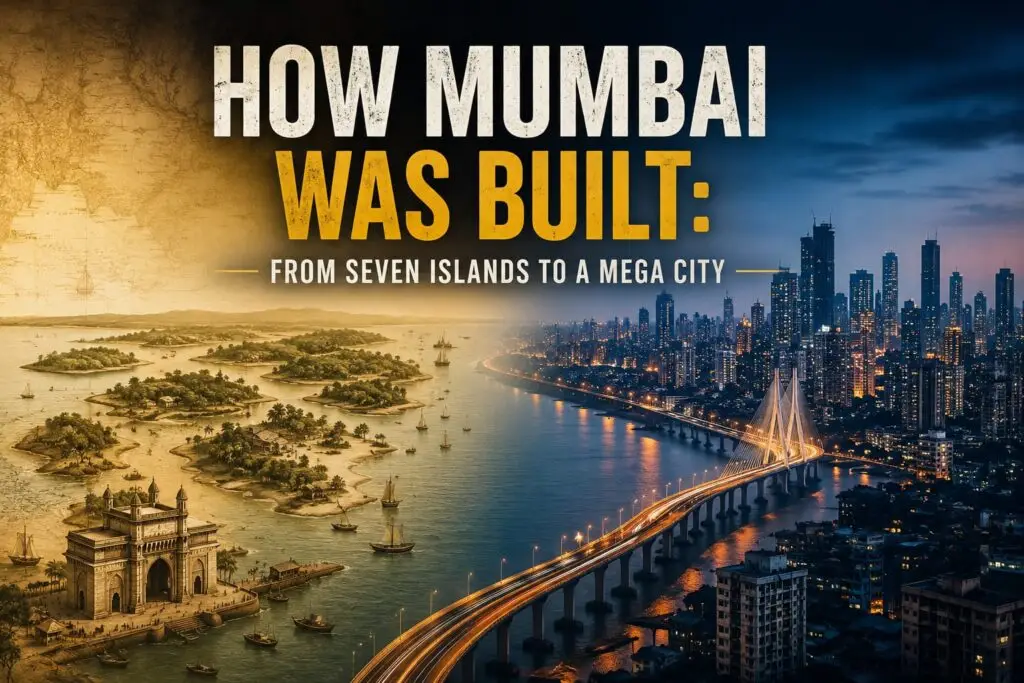
Mumbai is known today as India’s financial capital, home to millions of people and one of the busiest cities in the world. However, the city we know today did not always exist. Centuries ago, Mumbai was nothing more than a collection of seven small islands separated by creeks, marshes, and the Arabian Sea. Its transformation into a thriving metropolitan city is one of the greatest engineering and urban development stories in history.
Introduction
When people think of Mumbai, they often picture towering skyscrapers, the Gateway of India, Marine Drive, Bollywood, and a fast-paced lifestyle. Few realize that this global city was once made up of seven separate islands connected only by shallow waters and tidal marshes.
The story of how Mumbai was built is a fascinating journey of geography, colonial rule, ambitious land reclamation projects, trade expansion, and rapid urban development. Over several centuries, these isolated islands were gradually connected to create the modern city that has become India’s commercial and financial powerhouse.
In this guide, you’ll discover how Mumbai evolved from a group of small islands into one of the world’s largest mega cities, the people and projects that shaped its history, and the engineering achievements that continue to define its landscape today.
What Were the Seven Islands of Mumbai?
| Island | Historical Significance |
|---|---|
| Bombay Island | Commercial and administrative centre |
| Colaba | Military and coastal area |
| Little Colaba | Also known as Old Woman’s Island |
| Mazagaon | Historic fishing and trading settlement |
| Mahim | Ancient fishing village and fort |
| Parel | Textile mills and industrial growth |
| Worli | Coastal settlement with strategic importance |
Each island had its own villages, fishing communities, coconut plantations, and marshy landscapes. During high tide, large portions of land disappeared beneath the sea, making travel between the islands difficult and often dangerous.
The early inhabitants of these islands were primarily the Koli fishing community, who depended on fishing and maritime trade for their livelihood. Even today, the Kolis remain an important part of Mumbai’s cultural heritage.
Mumbai Before Colonial Rule
Long before European powers arrived, the seven islands were ruled by several Indian dynasties.
Historical records suggest that the islands came under the control of:
- The Maurya Empire
- The Satavahana Dynasty
- The Western Satraps
- The Chalukyas
- The Rashtrakutas
- The Silhara Dynasty
- The Gujarat Sultanate
During these periods, the islands were mainly occupied by small settlements, agricultural communities, and fishing villages. Although they were strategically located along important maritime trade routes, they had not yet developed into a major urban center.
Trade with merchants from Arabia, Persia, and East Africa helped establish the region’s importance along the western coast of India.
The Arrival of the Portuguese
A major turning point in Mumbai’s history came in the early 16th century when the Portuguese arrived on India’s western coast.
In 1534, the Sultan of Gujarat ceded the islands to Portugal through the Treaty of Bassein. The Portuguese named the region Bom Bahia, meaning “Good Bay,” because of its excellent natural harbor.
During Portuguese rule, churches, forts, and settlements were built across the islands. They also encouraged agriculture and strengthened maritime trade, although the islands remained largely undeveloped compared to modern Mumbai.
Many historic churches and Portuguese architectural influences can still be seen in parts of Mumbai today.
How the British Acquired Mumbai
Timeline of Mumbai’s Transformation
- 1534 – Portuguese acquired the seven islands.
- 1661 – Islands transferred to England.
- 1668 – Leased to the East India Company.
- 1784 – Hornby Vellard Project began.
- 1853 – India’s first passenger train started in Bombay.
- 1869 – Suez Canal boosted Bombay’s trade.
- 1947 – India gained independence.
- 1995 – Bombay officially renamed Mumbai.
- Today – Mumbai is India’s financial capital.
Another significant chapter began in 1661, when the islands were transferred from Portugal to England as part of the marriage treaty between King Charles II of England and Catherine of Braganza, the Portuguese princess.
Initially, the British Crown struggled to manage the islands effectively.
Just a few years later, in 1668, King Charles II leased the islands to the British East India Company for an annual rent of only £10.
This decision would completely transform the future of Mumbai.
Recognizing the region’s strategic location and natural harbor, the British East India Company began investing in trade, infrastructure, and urban development. Their long-term vision laid the foundation for the city that would eventually become India’s financial capital.
Why the Seven Islands Needed to Be Connected
Although Mumbai possessed one of the finest natural harbors in the world, the seven islands remained physically separated by tidal creeks, mudflats, and marshes.
During high tide:
- Roads disappeared underwater.
- Transportation became extremely difficult.
- Trade movement slowed considerably.
- Flooding affected settlements.
- Expansion opportunities remained limited.
To unlock the city’s full economic potential, engineers and administrators realized that the islands needed to be connected through ambitious land reclamation projects.
This vision marked the beginning of one of the largest urban engineering transformations in Indian history.
The Hornby Vellard Project: The Beginning of Mumbai’s Transformation
One of the most important milestones in Mumbai’s history was the Hornby Vellard Project. In the late 18th century, Governor William Hornby proposed an ambitious plan to connect the seven islands by constructing embankments across the tidal creeks.
At that time, seawater regularly flooded low-lying areas during high tide, making travel difficult and limiting urban development. The Hornby Vellard Project aimed to block seawater from entering these marshy regions and reclaim land for roads, buildings, and public infrastructure.
Although the project faced financial and engineering challenges, it became the foundation for Mumbai’s future expansion. It demonstrated that large-scale land reclamation was possible and encouraged further development across the islands.
Land Reclamation: Turning Sea into Land
Mumbai’s growth is one of the world’s most remarkable examples of land reclamation. Instead of expanding outward naturally, engineers gradually reclaimed land from the Arabian Sea to connect the islands and create space for development.
Large quantities of soil, rocks, and construction material were used to fill creeks and marshlands. Over several decades, separate islands slowly merged into a single landmass.
This engineering achievement allowed the construction of:
- Residential neighbourhoods
- Commercial districts
- Roads and bridges
- Government buildings
- Markets
- Public parks
- Educational institutions
Without land reclamation, modern Mumbai would not exist in its present form.
The Rise of Bombay Port
Mumbai’s natural harbour played a major role in its transformation into an international trading centre.
During British rule, Bombay Port became one of the busiest ports in Asia. Ships carrying cotton, spices, textiles, tea, and other goods connected India with Europe, Africa, and the Middle East.
The growth of maritime trade encouraged investment in:
- Warehouses
- Dockyards
- Shipbuilding facilities
- Customs offices
- Banking institutions
- Commercial markets
As trade increased, Bombay attracted merchants, entrepreneurs, and skilled workers from different parts of India and abroad.
Railways Accelerated Urban Growth
Another major turning point came with the arrival of the railway.
On 16 April 1853, India’s first passenger train ran between Bori Bunder (now Chhatrapati Shivaji Maharaj Terminus) and Thane, covering approximately 34 kilometres.
The railway transformed transportation by making it easier for people and goods to move across the region.
It also encouraged:
- Industrial expansion
- Population growth
- Development of new suburbs
- Faster movement of raw materials
- Better connectivity between businesses
This historic railway line played a significant role in shaping Mumbai into an economic powerhouse.
Industrial Growth and Economic Expansion
During the 19th century, Bombay emerged as India’s leading industrial city.
The cotton textile industry experienced rapid growth, especially during the American Civil War, when demand for Indian cotton increased significantly.
Large textile mills created thousands of employment opportunities, attracting workers from Maharashtra, Gujarat, Uttar Pradesh, Tamil Nadu, and many other regions.
As industries expanded, Bombay developed into an important centre for:
- Textile manufacturing
- Shipping
- Banking
- Finance
- Trade
- Commerce
The city’s economy continued to grow, strengthening its position as India’s commercial capital.
Population Growth Changed the City’s Landscape
Economic opportunities encouraged millions of people to migrate to Bombay in search of employment and better living conditions.
As the population increased, the city expanded rapidly.
New residential areas, schools, hospitals, markets, and public transport systems were developed to accommodate the growing population.
This continuous migration transformed Bombay into one of the most diverse cities in India, where people from different cultures, languages, and communities lived and worked together.
Today, Mumbai remains one of the most multicultural cities in the country.
From Bombay to Mumbai
In 1995, the Government of Maharashtra officially changed the city’s name from Bombay to Mumbai.
The new name was inspired by Mumbadevi, the patron goddess of the Koli fishing community, who are considered the city’s original inhabitants.
The renaming reflected the city’s cultural heritage and local identity while preserving its importance as India’s financial and entertainment capital.
Today, Mumbai is recognised worldwide for its:
- Financial institutions
- Stock exchanges
- Bollywood film industry
- International business
- Modern infrastructure
- Cultural diversity
- Historic landmarks
How Mumbai Became a Global Mega City
Over several centuries, Mumbai evolved through careful planning, engineering innovation, trade, and continuous development.
Today, the city is home to:
- More than 20 million people in the metropolitan region
- India’s largest financial institutions
- The Bombay Stock Exchange (BSE)
- The National Stock Exchange (NSE)
- One of the world’s busiest ports
- A globally recognised film industry
- Modern metro rail networks
- Iconic landmarks such as the Gateway of India and Marine Drive
Despite challenges such as traffic congestion and rapid urbanisation, Mumbai continues to drive India’s economy and remains one of the world’s most influential metropolitan cities.
Key Takeaway
Mumbai’s journey from seven small islands to a world-famous mega city is a remarkable story of vision, engineering, trade, and resilience. The city’s transformation highlights how strategic planning, infrastructure development, and economic opportunity can reshape geography and create one of the world’s most dynamic urban centres.
Famous Landmarks That Define Mumbai
Mumbai is home to some of India’s most iconic landmarks, each reflecting a different chapter of the city’s rich history and development. These attractions are not only popular tourist destinations but also symbols of Mumbai’s cultural and architectural heritage.
Some of the most famous landmarks include:
- Gateway of India
- Chhatrapati Shivaji Maharaj Terminus (CSMT)
- Marine Drive
- Haji Ali Dargah
- Elephanta Caves
- Bandra-Worli Sea Link
- Siddhivinayak Temple
- Chhatrapati Shivaji Maharaj Vastu Sangrahalaya
- Flora Fountain
- Rajabai Clock Tower
These landmarks showcase Mumbai’s unique blend of history, colonial architecture, religion, and modern engineering.
The Growth of Modern Infrastructure
Mumbai has continued to evolve with major infrastructure projects that support its growing population and economy.
Some of the city’s most significant developments include:
- Mumbai Metro Network
- Mumbai Coastal Road Project
- Mumbai Trans Harbour Link (Atal Setu)
- Eastern Freeway
- Bandra-Worli Sea Link
- Chhatrapati Shivaji Maharaj International Airport
- Navi Mumbai International Airport (under development)
These projects aim to reduce traffic congestion, improve connectivity, and support Mumbai’s future growth.
Mumbai: India’s Financial Capital
Mumbai is often called the financial capital of India because it is home to many of the country’s largest financial institutions and corporate headquarters.
Major institutions located in Mumbai include:
- Reserve Bank of India (RBI)
- Bombay Stock Exchange (BSE)
- National Stock Exchange (NSE)
- Securities and Exchange Board of India (SEBI)
Thousands of national and international companies operate from Mumbai, making it one of Asia’s leading business hubs.
The city contributes a significant share to India’s economy through finance, trade, banking, media, entertainment, and technology.
Bollywood and Mumbai’s Global Identity
Mumbai is internationally recognized as the home of Bollywood, the world’s largest film industry by the number of movies produced annually.
Every year, Bollywood produces hundreds of films watched by millions of people across India and around the world.
The film industry has helped establish Mumbai as a global centre for:
- Entertainment
- Television production
- Music
- Fashion
- Advertising
- Digital media
Bollywood also creates employment for thousands of artists, technicians, writers, musicians, and creative professionals.
Challenges of a Rapidly Growing City
Despite its remarkable growth, Mumbai faces several urban challenges.
Some of the biggest challenges include:
- Heavy traffic congestion
- Seasonal flooding during monsoon
- High population density
- Rising housing costs
- Air pollution
- Waste management
- Pressure on public transportation
Government agencies continue investing in infrastructure, public transport, and sustainable urban planning to address these issues and improve the quality of life for residents.
Interesting Facts About Mumbai
Mumbai’s history is filled with fascinating facts that many people may not know.
- Mumbai was originally made up of seven separate islands.
- India’s first passenger train started from Mumbai in 1853.
- The Bombay Stock Exchange is the oldest stock exchange in Asia.
- Mumbai is home to one of the world’s largest film industries.
- The city’s suburban railway carries millions of passengers every day.
- The Gateway of India was completed in 1924 and remains one of India’s most famous monuments.
- Mumbai has one of the world’s most expensive real estate markets.
- The city’s dabbawala delivery system is internationally recognized for its exceptional efficiency.
These facts highlight Mumbai’s historical significance and its continued importance on the global stage.
How Mumbai Continues to Evolve
Mumbai is constantly adapting to meet the needs of a growing population and changing economy.
Current development focuses on:
- Smart city initiatives
- Sustainable transportation
- Green infrastructure
- Metro rail expansion
- Coastal protection projects
- Digital governance
- Affordable housing
- Urban redevelopment
These initiatives aim to create a more connected, sustainable, and resilient city while preserving Mumbai’s rich cultural heritage.
Key Takeaway
Mumbai’s transformation from seven small islands into one of the world’s leading mega cities is a remarkable example of human vision, engineering excellence, and economic progress. Its history reflects centuries of trade, innovation, and urban planning that continue to shape the city’s future.
From its humble beginnings as a group of fishing villages to becoming India’s financial and entertainment capital, Mumbai remains a symbol of ambition, resilience, and opportunity.
Frequently Asked Questions (FAQs)
Why was Mumbai originally made up of seven islands?
Mumbai was originally a group of seven separate islands formed naturally along the Arabian Sea. These islands were divided by creeks, marshes, and tidal waters, making travel between them difficult. Over several centuries, land reclamation projects connected the islands to form the modern city.
Who connected the seven islands of Mumbai?
The transformation began during British rule. One of the most important projects was the Hornby Vellard Project, which started in the late 18th century. Over time, additional reclamation projects connected the islands and created the land on which modern Mumbai stands today.
Why is Mumbai called the Financial Capital of India?
Mumbai is home to major financial institutions such as the Reserve Bank of India (RBI), the Bombay Stock Exchange (BSE), the National Stock Exchange (NSE), and the headquarters of many national and multinational companies. Its strong banking, finance, trade, and corporate sectors have earned it the title of India’s Financial Capital.
Why was Bombay renamed Mumbai?
In 1995, the Government of Maharashtra officially changed the city’s name from Bombay to Mumbai. The name “Mumbai” is derived from Mumbadevi, the patron goddess of the Koli fishing community, who were among the city’s earliest inhabitants.
What is land reclamation?
Land reclamation is the process of creating new land by filling shallow coastal areas, marshes, or parts of the sea with soil, rocks, and other materials. Mumbai’s development is one of the world’s most famous examples of large-scale land reclamation.
What makes Mumbai one of the world’s leading mega cities?
Mumbai’s strategic location, excellent natural harbour, thriving financial sector, global trade connections, transportation network, and entertainment industry have transformed it into one of the world’s most influential metropolitan cities.
Lessons from Mumbai’s Transformation
Mumbai‘s remarkable journey offers valuable lessons about urban planning, engineering, and economic development.
Some of the biggest lessons include:
- Long-term planning creates sustainable growth.
- Infrastructure investment drives economic progress.
- Strategic geographic location supports global trade.
- Innovation can overcome natural challenges.
- Diverse communities contribute to cultural and economic success.
- Continuous development is essential for future growth.
Mumbai’s story demonstrates how vision, determination, and engineering excellence can completely transform a region over time.
Conclusion
The story of how Mumbai was built is far more than a tale of urban expansion—it’s a remarkable example of human ambition, engineering innovation, and economic transformation. From seven small islands inhabited by fishing communities to becoming India’s financial capital and one of the world’s largest metropolitan cities, Mumbai has undergone an extraordinary journey spanning several centuries.
Every stage of its development, from Portuguese and British influence to large-scale land reclamation, railway expansion, industrial growth, and modern infrastructure projects, has contributed to shaping the vibrant city we know today.
Today, Mumbai stands as a symbol of opportunity, resilience, and progress. While the city continues to face challenges such as rapid urbanization, traffic congestion, and environmental pressures, ongoing infrastructure projects and sustainable development initiatives are preparing it for the future.
Understanding Mumbai’s history allows us to appreciate not only its iconic skyline but also the vision and determination that transformed seven separate islands into one of the world’s most dynamic mega cities.
About the Author
Musarrat Jahan is the Founder of Elizeh Media, a digital marketing agency specializing in SEO, content marketing, website development, and digital growth strategies. She creates well-researched, informative, and engaging content that helps readers explore business, technology, history, and digital marketing topics with clarity and accuracy.
About Elizeh Media
Elizeh Media is a full-service digital marketing agency dedicated to helping businesses grow through SEO, website development, content marketing, local SEO, Google Ads, and performance-driven digital marketing solutions.
Our mission is to create valuable, search-optimized content that educates readers, builds brand authority, and delivers long-term online growth for businesses across different industries.